FE retake rules · Checked September 14, 2026
How many times can you take the FE exam?
NCEES allows one attempt per testing window and no more than three attempts in any 12-month period. Your licensing board may impose a stricter limit. The NCEES rule is not a lifetime limit of three attempts.
Both limits apply together. A new calendar year does not erase attempts still inside the preceding 12 months. Check your previous dates and the board selected in MyNCEES before paying for another registration. NCEES Examinee Guide, testing opportunities.
When can you retake the FE exam?
| Previous attempt window | Next possible window |
|---|---|
| January–March | April–June |
| April–June | July–September |
| July–September | October–December |
| October–December | January–March of the following year |
The table shows the earliest next window only. You still need room under the rolling three-attempt limit, any required board approval, and an available appointment. The policy uses calendar quarters; it does not establish a universal 90-day wait after every attempt.
For example, a September attempt and an October attempt fall in different windows. A July attempt and a September attempt fall in the same window. That distinction matters more than counting three months from the date on your result.
What happens after three failed attempts?
Write down all three exam dates. A fourth attempt must satisfy both the window rule and the rolling 12-month rule, so simply moving into the next quarter may not be enough. If MyNCEES requires board approval, use the board's repeat-exam process before booking. The NCEES licensing board directory is the starting point for the jurisdiction-specific rule.
How much does an FE retake cost?
The current NCEES FE registration fee is USD 225. A failed attempt requires another registration payment; it is not a free retry. Board or international administration charges may add to that amount. NCEES FE registration and fees.
Retaking after an exam and rescheduling an appointment you have not taken are different transactions. If you still have an upcoming booking, read its cancellation or rescheduling terms before creating another registration.
How to prepare after a failed FE attempt
Results usually appear in MyNCEES within 7–10 days. A failed result includes an area diagnostic. Start with that report before buying another course or committing to an early retake. NCEES scores first-time and repeat candidates to the same standard; failing once does not cause a harder passing requirement. NCEES scoring and results.
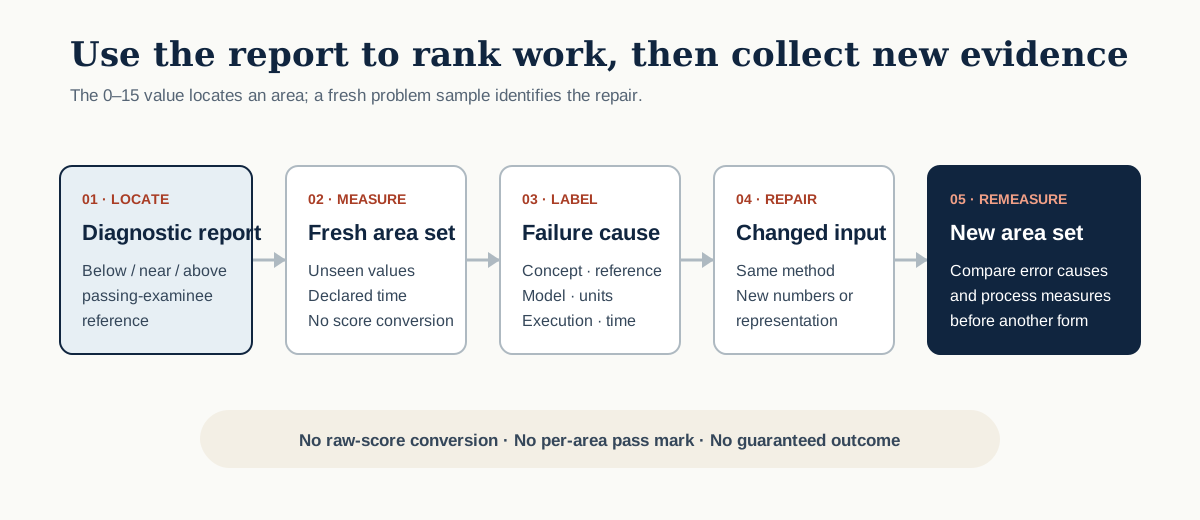
The diagnostic's 0–15 values cannot be converted into raw percentages. Read our FE passing score explanation if you are trying to work out how close you were. For study planning, identify the areas below the passing-candidate reference and check whether the difficulty is missing knowledge, handbook retrieval, or execution under time pressure.
Read three fields, not one bar
The current NCEES sample diagnostic report shows the knowledge area, number of items, a 0–15 performance value, and a visual comparison with the average performance of passing examinees. The guide says the scale exists to make diagnostic reports comparable across computer-based exams and across a candidate's attempts. It also states that the number of questions answered correctly cannot be determined from that scale.
Start with the relative position against the passing-examinee reference. Then use the published question range only as exposure context. Neither field tells you whether today's problem is concepts, handbook search, modelling, units, execution, or time.
Build a diagnostic-to-priority table
The rows below are fictional. Replace them with your areas and evidence from a new set of problems; do not enter candidate-identifying data in a shared document.
| Area | Report position | Question range | Fresh failure | Priority |
|---|---|---|---|---|
| Area A | Clearly below the passing-examinee reference | 10–15 | Equation selection | First |
| Area B | Near the reference | 8–12 | Units | Second |
| Area C | Above the reference | 4–6 | None in the sample | Maintenance |
Run four stages
- Measure. Solve a small unseen set in every below or near area. Record whether each miss came from concept, reference search, model, units, execution, or time.
- Repair. Practice the cause rather than the label. A handbook-search miss needs locator retrieval; a unit miss needs an explicit dimensional check.
- Transfer. Change the numbers, representation, or boundary condition so the previous answer cannot be recalled.
- Remeasure. Use a new knowledge-area set. Take another full form only after the cause-specific repair survives changed input.
A four-week evidence board
| Week | Work | Exit evidence |
|---|---|---|
| 1 | Fresh samples in below and near areas | Every miss has one earliest cause |
| 2 | Cause-specific drills and blank-paper reconstruction | The method works without the old solution |
| 3 | Changed-input area sets | Dominant error counts fall on unseen values |
| 4 | New full form under a written timing plan | Comparable area scorecard and next decision |
Choose the next full form on evidence
EngineerProof's independent practice forms contain 110 original four-choice questions and a knowledge-area score sheet. They do not reveal official questions, reproduce alternative item types, or convert a practice result into an NCEES result. Use the test–repair–retest gate before opening a second full form. FE Civil candidates can record the first sitting with the 14-area scorecard workflow.
Sources, ownership, and corrections
NCEES is the authority for exam administration, scoring, and the diagnostic report. EngineerProof owns this planning workflow. Report a suspected error through the contact information on the EngineerProof about page.