Forms A–B · First edition
FE Other Disciplines Practice Problems: 18 Free Questions with Solutions
18 free worked problems across 14 knowledge areas, with handbook references and explanations of every wrong choice. Start with 14 free worked problems, then choose one of two separate 110-question PDF forms covering all 14 FE Other Disciplines knowledge areas.
- Problems
- 110 per form
- Free problems
- 18
- Forms
- 2
Choose a practice exam form
Forms are sold separately for USD 29 each.
Practice Exam, Form A
USD29
- 110 original problems and complete worked solutions
- Answer key and knowledge-area score sheet
- 127-page immediate private PDF download
14-day full refund · 90-day download access
Practice Exam, Form B
USD29
- 110 original problems and complete worked solutions
- Answer key and knowledge-area score sheet
- 102-page immediate private PDF download
14-day full refund · 90-day download access
Free worked samples
$0
- One complete problem and solution from every knowledge area
- No account or email required
- Read online or print the free PDF with worked solutions
Secure checkout by Stripe. Full refund within 14 days under the refund policy. Download access lasts 90 days and corrected releases remain available to buyers.
Statics, dynamics, strength of materials, fluid mechanics, and thermodynamics and heat transfer account for 51 of the 110 problems here, with fluid mechanics the single heaviest area at 12 problems.
FE Other Disciplines is one of the seven NCEES Fundamentals of Engineering (FE) exams. In most U.S. states, passing the FE exam with an accredited degree is the step to Engineer in Training (EIT) or Engineer Intern (EI) certification.
FE Other Disciplines practice plan
Move from a 14-area diagnosis to a 110-question rehearsal
The current NCEES FE Other Disciplines specification, effective July 2020, has 14 knowledge areas. Form A and Form B each contain 110 original four-choice problems with complete solutions. In both forms, statics, dynamics, strength of materials, fluid mechanics, and thermodynamics and heat transfer account for 51 of the 110 questions; the other nine areas still appear and should not be skipped.
- Diagnose for free: Solve the 14 free worked problems, one from every knowledge area, with the electronic handbook and an approved calculator. The printable 17-page sample includes the same no-account starting point.
- Repair by system: Start with the weakest result, then connect statics and dynamics to strength of materials, fluid mechanics, and thermodynamics and heat transfer. Retest the other nine areas separately so the five larger mechanics and thermal areas do not hide a smaller-area gap.
- Rehearse: Choose Form A or Form B at USD 29 each and take its 110 unfamiliar questions under the FE answering budget. Form A is 127 pages and Form B is 102 pages; keep the other form unseen for a later check.
What each resource is for
- Official scope
- NCEES FE exam information and specifications
- Handbook and official exam prep
- MyNCEES exam-prep resources
- Calculator check
- Allowed models, rules, and calculation drills
This plan is a way to organize the resources on this page. It is not an official NCEES schedule, required study time, or pass prediction.
Pages from each form
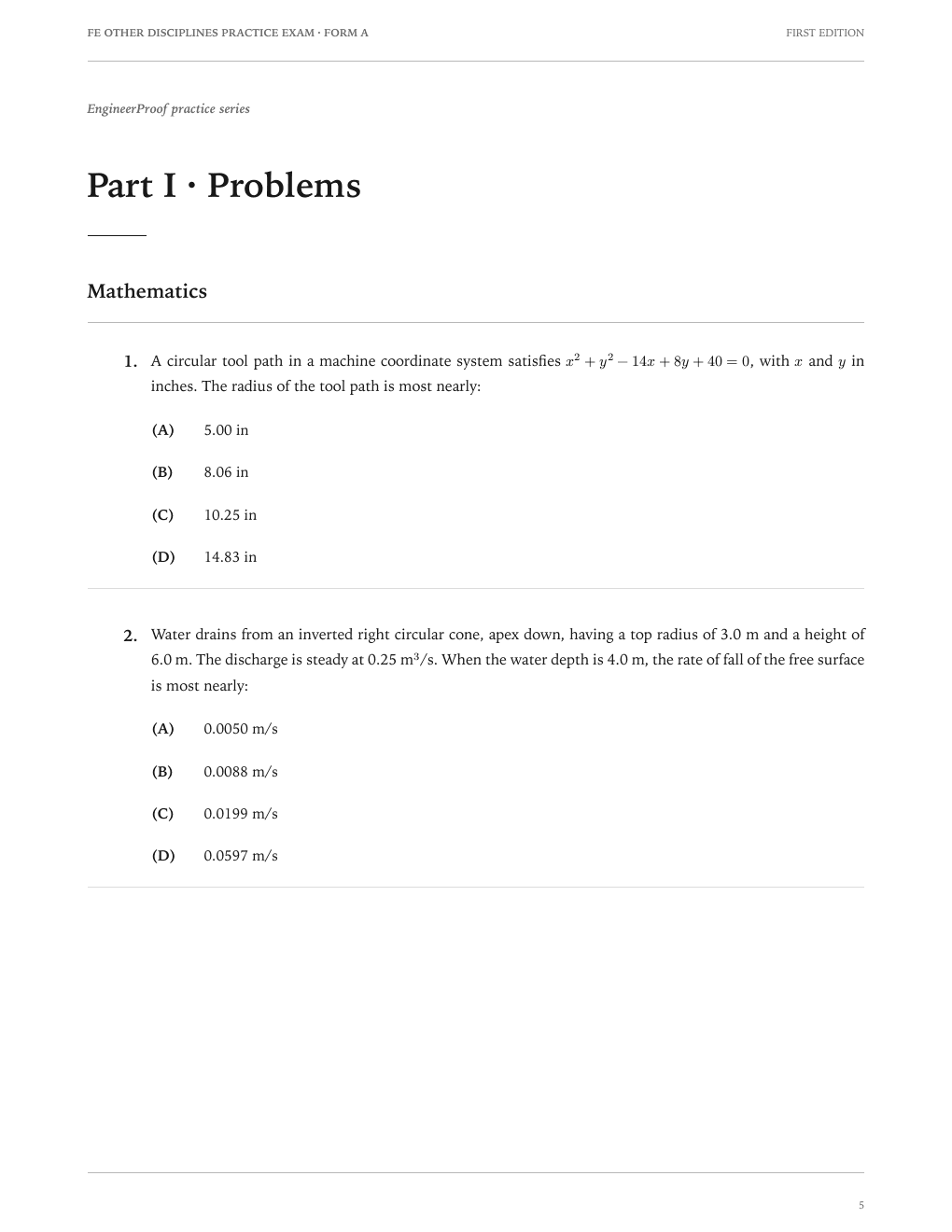
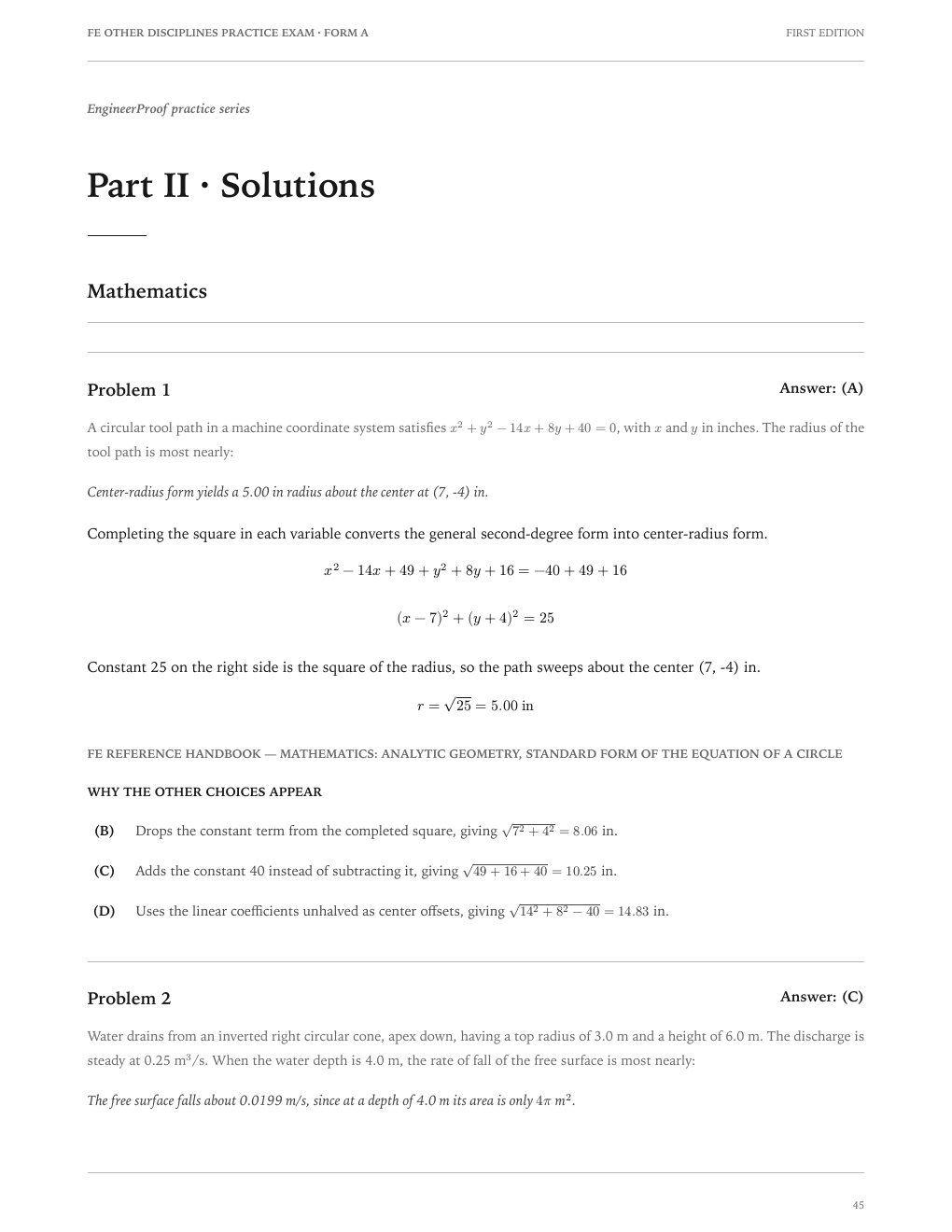
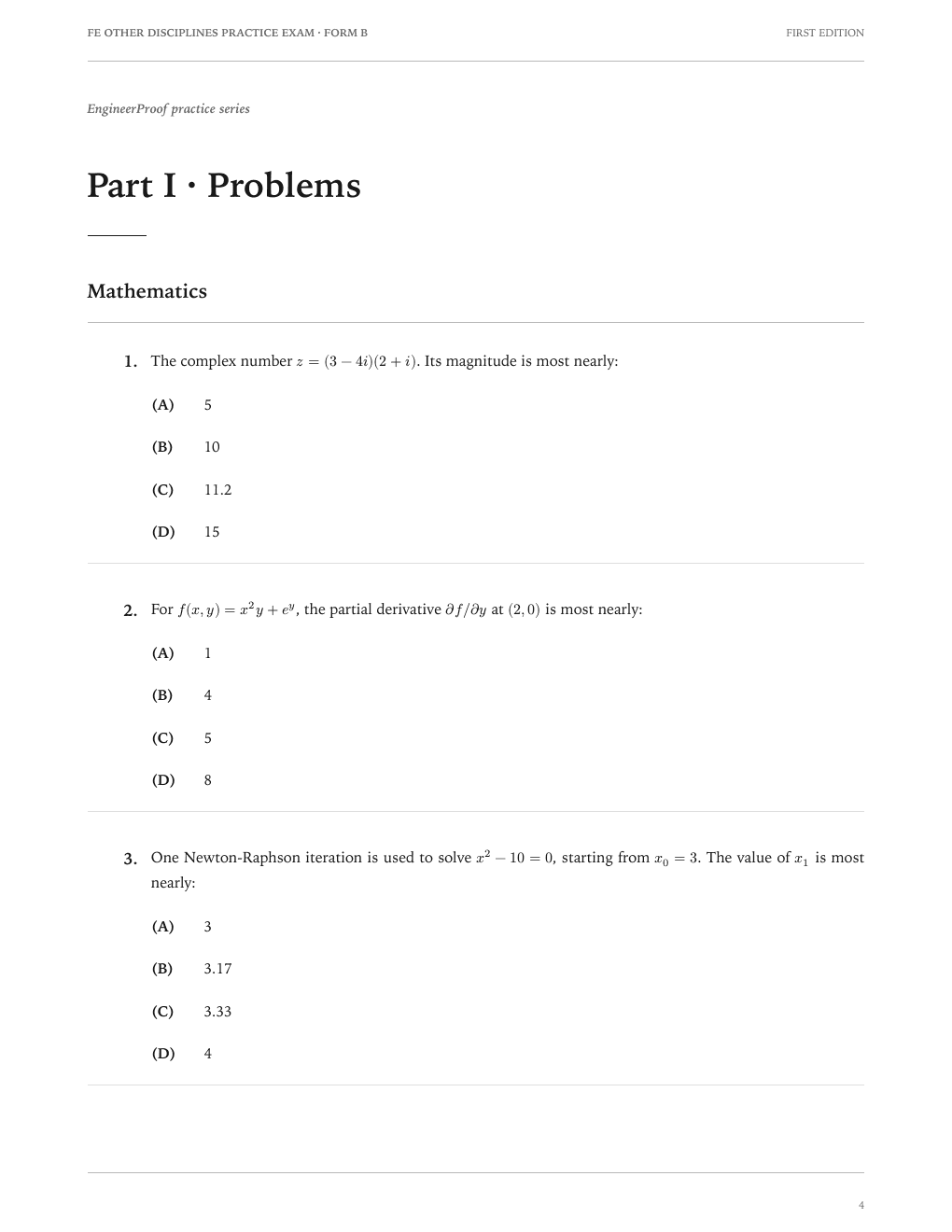
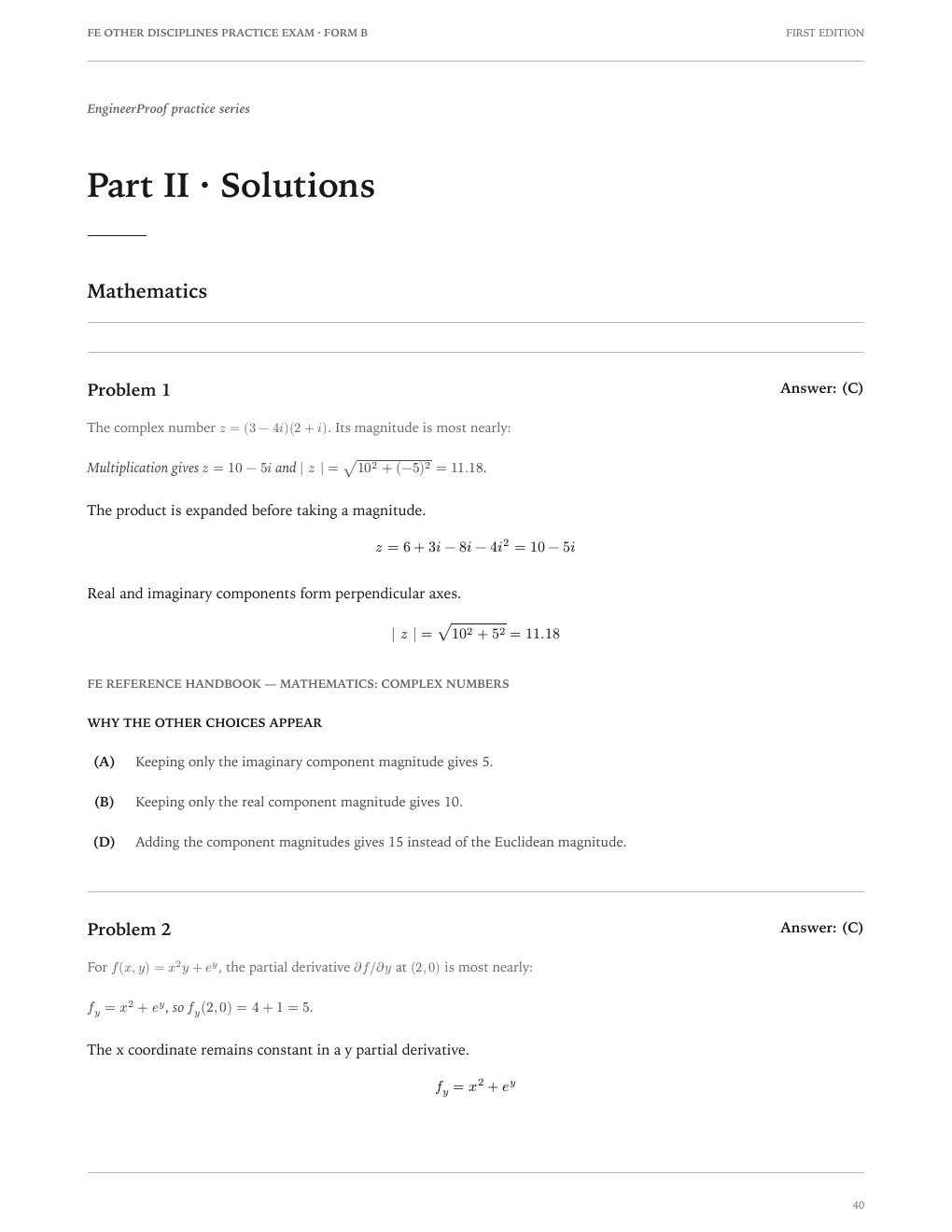
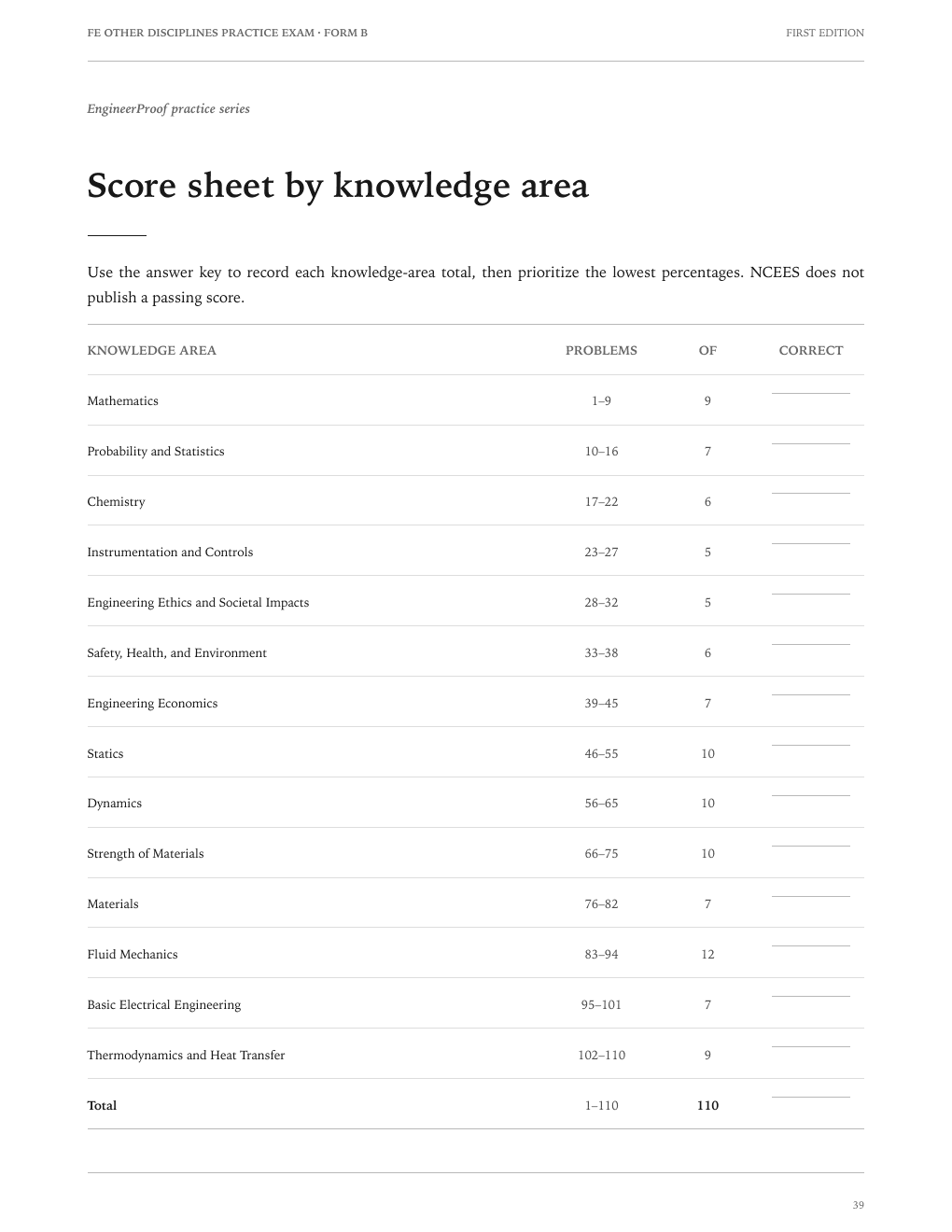
Direct renders from the current PDF releases, not illustrative mockups.
Form A
127 pages · Version 1.0.0

Form B
102 pages · Version 1.0.0
18 free FE Other Disciplines practice problems with solutions
Work through all 14 knowledge areas. Each problem includes four choices, a complete solution, a handbook reference and an explanation of the wrong answers. No account or email is required.
The free sample PDF contains 14 Form A samples, one per area. The additional questions below are independent of the paid forms and are also in the free printable supplement.
Mathematics
1 free problem · Form A: 9 of 110 questions · NCEES range: 8-12
Water drains from an inverted right circular cone, apex down, having a top radius of 3.0 m and a height of 6.0 m. The discharge is steady at 0.25 m/s. When the water depth is 4.0 m, the rate of fall of the free surface is most nearly:
- (A)0.0050 m/s
- (B)0.0088 m/s
- (C)0.0199 m/s
- (D)0.0597 m/s
Show worked solution
Answer: (C)
The free surface falls about 0.0199 m/s, since at a depth of 4.0 m its area is only m.
Geometric similarity ties the surface radius to the depth, reducing the volume to a single variable.
Differentiating volume with respect to depth produces the instantaneous free-surface area, the only geometry the drain rate responds to.
At 4.0 m depth the surface radius is 2.0 m and the surface area is m, so the level drops at
FE Reference Handbook — Mathematics: Mensuration of Areas and Volumes, Right Circular Cone; Differential Calculus, The Chain Rule
Why the other choices appear
- (A)Sets the surface radius equal to the depth, m, giving m/s.
- (B)Uses the fixed 3.0 m top radius as the surface radius, giving m/s.
- (D)Divides the volume by the depth instead of differentiating, taking m and giving 0.0597 m/s.
The complete practice exam contains 9 mathematics problems in Form A and 9 in Form B, with full solutions and a knowledge-area score sheet.
Compare Form A and Form B and buy a PDF · USD 29 eachAll knowledge areasProbability and Statistics
3 free problems · Form A: 7 of 110 questions · NCEES range: 6-9
A conduit plant fills orders from three extrusion lines. Line 1 supplies 50% of output at a 2% defect rate, Line 2 supplies 30% at a 4% defect rate, and Line 3 supplies 20% at a 5% defect rate. A unit drawn at random from finished stock is found to be defective. The probability that it was produced on Line 2 is most nearly:
- (A)0.040
- (B)0.300
- (C)0.313
- (D)0.375
Show worked solution
Answer: (D)
Line 2 accounts for 0.375 of all defective units, more than its 30% share of production because its defect rate runs above the plant average.
Total probability applies because the three lines partition the finished stock, so the plant-wide defect rate is the share-weighted sum of the line rates.
Bayes' theorem then rescales the 30% prior share of Line 2 by how readily that line generates the observed defect.
FE Reference Handbook — Engineering Probability and Statistics: Bayes' Theorem
Why the other choices appear
- (A)Reports the conditional defect rate of Line 2 itself, , rather than the reverse conditional probability.
- (B)Reports the prior output share , ignoring the defect evidence entirely.
- (C)Uses the Line 1 (or Line 3) numerator by mistake, .
Two more free problem types
Try a different setup before reading the solution. These additional original questions are separate from the sold practice forms, so solving them does not reveal another question from a full practice form.
At least two defects in a five-unit sample
Each unit independently has a 0.10 probability of being defective. Five units are sampled. What is the probability that at least two are defective?
- (A)0.01000
- (B)0.08146
- (C)0.32805
- (D)0.40951
Show worked solution
Answer: (B)
The probability is 0.08146, or about 8.15%.
Independent identical defect events give a binomial count with n = 5 and p = 0.10.
At least two is the complement of zero or one, so only two terms are needed.
Summing the four direct terms for k = 2, 3, 4, 5 independently gives 0.0729 + 0.0081 + 0.00045 + 0.00001 = 0.08146. At least is not the same as exactly.
FE Reference Handbook: Probability and Statistics — binomial distribution and complementary events.
Why the other choices appear
- (A)This uses the chance of two particular units being defective, ignoring other combinations.
- (C)This is the probability of exactly one defective unit.
- (D)This is the probability of at least one defective unit.
A positive inspection and the base rate
Four percent of incoming parts are defective. An inspection flags 95% of defective parts and falsely flags 8% of nondefective parts. A randomly selected part is flagged. What is the probability that it is defective?
- (A)0.0400
- (B)0.3310
- (C)0.8700
- (D)0.9500
Show worked solution
Answer: (B)
About 33.10% of flagged parts are defective under the stated model.
A flag can come from a defective part or a false positive. Weight both branches by their population fractions.
Restrict the denominator to all flagged parts, not to all parts or all defective parts.
In a hypothetical 10,000 parts, expect 380 true flags and 768 false flags. The share 380/(380 + 768) reproduces the conditional probability. Sensitivity alone does not answer the inverse question.
FE Reference Handbook: Probability and Statistics — total probability and Bayes theorem.
Why the other choices appear
- (A)This is the prior defect probability before inspection.
- (C)This does not use the correctly weighted false-positive branch.
- (D)This is sensitivity P(flag given defect), reversing the conditioning.
Download all 14 additional questions, diagrams and complete solutions (free PDF). Download the editable practice review sheet (CSV).
Original questions and diagrams by EngineerProof, September 30, 2026. Personal study and unchanged redistribution with attribution are permitted. The questions are independent practice, not official NCEES material. Report a correction.
The complete practice exam contains 7 probability and statistics problems in Form A and 7 in Form B, with full solutions and a knowledge-area score sheet.
Compare Form A and Form B and buy a PDF · USD 29 eachAll knowledge areasChemistry
1 free problem · Form A: 6 of 110 questions · NCEES range: 5-8
A groundwater supply contains 96 mg/L of magnesium ion (). Molar masses are g/mol and g/mol. The magnesium hardness expressed as mg/L as is most nearly:
- (A)46.6 mg/L as
- (B)198 mg/L as
- (C)240 mg/L as
- (D)395 mg/L as
Show worked solution
Answer: (D)
Reporting the divalent magnesium on an equivalent basis yields about 395 mg/L as calcium carbonate.
Hardness reporting restates every polyvalent ion as the chemically equivalent amount of calcium carbonate, so the ion concentration must first be expressed in equivalents using its charge of 2.
That same equivalent count is then priced at the equivalent weight of calcium carbonate, itself a divalent salt.
FE Reference Handbook — Chemistry: Equivalent Weight and Normality (Hardness as CaCO3)
Why the other choices appear
- (A)Inverts the conversion factor, multiplying the ion concentration by to obtain 46.6 mg/L.
- (B)Mismatches the weights by dividing by the magnesium molar mass while multiplying by the carbonate equivalent weight: mg/L.
- (C)Uses the equivalent weight of calcium (20.04 g/eq) in place of magnesium's: mg/L.
The complete practice exam contains 6 chemistry problems in Form A and 6 in Form B, with full solutions and a knowledge-area score sheet.
Compare Form A and Form B and buy a PDF · USD 29 eachAll knowledge areasInstrumentation and Controls
1 free problem · Form A: 5 of 110 questions · NCEES range: 4-6
A single active foil strain gauge occupies one arm of a Wheatstone bridge; the other three arms are fixed resistors of the same nominal resistance. Bridge excitation is V DC, the gauge factor is , and the bridge output drives an instrumentation amplifier of gain . For a surface strain of m/m, the amplifier output voltage is most nearly:
- (A)0.253 V
- (B)1.12 V
- (C)2.23 V
- (D)4.46 V
Show worked solution
Answer: (B)
Only one bridge arm is active, so the bridge delivers 4.46 mV and the gain-250 stage raises it to about 1.12 V.
A quarter bridge converts the fractional resistance change of its one active arm into a differential output equal to a quarter of the excitation times that fraction.
Gain of the signal-conditioning stage lifts this millivolt-level difference to a range a data acquisition input can resolve.
FE Reference Handbook — Instrumentation, Measurement, and Controls: Wheatstone Bridge and Strain Gauge Relations
Why the other choices appear
- (A)Dividing the strain by the gauge factor instead of multiplying: V.
- (C)Using the half-bridge sensitivity in place of , which doubles the result to 2.23 V.
- (D)Omitting the factor of 4 altogether: V.
The complete practice exam contains 5 instrumentation and controls problems in Form A and 5 in Form B, with full solutions and a knowledge-area score sheet.
Compare Form A and Form B and buy a PDF · USD 29 eachAll knowledge areasEngineering Ethics and Societal Impacts
1 free problem · Form A: 5 of 110 questions · NCEES range: 5-8
An engineer resigns from a consulting firm and joins a competitor, retaining a personal copy of a pump-selection spreadsheet that the engineer wrote while employed at the former firm, using the firm's test data and firm work hours. Under the NCEES Model Rules of Professional Conduct, use of that spreadsheet on the new employer's projects is:
- (A)Not permitted without the former firm's consent
- (B)Permitted, the engineer being the author of the file
- (C)Permitted if the former firm is credited in the deliverable
- (D)Permitted once any noncompete period has expired
Show worked solution
Answer: (A)
The spreadsheet belongs to the former firm, and having written it gives the engineer no right to carry it to a competitor.
Ownership of designs, data, and tools created within the scope of employment rests with the employer, so authorship by itself confers no right to carry the product to a competitor.
Attribution and the expiry of a noncompete answer different obligations, since credit is not a license to copy and a noncompete restrains employment rather than the use of proprietary material, which stays protected indefinitely.
Consent from the former firm is the only condition under which the file may be used, and absent that consent the engineer must rebuild the selection method from published data and public correlations.
FE Reference Handbook — Ethics and Professional Practice: Intellectual Property
Why the other choices appear
- (B)Equates authorship with ownership, an error that ignores the work-for-hire principle governing material produced on firm time with firm resources.
- (C)Treats attribution as a substitute for permission, confusing the duty to credit others' work with the separate requirement of a license to use it.
- (D)Applies the expiry of an employment restraint to a property right, which does not lapse on the noncompete schedule.
The complete practice exam contains 5 engineering ethics and societal impacts problems in Form A and 5 in Form B, with full solutions and a knowledge-area score sheet.
Compare Form A and Form B and buy a PDF · USD 29 eachAll knowledge areasSafety, Health, and Environment
1 free problem · Form A: 6 of 110 questions · NCEES range: 6-9
Personal sampling over a single 8-hour shift records a solvent vapor concentration of 180 ppm for 2.0 h, 95 ppm for 3.5 h, and 40 ppm for the remaining 2.5 h. The 8-hour time-weighted average exposure is most nearly:
- (A)87 ppm
- (B)99 ppm
- (C)105 ppm
- (D)126 ppm
Show worked solution
Answer: (B)
Weighted by duration over the full 8 h shift, the three intervals average about 99 ppm.
A time-weighted average charges each measured concentration for the fraction of the shift over which it persisted, so the three intervals enter as a duration-weighted sum, not as a plain average of concentrations.
Every interval belongs in the numerator, including the low-concentration period, since the denominator is the full 8 h shift.
FE Reference Handbook — Safety, Health, and Environment: Industrial Hygiene, Time-Weighted Average Exposure
Why the other choices appear
- (A)Drops the 2.5 h at 40 ppm from the numerator while retaining 8.0 h in the denominator: 692.5/8.0 = 86.6 ppm.
- (C)Averages the three concentrations without duration weighting: (180+95+40)/3 = 105 ppm.
- (D)Treats the 40 ppm period as non-exposure and divides the remaining 692.5 ppm-h by only 5.5 h of exposure: 126 ppm.
The complete practice exam contains 6 safety, health, and environment problems in Form A and 6 in Form B, with full solutions and a knowledge-area score sheet.
Compare Form A and Form B and buy a PDF · USD 29 eachAll knowledge areasEngineering Economics
3 free problems · Form A: 7 of 110 questions · NCEES range: 6-9
A municipal wastewater pumping station incurs a maintenance cost of USD 8{,}000 at the end of year 1. The cost increases by USD 1{,}200 in each following year through the end of year 8. At an interest rate of 7% per year, the present worth of the 8-year maintenance stream is most nearly:
- (A)USD 47{,}800
- (B)USD 54{,}900
- (C)USD 65{,}400
- (D)USD 70{,}300
Show worked solution
Answer: (D)
Base series and gradient together discount to a present worth of about USD 70{,}300.
Costs that grow by a constant amount each year separate into a uniform base series of USD 8{,}000 and an arithmetic gradient of USD 1{,}200 whose first increment falls at the end of year 2.
At 7% over eight years the two factors take the values below, with .
Gradient growth supplies almost a third of the obligation, so a reserve sized on the first-year cost alone falls badly short.
FE Reference Handbook — Engineering Economics: Uniform Series Present Worth Factor and Uniform Gradient Present Worth Factor
Why the other choices appear
- (A)Discounting only the uniform USD 8,000 base, 8,000(5.9713) = 47,770, discards the gradient entirely.
- (B)Treating the whole stream as a uniform USD 9,200 (the year-2 amount) gives 9,200(5.9713) = 54,936.
- (C)Using (P/G, 7%, 7) = 14.7149, from counting the seven gradient steps as the factor's period count, gives 47,770 + 17,658 = 65,428.
Two more free problem types
Try a different setup before reading the solution. These additional original questions are separate from the sold practice forms, so solving them does not reveal another question from a full practice form.
Present worth with a terminal salvage value
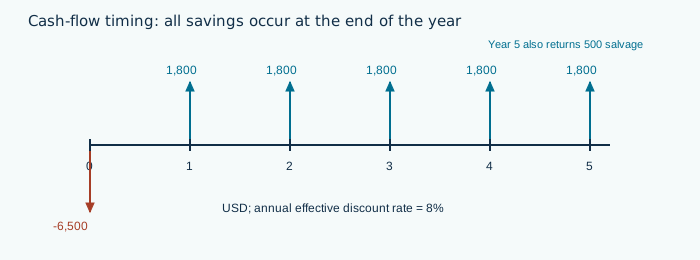
An energy retrofit costs USD 6,500 now. It saves USD 1,800 at the end of each of the next five years and has a USD 500 salvage value at the end of year five. With an effective annual discount rate of 8%, what is its net present worth?
- (A)USD -1,473
- (B)USD 687
- (C)USD 1,027
- (D)USD 3,000
Show worked solution
Answer: (C)
The net present worth is positive, about USD 1,027.
Use end-of-year savings and discount the salvage value separately at year five. The initial cost is already at time zero.
The annuity factor is 3.992710 and the single-payment factor is 0.680583.
Discount each of the five USD 1,800 payments directly and add the discounted salvage. This finite cash-flow sum gives the same result. Positive present worth means the stated cash flows clear the stated 8% rate, not that omitted project risks vanish.
FE Reference Handbook: Engineering Economics — present worth, uniform series and single-payment factors.
Why the other choices appear
- (A)This omits substantial annual benefits or misplaces their timing.
- (B)This omits the discounted USD 500 salvage.
- (D)This totals undiscounted cash flows and ignores the time value of money.
Equivalent annual cost with salvage and maintenance
A machine costs USD 12,000 now, lasts four years, and is sold for USD 2,000 at the end of year four. Maintenance costs USD 900 at each year end. At 6% effective annual interest, what is the equivalent annual cost?
- (A)USD 3,000
- (B)USD 3,406
- (C)USD 3,906
- (D)USD 4,500
Show worked solution
Answer: (C)
The equivalent annual cost is about USD 3,906 per year.
Convert purchase and terminal salvage to equivalent uniform annual amounts. Maintenance is already an annual cost.
Use the capital-recovery and sinking-fund factors with the same interest rate and four-year horizon.
Independently discount the four maintenance costs and salvage to time zero, add the initial purchase, and divide by the present-worth annuity factor. Both routes produce the same positive annual cost.
FE Reference Handbook: Engineering Economics — capital recovery, sinking fund and annual worth.
Why the other choices appear
- (A)This divides the purchase by life and omits interest, salvage and maintenance.
- (B)This straight-line calculation ignores time value of money.
- (D)This omits the salvage credit and misstates the financing adjustment.
Download all 14 additional questions, diagrams and complete solutions (free PDF). Download the editable practice review sheet (CSV).
Original questions and diagrams by EngineerProof, September 30, 2026. Personal study and unchanged redistribution with attribution are permitted. The questions are independent practice, not official NCEES material. Report a correction.
The complete practice exam contains 7 engineering economics problems in Form A and 7 in Form B, with full solutions and a knowledge-area score sheet.
Compare Form A and Form B and buy a PDF · USD 29 eachAll knowledge areasStatics
1 free problem · Form A: 10 of 110 questions · NCEES range: 9-14
A 900 lb load hangs from a ring at joint A. The ring is held by cable AB, which runs upward to the left at above the horizontal, and by cable AC, which runs upward to the right at above the horizontal. The tension in cable AB is most nearly:
- (A)516 lb
- (B)630 lb
- (C)737 lb
- (D)785 lb
Show worked solution
Answer: (A)
Cable AB carries 516 lb, the projection of the 900 lb weight onto its own line.
Cable inclinations that sum to make the two cables mutually perpendicular, so the vertical load resolves along each cable line without solving simultaneous equations.
Projecting the 900 lb weight onto the AB direction gives that cable's share of the load.
FE Reference Handbook — Statics: Equilibrium Requirements, Concurrent Force Systems
Why the other choices appear
- (B)Uses lb, treating the weight as the adjacent side of the angle.
- (C)Uses lb, which is the tension in cable AC, not AB.
- (D)Assumes both cables are inclined at , giving lb.
The complete practice exam contains 10 statics problems in Form A and 10 in Form B, with full solutions and a knowledge-area score sheet.
Compare Form A and Form B and buy a PDF · USD 29 eachAll knowledge areasDynamics
1 free problem · Form A: 10 of 110 questions · NCEES range: 9-14
Gravel leaves the head pulley of a conveyor horizontally at 4.2 m/s and falls freely 3.6 m to the surface of a stockpile. Air resistance is negligible. The horizontal distance from the discharge point to the point of impact is most nearly:
- (A)2.54 m
- (B)3.08 m
- (C)3.60 m
- (D)5.09 m
Show worked solution
Answer: (C)
A 0.857 s fall paired with an unchanged 4.2 m/s horizontal velocity puts the impact point 3.60 m from the discharge point.
Vertical motion is free fall from rest, so the drop height alone fixes the flight time.
Horizontal velocity is constant because no horizontal force acts during flight.
FE Reference Handbook — Dynamics: Particle Kinematics, Projectile Motion
Why the other choices appear
- (A)Omits the factor 2 inside the radical, using t = sqrt(h/g) = 0.606 s, which gives 4.2(0.606) = 2.54 m.
- (B)Solves h = gt²/2 incorrectly as t = 2h/g = 0.734 s, giving 4.2(0.734) = 3.08 m.
- (D)Reports the straight-line distance from discharge point to impact point, sqrt(3.60² + 3.60²) = 5.09 m, instead of the horizontal distance.
The complete practice exam contains 10 dynamics problems in Form A and 10 in Form B, with full solutions and a knowledge-area score sheet.
Compare Form A and Form B and buy a PDF · USD 29 eachAll knowledge areasStrength of Materials
1 free problem · Form A: 10 of 110 questions · NCEES range: 9-14
A stepped steel anchor rod consists of a 1.2 m length of 40 mm diameter bar butt-welded to a 0.8 m length of 25 mm diameter bar. The rod carries an axial tensile load of 90 kN, and GPa. The total elongation of the rod is most nearly:
- (A)0.43 mm
- (B)0.73 mm
- (C)1.16 mm
- (D)1.83 mm
Show worked solution
Answer: (C)
The slender 25 mm portion supplies most of the movement, and the two series stretches add to about 1.16 mm at the loaded end.
Series segments transmit the identical 90 kN, so each one deforms according to its own area.
The 40 mm portion is more than two and a half times as stiff per unit length, so its share stays small despite being the longer piece.
Compatibility places the free-end movement at the sum of the two segment stretches.
FE Reference Handbook — Mechanics of Materials: Uniaxial Loading and Deformation
Why the other choices appear
- (A)Counts only the 40 mm segment, 90,000(1200)/[1257(200,000)] = 0.430 mm, ignoring the smaller bar.
- (B)Counts only the 25 mm segment, 90,000(800)/[490.9(200,000)] = 0.733 mm.
- (D)Applies the full 2.0 m length to the 25 mm area, 90,000(2000)/[490.9(200,000)] = 1.83 mm.
The complete practice exam contains 10 strength of materials problems in Form A and 10 in Form B, with full solutions and a knowledge-area score sheet.
Compare Form A and Form B and buy a PDF · USD 29 eachAll knowledge areasMaterials
1 free problem · Form A: 7 of 110 questions · NCEES range: 6-9
A binary alloy of overall composition 40 wt% B is held at a temperature at which solid and liquid coexist. At that temperature the solidus boundary lies at 12 wt% B and the liquidus lies at 62 wt% B. The mass fraction of liquid present is most nearly:
- (A)0.30
- (B)0.44
- (C)0.45
- (D)0.56
Show worked solution
Answer: (D)
Slightly more than half the alloy is molten, because the lever arm opposite the liquid spans 28 of the 50 wt% tie line.
Tie-line geometry sets the phase amounts: the fraction of one phase uses the arm on the far side of the overall composition.
With the tie line running from 12 to 62 wt% B, the full length is 50 wt% and the arm opposite the liquid measures 28 wt%.
FE Reference Handbook — Materials Science/Structure of Matter: Binary Phase Diagrams, Lever Rule
Why the other choices appear
- (A)Forms the ratio of the boundary composition to the overall composition, , instead of using a lever arm.
- (B)Inverts the lever and reports the arm adjacent to the liquidus, , which is the fraction.
- (C)Divides the correct arm by the liquidus composition rather than the tie-line length, .
The complete practice exam contains 7 materials problems in Form A and 7 in Form B, with full solutions and a knowledge-area score sheet.
Compare Form A and Form B and buy a PDF · USD 29 eachAll knowledge areasFluid Mechanics
1 free problem · Form A: 12 of 110 questions · NCEES range: 12-18
A vertical rectangular sluice gate 4 ft wide and 6 ft high is set in the side wall of a reservoir. The top edge of the gate lies 8 ft below the free water surface, which is open to the atmosphere. Water has a specific weight of 62.4 lbf/ft. The resultant hydrostatic force on the gate is most nearly:
- (A)12,000 lbf
- (B)16,500 lbf
- (C)16,900 lbf
- (D)21,000 lbf
Show worked solution
Answer: (B)
The gate's centroid lies 11 ft below the surface, and pressure at that depth acting over the whole gate gives a resultant near 16,500 lbf.
Hydrostatic pressure grows linearly with depth, so the resultant on a plane area is the centroidal pressure acting over the whole area.
The second moment of area shifts the line of action below the centroid but leaves the magnitude untouched.
FE Reference Handbook — Fluid Mechanics: Forces on Submerged Surfaces, Resultant Force on a Plane Surface
Why the other choices appear
- (A)Takes the top-edge depth of 8 ft as the centroidal depth: lbf.
- (C)Uses the center-of-pressure depth ft in the force equation: lbf.
- (D)Takes the bottom-edge depth of 14 ft as the centroidal depth: lbf.
The complete practice exam contains 12 fluid mechanics problems in Form A and 12 in Form B, with full solutions and a knowledge-area score sheet.
Compare Form A and Form B and buy a PDF · USD 29 eachAll knowledge areasBasic Electrical Engineering
1 free problem · Form A: 7 of 110 questions · NCEES range: 6-9
A 24 V DC source drives a 150 resistor in series with a parallel combination of a 470 resistor and a 330 resistor. The voltage across the 150 resistor is most nearly:
- (A)3.79 V
- (B)5.81 V
- (C)6.55 V
- (D)10.5 V
Show worked solution
Answer: (D)
Because the parallel pair reduces to 194 , the 150 series element claims about 10.5 V of the 24 V supply.
Parallel branches reduce first, since only their equivalent shares the loop with the 150 element.
Loop current is fixed by the total series resistance seen by the source.
Series element voltage follows from that shared current, with the balance appearing across the parallel pair.
FE Reference Handbook — Electrical and Computer Engineering: Resistors in Series and Parallel, Voltage Division
Why the other choices appear
- (A)Adds the two branch resistors as if in series, 470 + 330 = 800 ohm, giving 24(150)/950 = 3.79 V.
- (B)Ignores the 330 ohm branch entirely, giving 24(150)/(150 + 470) = 5.81 V.
- (C)Uses the arithmetic mean of the branch resistors, 400 ohm, giving 24(150)/550 = 6.55 V.
The complete practice exam contains 7 basic electrical engineering problems in Form A and 7 in Form B, with full solutions and a knowledge-area score sheet.
Compare Form A and Form B and buy a PDF · USD 29 eachAll knowledge areasThermodynamics and Heat Transfer
1 free problem · Form A: 9 of 110 questions · NCEES range: 9-14
A binary-cycle geothermal plant produces 450 kW of net power while receiving 3.60 MW from a brine stream at 165 C and rejecting heat to a condenser loop at 30 C. The ratio of the plant thermal efficiency to the maximum efficiency attainable between these two temperatures is most nearly:
- (A)0.13
- (B)0.15
- (C)0.31
- (D)0.41
Show worked solution
Answer: (D)
An actual efficiency of 12.5 percent sits at about 41 percent of the 30.8 percent reversible ceiling set by the 438 K and 303 K reservoirs.
The reversible limit between the same two reservoirs fixes the benchmark, and both temperatures enter on the absolute scale.
Plant performance follows from the metered energy streams once the net power and the brine heat input carry the same units.
Their quotient is the second-law efficiency, which the Kelvin-Planck statement holds below unity for any real engine and which lands near two-fifths for low-temperature organic Rankine hardware.
FE Reference Handbook — Thermodynamics: Carnot Cycle Efficiency and Power Cycle Thermal Efficiency
Why the other choices appear
- (A)Reports the plant thermal efficiency itself, 450/3600 = 0.125.
- (B)Builds the ceiling from Celsius readings, 1 - 30/165 = 0.818, giving 0.125/0.818 = 0.153.
- (C)Stops at the Carnot ceiling, 1 - 303/438 = 0.308, and offers it as the requested ratio.
The complete practice exam contains 9 thermodynamics and heat transfer problems in Form A and 9 in Form B, with full solutions and a knowledge-area score sheet.
Compare Form A and Form B and buy a PDF · USD 29 eachAll knowledge areasPlan your FE preparation
Topics, resources, and study time
What each download contains
- Edition
- First edition
- Form A
- 127 pages · Version 1.0.0
- Form B
- 102 pages · Version 1.0.0
- Questions
- 110 original problems per form
- Coverage
- 14 knowledge areas
- Question type
- Four-choice, single-answer
- Format
- Print-ready PDF, US Letter
Built against the NCEES FE Other Disciplines specifications effective July 2020, current as of July 2026. Official exam format and appointment facts are available from NCEES. This printable form does not reproduce the Pearson VUE interface or interactive alternative item types.
Knowledge-area coverage
| Knowledge area | Form A | NCEES range |
|---|---|---|
| Mathematics | 9 | 8-12 |
| Probability and Statistics | 7 | 6-9 |
| Chemistry | 6 | 5-8 |
| Instrumentation and Controls | 5 | 4-6 |
| Engineering Ethics and Societal Impacts | 5 | 5-8 |
| Safety, Health, and Environment | 6 | 6-9 |
| Engineering Economics | 7 | 6-9 |
| Statics | 10 | 9-14 |
| Dynamics | 10 | 9-14 |
| Strength of Materials | 10 | 9-14 |
| Materials | 7 | 6-9 |
| Fluid Mechanics | 12 | 12-18 |
| Basic Electrical Engineering | 7 | 6-9 |
| Thermodynamics and Heat Transfer | 9 | 9-14 |
Verification and corrections
Original problems, checked by a second calculation route
Every answer is reproduced with an alternate formula, a limiting case, a dimensional check, or a direct recomputation before publication. Official examination questions are confidential and are not reproduced or paraphrased.
Confirmed errors are published as versioned corrections. Buyers can re-download the corrected release at no charge. Read the full editorial method.
For a repeat attempt
Close the weak areas before another USD 225 appointment
FE Other Disciplines repeat examinees passed at 29% versus 61% for first-time examinees in the cited NCEES data. Use the form's score sheet beside your diagnostic report, then read the FE Other Disciplines retake plan or compare FE pass rates by discipline.
Before you buy
Questions about the PDF
Is this an official NCEES practice exam?
EngineerProof is not affiliated with, endorsed by, or sponsored by NCEES. FE and NCEES are registered trademarks of the National Council of Examiners for Engineering and Surveying, used solely to identify the examination for which these study materials are relevant. All problems and solutions in this publication are original works.
Does it reproduce the computer-based test interface?
No. This is a printable four-choice PDF. It does not include the Pearson VUE interface or interactive alternative item types such as point-and-click and drag-and-drop.
How is the PDF delivered?
Stripe returns you to a private download page after payment. The same 90-day link is sent to the checkout email.
Can I print the exam?
Yes. One purchase includes a personal license to download and print the PDF for your own study.
What if the book is not right for me?
Email inshihub.com@gmail.com within 14 days for a full refund. No reason is required.
USD 29 each