Forms A–B · First edition
FE Civil Practice Problems: 16 Free Questions with Solutions
16 free worked problems across 14 knowledge areas, with handbook references and explanations of every wrong choice. Start with 14 free worked problems, then choose one of two separate 110-question PDF forms covering all 14 FE Civil knowledge areas.
- Problems
- 110 per form
- Free problems
- 16
- Forms
- 2
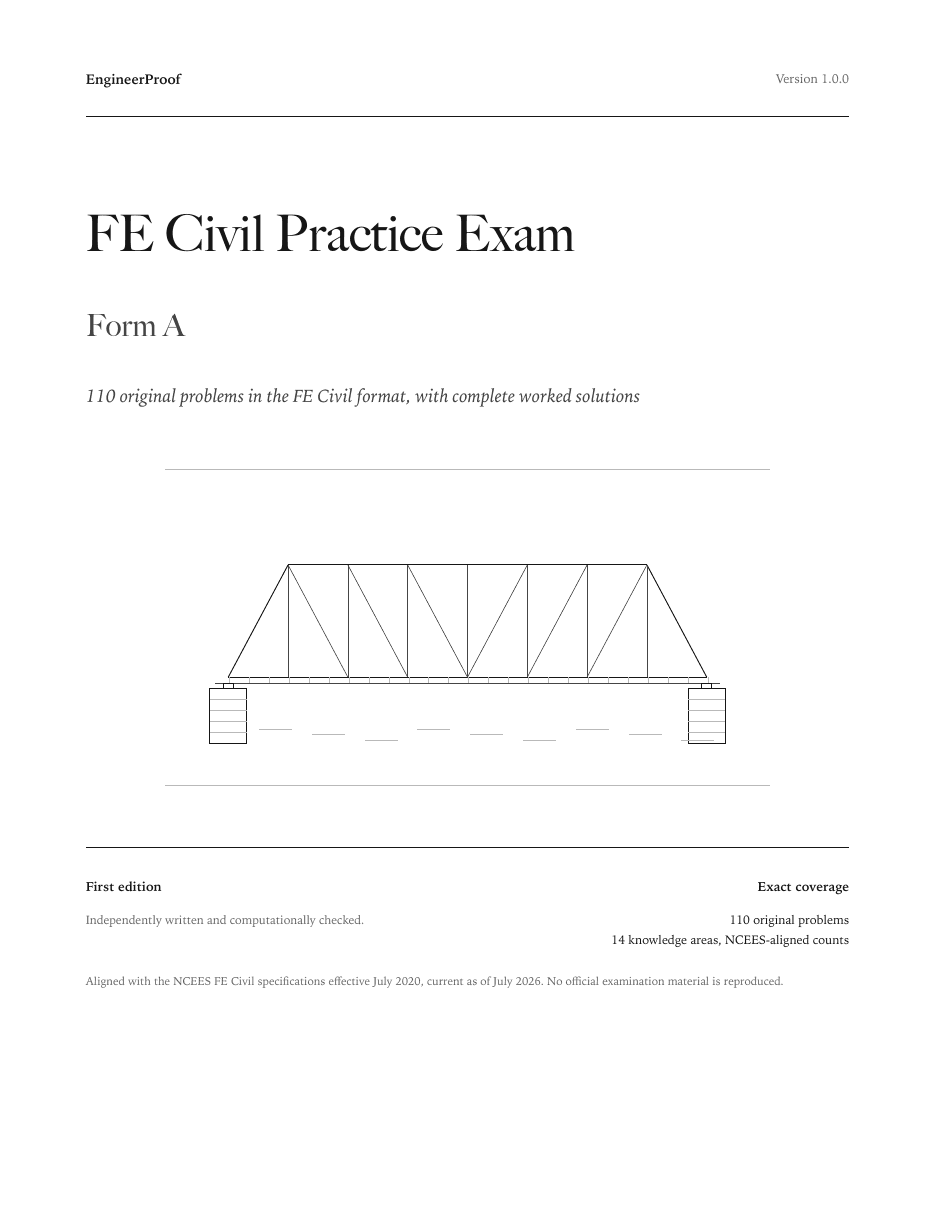
Choose a practice exam form
Forms are sold separately for USD 29 each.
Practice Exam, Form A
USD29
- 110 original problems and complete worked solutions
- Answer key and knowledge-area score sheet
- 119-page immediate private PDF download
14-day full refund · 90-day download access
Practice Exam, Form B
USD29
- 110 original problems and complete worked solutions
- Answer key and knowledge-area score sheet
- 103-page immediate private PDF download
14-day full refund · 90-day download access
Free worked samples
$0
- One complete problem and solution from every knowledge area
- No account or email required
- Read online or print the free PDF with worked solutions
Secure checkout by Stripe. Full refund within 14 days under the refund policy. Download access lasts 90 days and corrected releases remain available to buyers.
Structural, geotechnical, and water resources problems carry the most weight on this form — 35 of the 110 problems — because that is where the real exam concentrates its questions.
FE Civil is one of the seven NCEES Fundamentals of Engineering (FE) exams. In most U.S. states, passing the FE exam with an accredited degree is the step to Engineer in Training (EIT) or Engineer Intern (EI) certification.
FE Civil practice plan
Move from a 14-area diagnosis to a 110-question rehearsal
The current NCEES FE Civil specification, effective July 2020, has 14 knowledge areas. Form A and Form B each contain 110 original four-choice problems with complete solutions and a knowledge-area score sheet. Use the official NCEES resources for the computer-based interface and alternative item types; these independent forms are printable PDFs.
- Diagnose for free: Solve the 14 free worked problems, one from every knowledge area, with the electronic handbook and an approved calculator. The printable 17-page sample includes the same no-account starting point.
- Repair by result: Record concept, handbook lookup, setup, unit, and arithmetic misses by knowledge area. Use the Civil study guide for topic order, then retest each weak area with a different problem instead of memorizing the first solution.
- Rehearse: Choose Form A or Form B at USD 29 each and take its 110 unfamiliar questions under the FE answering budget. Form A is 119 pages and Form B is 103 pages; keep the other form unseen for a later check.
What each resource is for
- Official scope
- NCEES FE exam information and specifications
- Handbook and official exam prep
- MyNCEES exam-prep resources
- Calculator check
- Allowed models, rules, and calculation drills
This plan is a way to organize the resources on this page. It is not an official NCEES schedule, required study time, or pass prediction.
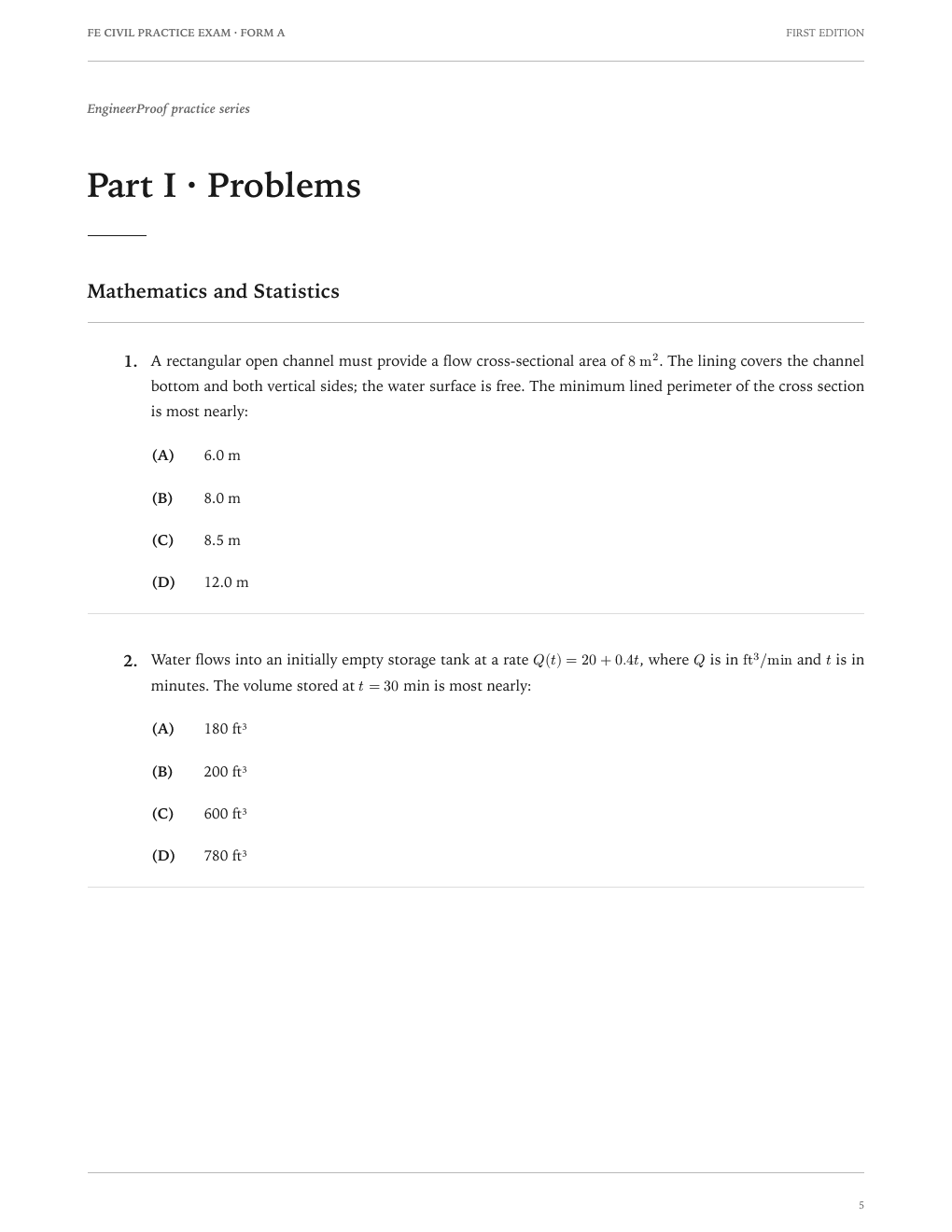
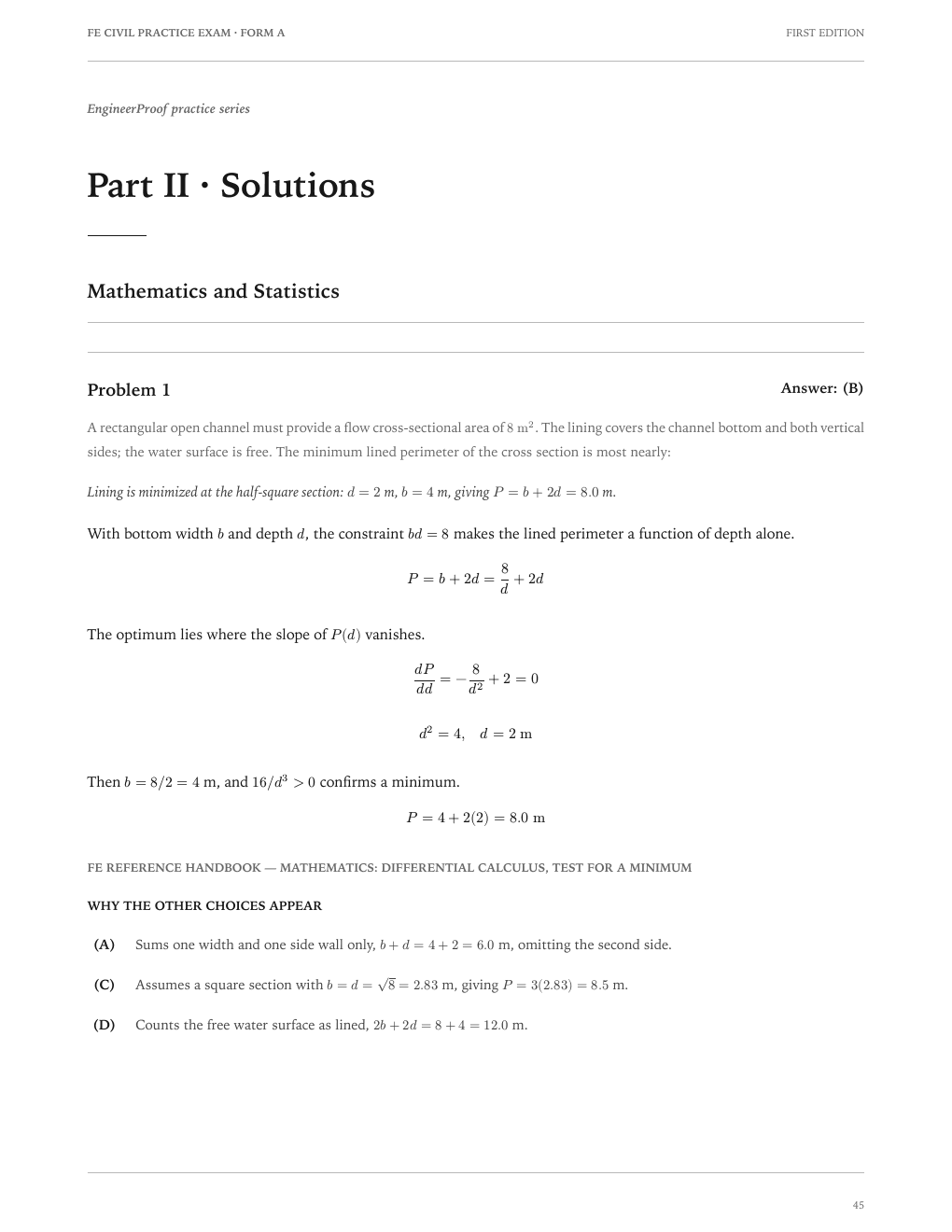
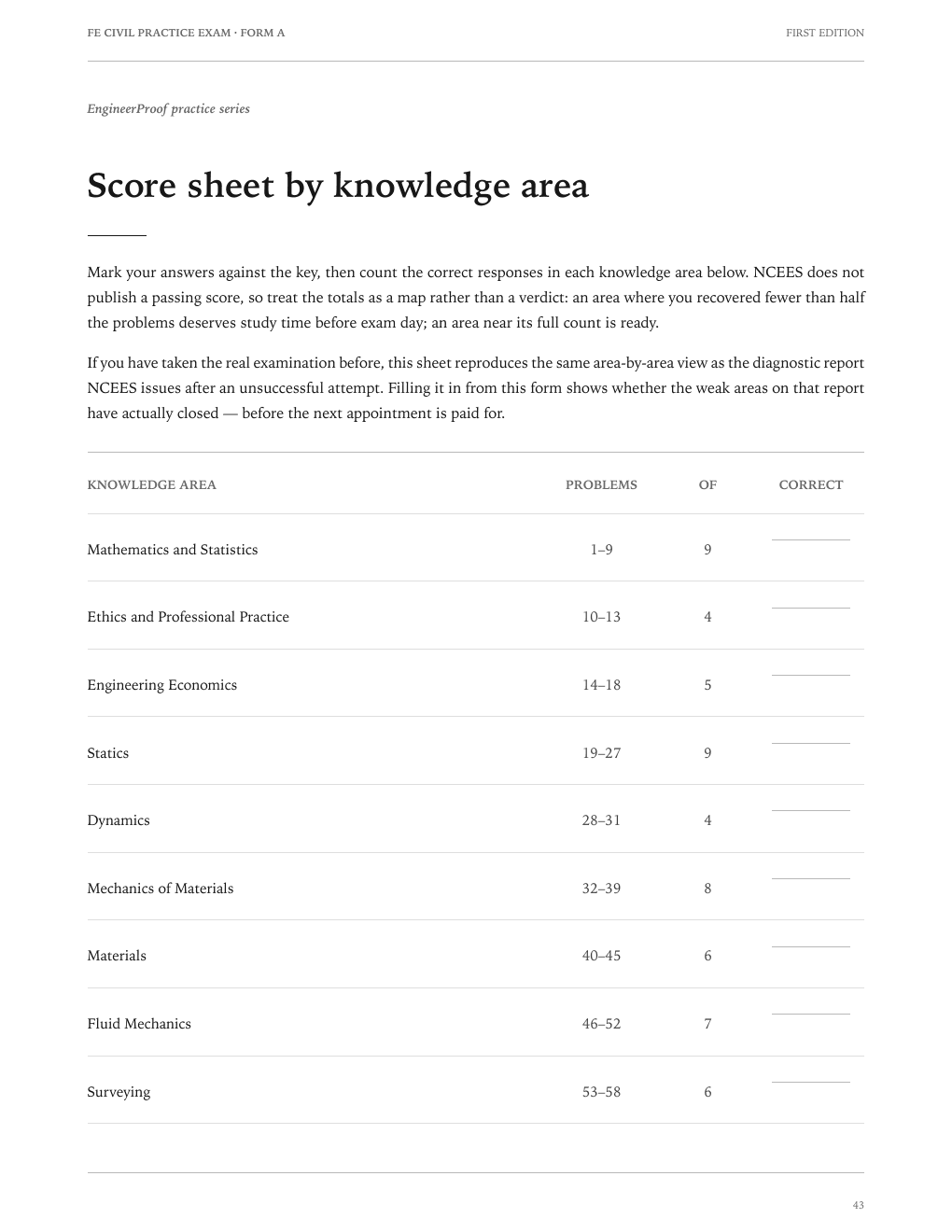
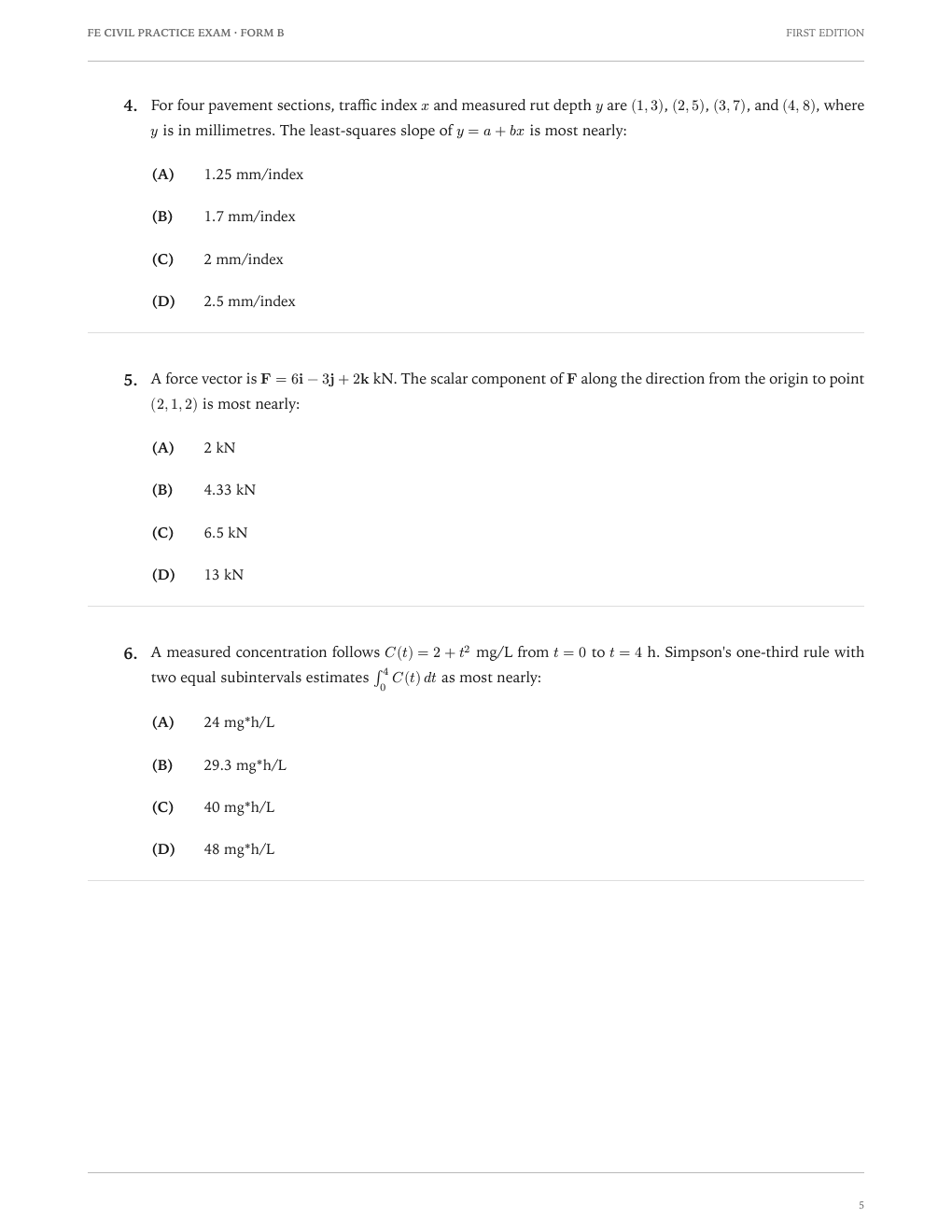
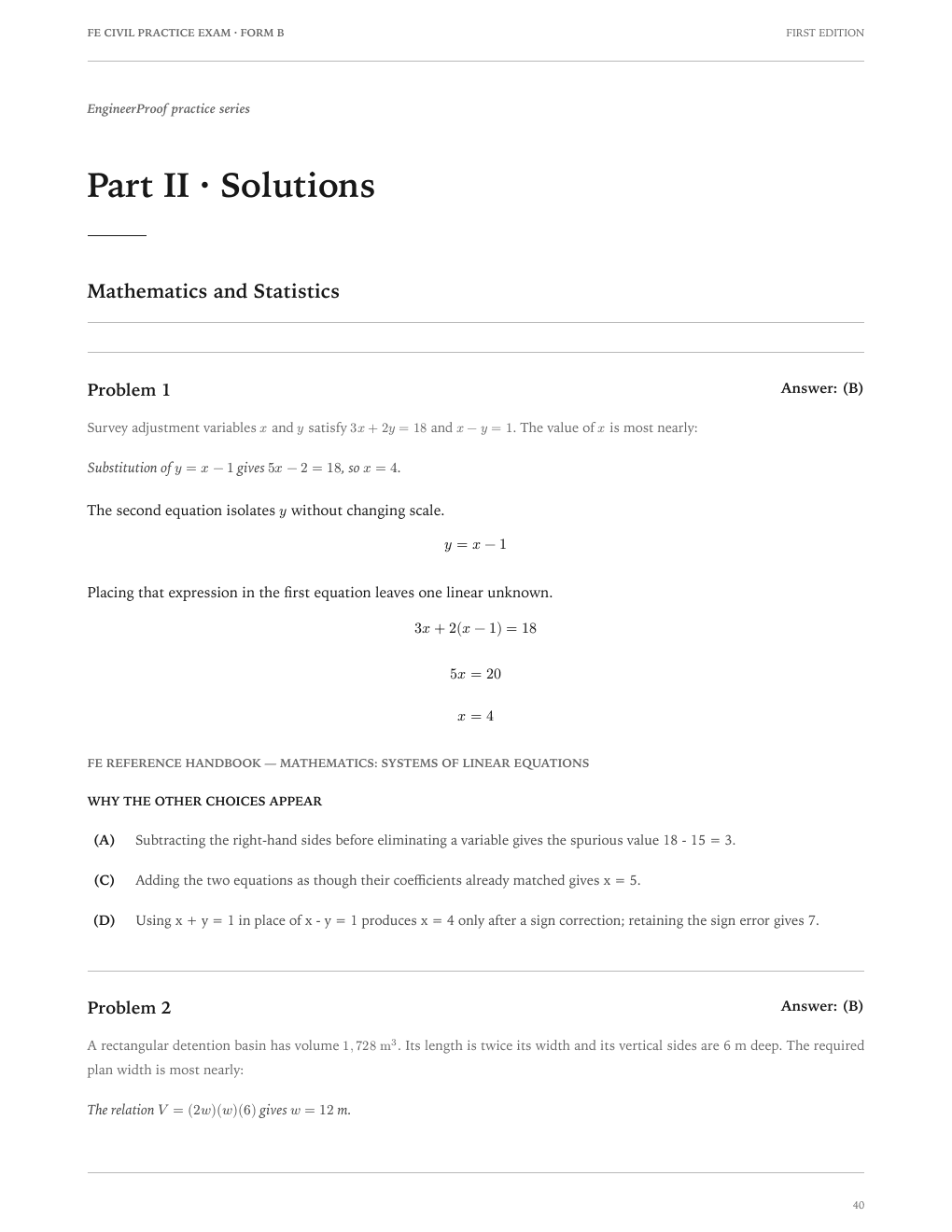
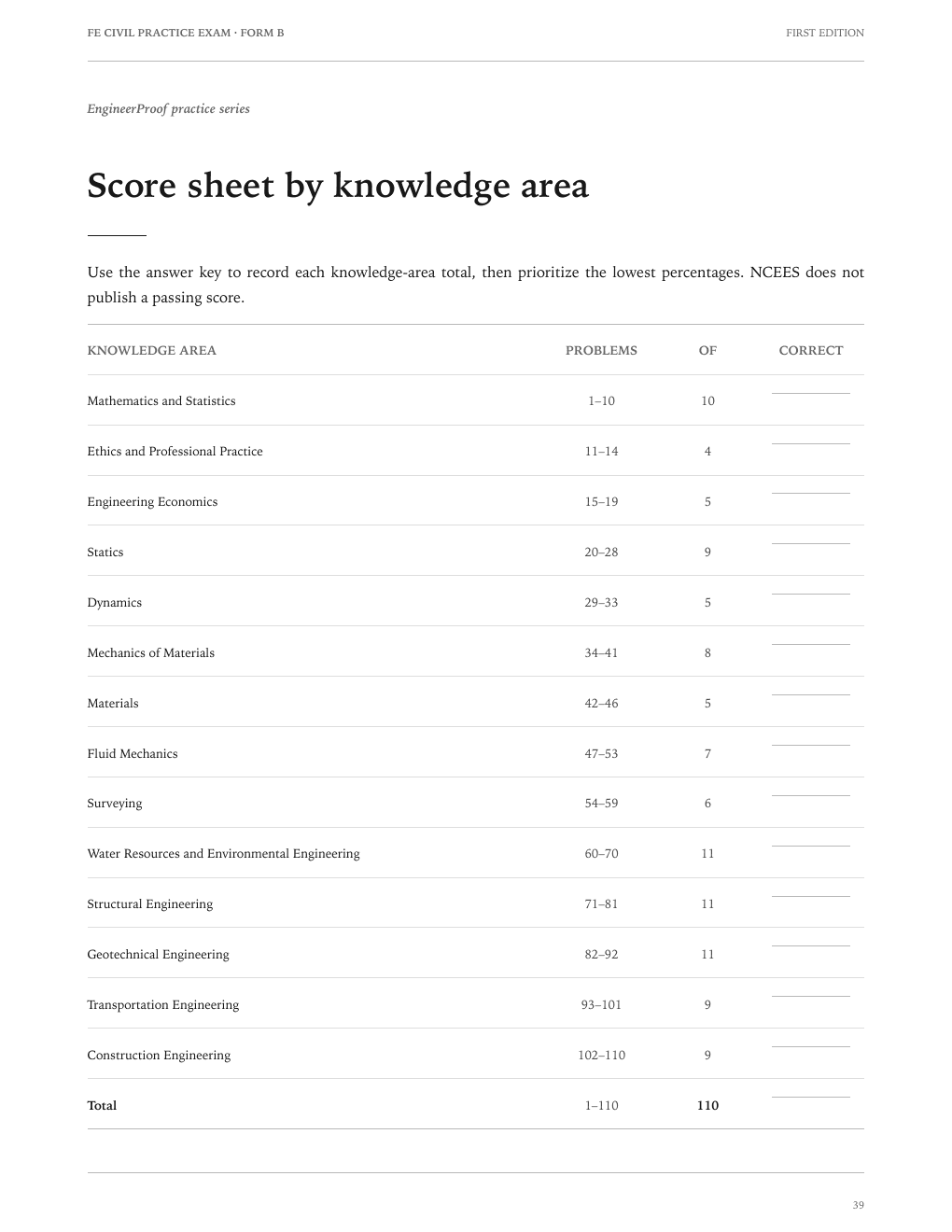
Pages from each form
Direct renders from the current PDF releases, not illustrative mockups.
Form A
119 pages · Version 1.0.0
Form B
103 pages · Version 1.0.0
16 free FE Civil practice problems with solutions
Work through all 14 knowledge areas. Each problem includes four choices, a complete solution, a handbook reference and an explanation of the wrong answers. No account or email is required.
The free sample PDF contains 14 Form A samples, one per area. The additional questions below are independent of the paid forms and are also in the free printable supplement.
Mathematics and Statistics
1 free problem · Form A: 9 of 110 questions · NCEES range: 8-12
A rectangular open channel must provide a flow cross-sectional area of . The lining covers the channel bottom and both vertical sides; the water surface is free. The minimum lined perimeter of the cross section is most nearly:
- (A)6.0 m
- (B)8.0 m
- (C)8.5 m
- (D)12.0 m
Show worked solution
Answer: (B)
Lining is minimized at the half-square section: m, m, giving m.
With bottom width and depth , the constraint makes the lined perimeter a function of depth alone.
The optimum lies where the slope of vanishes.
Then m, and confirms a minimum.
FE Reference Handbook — Mathematics: Differential Calculus, Test for a Minimum
Why the other choices appear
- (A)Sums one width and one side wall only, m, omitting the second side.
- (C)Assumes a square section with m, giving m.
- (D)Counts the free water surface as lined, m.
The complete practice exam contains 9 mathematics and statistics problems in Form A and 10 in Form B, with full solutions and a knowledge-area score sheet.
Compare Form A and Form B and buy a PDF · USD 29 eachAll knowledge areasEthics and Professional Practice
1 free problem · Form A: 4 of 110 questions · NCEES range: 4-6
An engineer employed by a municipal public works department is evaluating bids for a water main replacement contract. Before the award, one of the bidding contractors offers the engineer tickets to a professional sporting event with a face value of USD 300. According to the NCEES Model Rules, the engineer should:
- (A)accept the tickets because their value is nominal relative to the contract amount
- (B)accept the tickets and disclose the gift to the department after the contract is awarded
- (C)decline the tickets and continue the impartial evaluation of all bids
- (D)decline the tickets and disqualify the contractor from the bidding process
Show worked solution
Answer: (C)
A gratuity from a bidder on work the engineer is evaluating must be refused outright — no value threshold, no cure by disclosure — but refusal, not disqualification, is the limit of the engineer's own authority.
Licensees may not solicit or accept anything of value, directly or indirectly, from contractors or their agents in connection with work for their employer or client.
Tickets from a bidder whose bid the engineer is judging fall squarely within that prohibition; neither the USD 300 value nor after-the-fact disclosure changes it.
Disqualifying the bidder is a procurement decision that belongs to the department, not the individual engineer. The duty is to refuse and keep the evaluation impartial.
FE Reference Handbook — Ethics and Professional Practice: NCEES Model Rules, Rules of Professional Conduct (conflicts of interest and gratuities provisions)
Why the other choices appear
- (A)Applies a nonexistent de minimis exception; the Model Rules prohibition on gratuities from contractors in connection with the licensee's work contains no value threshold.
- (B)Treats disclosure as a cure for acceptance; disclosure applies to unavoidable conflicts of interest, not to gratuities, which must be refused outright.
- (D)Overextends the engineer's authority; the ethical duty is to refuse the gratuity, and unilaterally disqualifying the bidder is a procurement action the rules neither require nor authorize the engineer to take alone.
The complete practice exam contains 4 ethics and professional practice problems in Form A and 4 in Form B, with full solutions and a knowledge-area score sheet.
Compare Form A and Form B and buy a PDF · USD 29 eachAll knowledge areasEngineering Economics
1 free problem · Form A: 5 of 110 questions · NCEES range: 5-8
Two booster pump stations are being considered for a water main extension. Station A has a first cost of USD 60,000 and annual operating costs of USD 11,000. Station B has a first cost of USD 95,000 and annual operating costs of USD 5,000. Both stations have 10-year lives with no salvage value. At an interest rate of 8% per year, the equivalent uniform annual cost of the more economical alternative is most nearly:
- (A)USD 11,560
- (B)USD 14,500
- (C)USD 19,160
- (D)USD 19,940
Show worked solution
Answer: (C)
At 8% the capital recovery factor is 0.14903; Station B annualizes to USD 19,158 against USD 19,942 for Station A, so the economical alternative costs most nearly USD 19,160 per year.
Equal 10-year lives with no salvage make equivalent uniform annual cost the natural basis; first find the capital recovery factor.
FE Reference Handbook — Engineering Economics: Capital Recovery (A/P, i%, n)
Why the other choices appear
- (A)Using the sinking fund factor (A/F, 8%, 10) = 0.06903 in place of (A/P) for Station B gives 95,000(0.06903) + 5,000 = 11,558.
- (B)Dividing the first cost of Station B by the life without interest gives 95,000/10 + 5,000 = 14,500.
- (D)USD 19,942 is the equivalent uniform annual cost of Station A, the less economical alternative.
The complete practice exam contains 5 engineering economics problems in Form A and 5 in Form B, with full solutions and a knowledge-area score sheet.
Compare Form A and Form B and buy a PDF · USD 29 eachAll knowledge areasStatics
3 free problems · Form A: 9 of 110 questions · NCEES range: 8-12
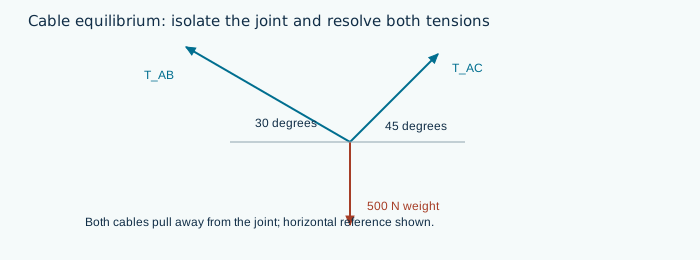
A 500-N traffic signal head hangs from point A. Cable AB extends from A to a pole on one side and rises at above the horizontal; cable AC extends to a pole on the opposite side and rises at above the horizontal. The tension in cable AB is most nearly:
- (A)366 N
- (B)414 N
- (C)448 N
- (D)500 N
Show worked solution
Answer: (A)
Force balance at A in both directions yields N.
Three forces meet at A: the 500-N weight and the two cable tensions.
With , the horizontal equation gives ; the vertical sum then contains only .
FE Reference Handbook — Statics: Equilibrium Requirements
Why the other choices appear
- (B)Assumes the two cable tensions are equal and sums vertical components, , giving 414 N.
- (C)Reports the tension in cable AC (448 N) instead of cable AB.
- (D)Sets the cable tension equal to the full supported weight.
Two more free problem types
Try a different setup before reading the solution. These additional original questions are separate from the sold practice forms, so solving them does not reveal another question from a full practice form.
Support reactions with a partial distributed load
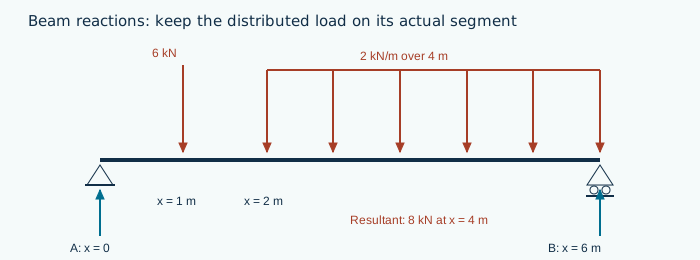
A horizontal 6 m beam is pinned at A (x = 0) and supported by a roller at B (x = 6 m). A 6 kN downward point load acts at x = 1 m. A uniform 2 kN/m downward load acts only from x = 2 m to x = 6 m. Neglect the beam weight. What is the upward reaction at B?
- (A)2.00 kN
- (B)4.00 kN
- (C)6.33 kN
- (D)8.33 kN
Show worked solution
Answer: (C)
The reaction at B is 6.33 kN; the reaction at A is 7.67 kN.
Replace the 4 m loaded segment by its 8 kN resultant at the segment midpoint x = 4 m, not the midpoint of the entire beam.
Take moments about A so the reaction at A disappears. Counterclockwise moments are positive.
Vertical force balance gives A = 14 - 6.333 = 7.667 kN. Taking moments about B independently gives 6A = 6(5) + 8(2) = 46 kN m.
FE Reference Handbook: Statics — resultant of a distributed load and planar rigid-body equilibrium.
Why the other choices appear
- (A)This discards the point load and uses the wrong load lever arm.
- (B)This applies the distributed resultant at x = 3 m and ignores the point load.
- (D)This result does not satisfy the 38 kN m load moment about A.
Impending slip: normal force versus friction
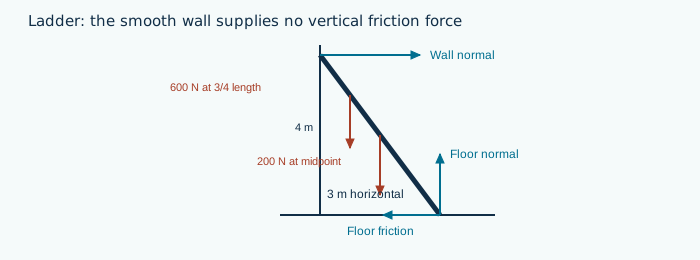
A 5 m ladder rests against a smooth vertical wall. Its foot is 3 m from the wall and its top is 4 m high. The ladder weighs 200 N uniformly. A 600 N worker stands three-quarters of the way up the ladder. The floor alone supplies friction. What minimum coefficient of static friction at the floor prevents sliding?
- (A)0.375
- (B)0.500
- (C)0.516
- (D)0.688
Show worked solution
Answer: (C)
The minimum coefficient is 0.516. The wall reaction is 412.5 N and the floor normal is 800 N.
The smooth wall has only a horizontal normal reaction. The floor normal balances both weights; the floor friction balances the wall reaction.
About the foot, the ladder weight has a 1.5 m horizontal arm and the worker a 2.25 m arm. The wall reaction has a 4 m vertical arm.
At impending slip, floor friction reaches its maximum. Dividing by the floor normal gives the required coefficient. A lower value cannot provide 412.5 N of friction.
FE Reference Handbook: Statics — rigid-body equilibrium and limiting dry friction.
Why the other choices appear
- (A)This places the worker at the ladder midpoint.
- (B)This underestimates the required horizontal reaction.
- (D)This divides friction by worker weight rather than the complete floor normal.
Download all 14 additional questions, diagrams and complete solutions (free PDF). Download the editable practice review sheet (CSV).
Original questions and diagrams by EngineerProof, September 30, 2026. Personal study and unchanged redistribution with attribution are permitted. The questions are independent practice, not official NCEES material. Report a correction.
The complete practice exam contains 9 statics problems in Form A and 9 in Form B, with full solutions and a knowledge-area score sheet.
Compare Form A and Form B and buy a PDF · USD 29 eachAll knowledge areasDynamics
1 free problem · Form A: 4 of 110 questions · NCEES range: 4-6
A water jet discharges from a nozzle at grade with an initial velocity of 18 m/s at an angle of above the horizontal. Air resistance is neglected. The horizontal distance from the nozzle to the point where the jet returns to nozzle elevation is most nearly:
- (A)15.5 m
- (B)18.9 m
- (C)31.0 m
- (D)37.9 m
Show worked solution
Answer: (C)
Symmetric flight over level ground: the jet stays aloft for while drifting downrange at , landing 31.0 m from the nozzle.
Velocity components at launch:
Zero net vertical displacement fixes the time aloft:
Carried at constant for that time, the jet travels
FE Reference Handbook — Dynamics: Projectile Motion
Why the other choices appear
- (A)Omits the factor of 2 in the range expression, computing m.
- (B)Uses instead of in , giving m.
- (D)Multiplies the full speed 18 m/s, instead of the horizontal component, by the flight time 2.105 s, giving 37.9 m.
The complete practice exam contains 4 dynamics problems in Form A and 5 in Form B, with full solutions and a knowledge-area score sheet.
Compare Form A and Form B and buy a PDF · USD 29 eachAll knowledge areasMechanics of Materials
1 free problem · Form A: 8 of 110 questions · NCEES range: 7-11
A straight steel member with a cross-sectional area of 8.0 in² is fully restrained against axial deformation between two bridge abutments. The coefficient of thermal expansion is per degree F, and the modulus of elasticity is psi. For a uniform temperature rise of 70 degrees F, the compressive force developed in the member is most nearly:
- (A)13.2 kips
- (B)58.6 kips
- (C)106 kips
- (D)190 kips
Show worked solution
Answer: (C)
Restrained thermal strain converts entirely to stress: psi, which over 8.0 in² is lb — about 106 kips.
Left free, the member would expand by ; the abutments deny all of it.
That denied strain returns as elastic stress.
FE Reference Handbook — Mechanics of Materials: Thermal Deformations
Why the other choices appear
- (A)Stopped at the restraint stress, 13,195 psi = 13.2 ksi, and reported it as a force in kips.
- (B)Converted the 70 degree F rise to 38.9 degrees C while keeping alpha per degree F, giving (188.5)(38.9)(8.0) = 58.6 kips.
- (D)Used the SI coefficient 11.7e-6 per degree C with the Fahrenheit temperature rise, giving 23,751 psi times 8.0 in² = 190 kips.
The complete practice exam contains 8 mechanics of materials problems in Form A and 8 in Form B, with full solutions and a knowledge-area score sheet.
Compare Form A and Form B and buy a PDF · USD 29 eachAll knowledge areasMaterials
1 free problem · Form A: 6 of 110 questions · NCEES range: 5-8
A sieve analysis of a concrete fine aggregate gives cumulative percentages retained on the 4.75-mm, 2.36-mm, 1.18-mm, 0.600-mm, 0.300-mm, and 0.150-mm sieves of 4, 15, 36, 58, 78, and 89, respectively. The fineness modulus of the aggregate is most nearly:
- (A)0.89
- (B)2.80
- (C)3.20
- (D)3.80
Show worked solution
Answer: (B)
The six cumulative retained percentages total 280, making the fineness modulus 280/100 = 2.80.
Fineness modulus works on cumulative percent retained — not incremental values, not percent passing.
FE Reference Handbook — Civil Engineering: Aggregate Gradation, Fineness Modulus
Why the other choices appear
- (A)Sums the incremental (individual) percentages retained, which totals 89, and divides by 100, giving 0.89.
- (C)Sums the cumulative percentages passing (96 + 85 + 64 + 42 + 22 + 11 = 320) instead of retained, giving 3.20.
- (D)Adds 100 percent for the pan to the cumulative retained sum, (280 + 100)/100 = 3.80.
The complete practice exam contains 6 materials problems in Form A and 5 in Form B, with full solutions and a knowledge-area score sheet.
Compare Form A and Form B and buy a PDF · USD 29 eachAll knowledge areasFluid Mechanics
1 free problem · Form A: 7 of 110 questions · NCEES range: 6-9
A vertical rectangular gate in a reservoir retaining wall is 4 ft wide and 6 ft tall. The top edge of the gate is 8 ft below the free water surface. The specific weight of water is 62.4 lbf/ft. The magnitude of the resultant hydrostatic force on the gate is most nearly:
- (A)12,000 lbf
- (B)16,500 lbf
- (C)21,000 lbf
- (D)24,500 lbf
Show worked solution
Answer: (B)
Pressure at the centroid governs: ft over ft gives lbf.
Depth to the gate centroid, and the wetted area.
Centroid pressure times area gives the resultant on any plane surface.
FE Reference Handbook — Fluid Mechanics: Forces on Submerged Surfaces (Resultant Force on a Plane Surface)
Why the other choices appear
- (A)Using the depth to the top edge (8 ft) instead of the centroid gives 62.4 x 8 x 24 = 11,981 lbf.
- (C)Using the depth to the bottom edge (14 ft) instead of the centroid gives 62.4 x 14 x 24 = 20,966 lbf.
- (D)Integrating the pressure prism from the free surface to the bottom edge over the gate width, (1/2)(62.4)(14²)(4), gives 24,461 lbf.
The complete practice exam contains 7 fluid mechanics problems in Form A and 7 in Form B, with full solutions and a knowledge-area score sheet.
Compare Form A and Form B and buy a PDF · USD 29 eachAll knowledge areasSurveying
1 free problem · Form A: 6 of 110 questions · NCEES range: 6-9
A water main is to be laid from point A (N 1,200.00 m, E 800.00 m) to point B (N 950.00 m, E 1,100.00 m). The azimuth from north of line AB is most nearly:
- (A)39.8°
- (B)50.2°
- (C)129.8°
- (D)230.2°
Show worked solution
Answer: (C)
AB runs southeast ( m, m), so the bearing angle becomes azimuth .
Inverse from A to B.
Departure over latitude gives the angle off the meridian.
with places the line S 50.19° E; the azimuth folds back from 180°.
FE Reference Handbook — Civil Engineering, Surveying: Coordinate Inverse (Azimuth from Latitudes and Departures)
Why the other choices appear
- (A)Inverts the tangent ratio, computing arctan(250/300) = 39.8° and stopping without quadrant adjustment.
- (B)Reports the reference angle 50.2° (the bearing angle) without converting to an azimuth in the southeast quadrant.
- (D)Places the line in the southwest quadrant, computing 180° + 50.2° = 230.2° (sign error on the departure).
The complete practice exam contains 6 surveying problems in Form A and 6 in Form B, with full solutions and a knowledge-area score sheet.
Compare Form A and Form B and buy a PDF · USD 29 eachAll knowledge areasWater Resources and Environmental Engineering
1 free problem · Form A: 11 of 110 questions · NCEES range: 10-15
A rectangular concrete-lined drainage channel has a bottom width of 8 ft and carries uniform flow at a depth of 3 ft. The Manning roughness coefficient is 0.013, and the bed slope is 0.002 ft/ft. The discharge is most nearly:
- (A)118 ft³/s
- (B)176 ft³/s
- (C)255 ft³/s
- (D)275 ft³/s
Show worked solution
Answer: (B)
With ft² and ft, the USCS Manning equation gives 176 ft³/s.
Only the bed and the two side walls are wetted.
Manning's equation governs uniform flow; in USCS units the 1.486 factor is mandatory.
FE Reference Handbook — Water Resources and Environmental Engineering: Manning Equation
Why the other choices appear
- (A)Omitting the USCS conversion factor 1.486 (using the SI form with n = 0.013) gives 118 ft³/s.
- (C)Using the flow depth 3 ft as the hydraulic radius instead of A/P gives 255 ft³/s.
- (D)Raising R to the 3/2 power instead of the 2/3 power gives 275 ft³/s.
The complete practice exam contains 11 water resources and environmental engineering problems in Form A and 11 in Form B, with full solutions and a knowledge-area score sheet.
Compare Form A and Form B and buy a PDF · USD 29 eachAll knowledge areasStructural Engineering
1 free problem · Form A: 12 of 110 questions · NCEES range: 10-15
A determinate portal frame consists of vertical columns AB and DC, each 4 m tall, and horizontal beam BC spanning 6 m between the column tops B and C. The frame is supported by a pin at base A and by a roller at base D that resists vertical force only. A horizontal load of 30 kN is applied at joint B, directed toward C. The maximum bending moment in the frame is most nearly:
- (A)60 kN·m
- (B)80 kN·m
- (C)120 kN·m
- (D)180 kN·m
Show worked solution
Answer: (C)
Only the pin at A can resist horizontal force, so column AB carries the full 30 kN and the moment peaks at its top: kN·m.
With the roller at D unable to take horizontal force, the pin at A resists the full 30 kN; the vertical reactions form a couple balancing the overturning.
Cut column AB just below B: the 30-kN base shear acting through 4 m sets the joint moment. Along the beam it falls linearly to zero at C, since column DC carries axial force only.
FE Reference Handbook — Statics: Equations of Equilibrium (frames and free-body diagrams)
Why the other choices appear
- (A)Splits the 30-kN lateral load equally between the two columns as in the portal method, giving 15 x 4 = 60 kN·m, although the roller cannot resist horizontal force.
- (B)Multiplies the 20-kN vertical reaction at D by the 4-m column height instead of tracking the lateral load path.
- (D)Multiplies the 30-kN load by the 6-m beam span instead of the 4-m column height.
The complete practice exam contains 12 structural engineering problems in Form A and 11 in Form B, with full solutions and a knowledge-area score sheet.
Compare Form A and Form B and buy a PDF · USD 29 eachAll knowledge areasGeotechnical Engineering
1 free problem · Form A: 12 of 110 questions · NCEES range: 10-15
A saturated clay specimen has a water content of 40% and a specific gravity of solids of 2.70. The saturated unit weight of the specimen is most nearly:
- (A)8.0 kN/m³
- (B)12.7 kN/m³
- (C)17.8 kN/m³
- (D)24.3 kN/m³
Show worked solution
Answer: (C)
Saturation forces e = wG_s = 1.08, and the phase relation returns γ_sat = 17.8 kN/m³.
Saturation () fixes the void ratio through .
With known, the unit weight follows directly, taking kN/m³.
FE Reference Handbook — Geotechnical: Phase Relationships (Unit Weight Equations)
Why the other choices appear
- (A)Reports the buoyant (submerged) unit weight, 17.83 − 9.81 = 8.0 kN/m³, instead of the saturated unit weight.
- (B)Reports the dry unit weight, G_s·γ_w/(1+e) = 12.7 kN/m³, omitting the pore water.
- (D)Computes the void ratio as e = w/G_s = 0.148, giving (2.70 + 0.148)(9.81)/1.148 = 24.3 kN/m³.
The complete practice exam contains 12 geotechnical engineering problems in Form A and 11 in Form B, with full solutions and a knowledge-area score sheet.
Compare Form A and Form B and buy a PDF · USD 29 eachAll knowledge areasTransportation Engineering
1 free problem · Form A: 9 of 110 questions · NCEES range: 9-14
A two-lane rural highway approaches an intersection on a 4.0% downgrade. The design speed is 50 mph, the perception-reaction time is 2.5 s, and the deceleration rate is 11.2 ft/s. The stopping sight distance is most nearly:
- (A)271 ft
- (B)399 ft
- (C)423 ft
- (D)454 ft
Show worked solution
Answer: (D)
A downgrade reduces the effective deceleration, stretching the braking distance to 270.7 ft; added to 183.75 ft of perception-reaction travel, the SSD is 454 ft.
On a downgrade gravity works against the brakes, so subtracts inside the braking term.
Reaction covers ground before the brakes do anything.
Braking distance follows, with .
FE Reference Handbook — Transportation: Stopping Sight Distance (grade-adjusted braking distance equation)
Why the other choices appear
- (A)Omits the perception-reaction distance and reports the braking distance alone, 270.7 ft.
- (B)Adds the grade term instead of subtracting it (treats the downgrade as an upgrade): 183.75 + 2500/(30 x 0.3878) = 398.6 ft.
- (C)Ignores the grade entirely: 183.75 + 2500/(30 x 0.3478) = 423.3 ft.
The complete practice exam contains 9 transportation engineering problems in Form A and 9 in Form B, with full solutions and a knowledge-area score sheet.
Compare Form A and Form B and buy a PDF · USD 29 eachAll knowledge areasConstruction Engineering
1 free problem · Form A: 8 of 110 questions · NCEES range: 8-12
Between station 12+00 and station 30+00, a roadway grading plan shows 8{,}200 yd³ of excavation (bank measure) and 6{,}600 yd³ of embankment (compacted measure). The shrinkage factor from bank volume to compacted volume is 0.88. The change in the mass haul diagram ordinate across this interval, expressed in bank volume, is most nearly:
- (A)1{,}600 yd³
- (B)2{,}390 yd³
- (C)2{,}720 yd³
- (D)700 yd³
Show worked solution
Answer: (D)
Compacted fill converts to 6,600/0.88 = 7,500 yd³ of bank material, leaving a 700 yd³ cut surplus across the interval.
Cut and fill must be compared in the same measure, so bring the embankment to bank volume.
Surplus cut drives the ordinate upward: the change is cut minus fill, both in bank measure.
FE Reference Handbook — Civil Engineering: Earthwork Formulas (Shrinkage/Swell) and Mass Diagram
Why the other choices appear
- (A)Ignores shrinkage and subtracts volumes in different measures (8,200 − 6,600 = 1,600).
- (B)Multiplies the fill by 0.88 instead of dividing (8,200 − 6,600 × 0.88 = 2,392).
- (C)Applies the factor to the cut instead of the fill (8,200/0.88 − 6,600 = 2,718).
The complete practice exam contains 8 construction engineering problems in Form A and 9 in Form B, with full solutions and a knowledge-area score sheet.
Compare Form A and Form B and buy a PDF · USD 29 eachAll knowledge areasPlan your FE preparation
FE exam scores and preparation
What each download contains
- Edition
- First edition
- Form A
- 119 pages · Version 1.0.0
- Form B
- 103 pages · Version 1.0.0
- Questions
- 110 original problems per form
- Coverage
- 14 knowledge areas
- Question type
- Four-choice, single-answer
- Format
- Print-ready PDF, US Letter
Built against the NCEES FE Civil specifications effective July 2020, current as of July 2026. Official exam format and appointment facts are available from NCEES. This printable form does not reproduce the Pearson VUE interface or interactive alternative item types.
Knowledge-area coverage
| Knowledge area | Form A | NCEES range |
|---|---|---|
| Mathematics and Statistics | 9 | 8-12 |
| Ethics and Professional Practice | 4 | 4-6 |
| Engineering Economics | 5 | 5-8 |
| Statics | 9 | 8-12 |
| Dynamics | 4 | 4-6 |
| Mechanics of Materials | 8 | 7-11 |
| Materials | 6 | 5-8 |
| Fluid Mechanics | 7 | 6-9 |
| Surveying | 6 | 6-9 |
| Water Resources and Environmental Engineering | 11 | 10-15 |
| Structural Engineering | 12 | 10-15 |
| Geotechnical Engineering | 12 | 10-15 |
| Transportation Engineering | 9 | 9-14 |
| Construction Engineering | 8 | 8-12 |
Verification and corrections
Original problems, checked by a second calculation route
Every answer is reproduced with an alternate formula, a limiting case, a dimensional check, or a direct recomputation before publication. Official examination questions are confidential and are not reproduced or paraphrased.
Confirmed errors are published as versioned corrections. Buyers can re-download the corrected release at no charge. Read the full editorial method.
For a repeat attempt
Close the weak areas before another USD 225 appointment
FE Civil repeat examinees passed at 32% versus 61% for first-time examinees in the cited NCEES data. Use the form's score sheet beside your diagnostic report, then read the FE Civil retake plan or compare FE pass rates by discipline. Record accuracy, first-pass completion, and verification with the 14-area FE Civil practice-test scorecard.
Before you buy
Questions about the PDF
Is this an official NCEES practice exam?
EngineerProof is not affiliated with, endorsed by, or sponsored by NCEES. FE and NCEES are registered trademarks of the National Council of Examiners for Engineering and Surveying, used solely to identify the examination for which these study materials are relevant. All problems and solutions in this publication are original works.
Does it reproduce the computer-based test interface?
No. This is a printable four-choice PDF. It does not include the Pearson VUE interface or interactive alternative item types such as point-and-click and drag-and-drop.
How is the PDF delivered?
Stripe returns you to a private download page after payment. The same 90-day link is sent to the checkout email.
Can I print the exam?
Yes. One purchase includes a personal license to download and print the PDF for your own study.
What if the book is not right for me?
Email inshihub.com@gmail.com within 14 days for a full refund. No reason is required.
USD 29 each