FE Civil Statics Practice Problems

Work 3 free FE Civil statics practice problems with complete solutions, governing equations and checks. Attempt the setup before reading the answer.

Free sample problem

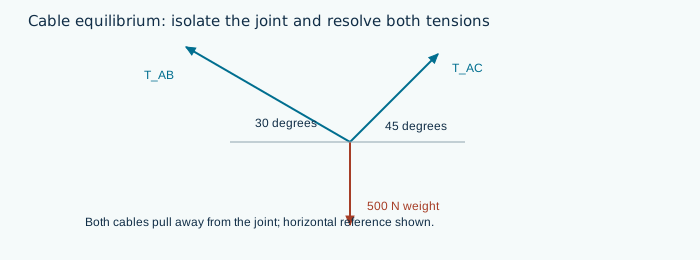
Free-body diagram at the signal joint: cable AB points up left at 30 degrees, cable AC points up right at 45 degrees, and the 500 N weight acts down
Isolate the joint: each tension pulls away from it along its cable. Angles are measured from the horizontal.

A 500-N traffic signal head hangs from point A. Cable AB extends from A to a pole on one side and rises at 30∘30^\circ above the horizontal; cable AC extends to a pole on the opposite side and rises at 45∘45^\circ above the horizontal. The tension in cable AB is most nearly:

  1. (A)366 N
  2. (B)414 N
  3. (C)448 N
  4. (D)500 N
Show worked solution

Answer: (A)

Force balance at A in both directions yields TAB=500/(sin⁡30∘+cos⁡30∘)=366T_{AB} = 500/(\sin 30^\circ + \cos 30^\circ) = 366 N.

Three forces meet at A: the 500-N weight and the two cable tensions.

ΣFx: TABcos⁡30∘=TACcos⁡45∘\Sigma F_x:\ T_{AB}\cos 30^\circ = T_{AC}\cos 45^\circ
ΣFy: TABsin⁡30∘+TACsin⁡45∘=500 N\Sigma F_y:\ T_{AB}\sin 30^\circ + T_{AC}\sin 45^\circ = 500\ \text{N}

With tan⁡45∘=1\tan 45^\circ = 1, the horizontal equation gives TACsin⁡45∘=TABcos⁡30∘T_{AC}\sin 45^\circ = T_{AB}\cos 30^\circ; the vertical sum then contains only TABT_{AB}.

TAB(sin⁡30∘+cos⁡30∘)=500T_{AB}(\sin 30^\circ + \cos 30^\circ) = 500

TAB=5001.366=366 NT_{AB} = \frac{500}{1.366} = 366\ \text{N}

FE Reference Handbook — Statics: Equilibrium Requirements

Why the other choices appear

  • (B)Assumes the two cable tensions are equal and sums vertical components, T(sin⁡30∘+sin⁡45∘)=500T(\sin 30^\circ + \sin 45^\circ) = 500, giving 414 N.
  • (C)Reports the tension in cable AC (448 N) instead of cable AB.
  • (D)Sets the cable tension equal to the full supported weight.

Two more free problem types

Try a different setup before reading the solution. These additional original questions are separate from the sold practice forms, so solving them does not reveal another question from a full practice form.

Support reactions with a partial distributed load

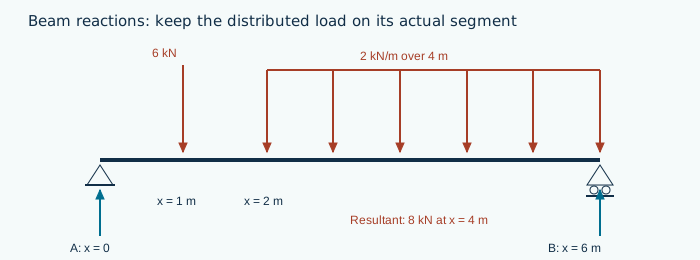
Support reactions with a partial distributed load: geometry, loads or connections stated in the question
Original schematic. Use the stated dimensions and assumptions; the sketch is not a scale drawing.

A horizontal 6 m beam is pinned at A (x = 0) and supported by a roller at B (x = 6 m). A 6 kN downward point load acts at x = 1 m. A uniform 2 kN/m downward load acts only from x = 2 m to x = 6 m. Neglect the beam weight. What is the upward reaction at B?

  1. (A)2.00 kN
  2. (B)4.00 kN
  3. (C)6.33 kN
  4. (D)8.33 kN
Show worked solution

Answer: (C)

The reaction at B is 6.33 kN; the reaction at A is 7.67 kN.

Replace the 4 m loaded segment by its 8 kN resultant at the segment midpoint x = 4 m, not the midpoint of the entire beam.

W=2(6−2)=8 kN,xW=4 mW=2(6-2)=8\ \mathrm{kN},\qquad x_W=4\ \mathrm{m}

Take moments about A so the reaction at A disappears. Counterclockwise moments are positive.

6RB−6(1)−8(4)=0,RB=38/6=6.333 kN6R_B-6(1)-8(4)=0,\qquad R_B=38/6=6.333\ \mathrm{kN}

Vertical force balance gives A = 14 - 6.333 = 7.667 kN. Taking moments about B independently gives 6A = 6(5) + 8(2) = 46 kN m.

FE Reference Handbook: Statics — resultant of a distributed load and planar rigid-body equilibrium.

Why the other choices appear

  • (A)This discards the point load and uses the wrong load lever arm.
  • (B)This applies the distributed resultant at x = 3 m and ignores the point load.
  • (D)This result does not satisfy the 38 kN m load moment about A.

Impending slip: normal force versus friction

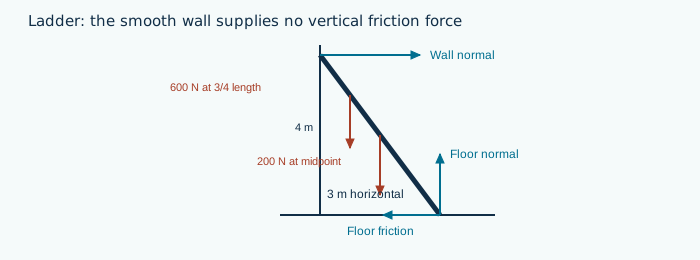
Impending slip: normal force versus friction: geometry, loads or connections stated in the question
Original schematic. Use the stated dimensions and assumptions; the sketch is not a scale drawing.

A 5 m ladder rests against a smooth vertical wall. Its foot is 3 m from the wall and its top is 4 m high. The ladder weighs 200 N uniformly. A 600 N worker stands three-quarters of the way up the ladder. The floor alone supplies friction. What minimum coefficient of static friction at the floor prevents sliding?

  1. (A)0.375
  2. (B)0.500
  3. (C)0.516
  4. (D)0.688
Show worked solution

Answer: (C)

The minimum coefficient is 0.516. The wall reaction is 412.5 N and the floor normal is 800 N.

The smooth wall has only a horizontal normal reaction. The floor normal balances both weights; the floor friction balances the wall reaction.

Nf=200+600=800 N,Ff=NwN_f=200+600=800\ \mathrm{N},\qquad F_f=N_w

About the foot, the ladder weight has a 1.5 m horizontal arm and the worker a 2.25 m arm. The wall reaction has a 4 m vertical arm.

4Nw=200(1.5)+600(2.25),Nw=412.5 N4N_w=200(1.5)+600(2.25),\qquad N_w=412.5\ \mathrm{N}

At impending slip, floor friction reaches its maximum. Dividing by the floor normal gives the required coefficient. A lower value cannot provide 412.5 N of friction.

μs,min⁡=Ff/Nf=412.5/800=0.515625\mu_{s,\min}=F_f/N_f=412.5/800=0.515625

FE Reference Handbook: Statics — rigid-body equilibrium and limiting dry friction.

Why the other choices appear

  • (A)This places the worker at the ladder midpoint.
  • (B)This underestimates the required horizontal reaction.
  • (D)This divides friction by worker weight rather than the complete floor normal.

Download all 14 additional questions, diagrams and complete solutions (free PDF). Download the editable practice review sheet (CSV).

Original questions and diagrams by EngineerProof, September 30, 2026. Personal study and unchanged redistribution with attribution are permitted. The questions are independent practice, not official NCEES material. Report a correction.

Three free problem types · two paid forms

Use this FE Civil statics problem as a setup test

The current NCEES FE Civil specification, effective July 2020, assigns 8-12 of the 110 questions to Statics. The free cable-equilibrium problem above checks one part of that range. It does not by itself establish readiness across every listed statics topic.

  1. Isolate the joint. Draw the signal head at A with its 500-N weight and the two cable tensions before writing an equation.
  2. Use both equilibrium directions. Relate the cable tensions with horizontal balance, then substitute that relation into vertical balance.
  3. Do not assume equal tensions. The cables rise at different angles, so equal magnitudes do not satisfy both component equations.
  4. Check the requested quantity. The visible solution separates the tension in cable AB from cable AC and explains the specific error behind every wrong choice.

After checking the worked solution, redraw the free-body diagram from memory and solve the two equations without following the page. Then use an unfamiliar problem to test whether the setup transfers. The FE Civil study guide connects statics reactions to mechanics of materials and structural work.

What is free and what is paid?

ResourceStatics practiceFull scopePrice
This HTML page3 complete questions: cable equilibrium, beam reactions, ladder frictionHandbook equation and four-choice error analysisUSD 0
Free FE Civil sample PDFThe same 1 Statics sample14 worked problems, one per Civil areaUSD 0
Form A9 Statics problems110 problems · 119-page PDF · complete solutions and area score sheetUSD 29
Form B9 Statics problems110 problems · 103-page PDF · complete solutions and area score sheetUSD 29

Compare Form A and Form B previews and buy one form. They are sold separately for USD 29 each and use different scenarios and solution paths. Both are independent printable practice PDFs, not official NCEES questions or a reproduction of the computer-based interface.

Official scope checked September 24, 2026. Practice problems and solution analysis are by EngineerProof. Editorial method and corrections.

The complete FE Civil practice exam contains 9 problems in this area and 110 problems overall, with an answer key, full solutions, and a score sheet by knowledge area.

Retaking the FE exam? The FE Civil retake plan turns the NCEES diagnostic report into an area-by-area plan, starting from the 32 percent repeat pass rate. The same guide covers testing windows, the attempt limit, and the registration fee.