NCEES data · Checked September 14, 2026
FE exam pass rates by discipline
The latest NCEES update is July 2026. FE Civil has a 66% pass rate, Mechanical 73%, and Other Disciplines 61% in the reported first-time group. All seven disciplines are shown below.
These January–June 2026 figures cover first-time examinees from EAC/ABET-accredited engineering programs who took the exam within 12 months of graduation. They do not include all FE candidates or repeat attempts. Source: NCEES FE exam page.
Latest FE pass rates: July 2026 update
| FE discipline | Examinees | Pass rate |
|---|---|---|
| FE Chemical | 743 | 68% |
| FE Civil | 6,247 | 66% |
| FE Electrical and Computer | 1,782 | 70% |
| FE Environmental | 1,063 | 71% |
| FE Industrial and Systems | 259 | 67% |
| FE Mechanical | 5,153 | 73% |
| FE Other Disciplines | 921 | 61% |
Looking for the percentage of questions you must answer correctly? That is a different question: NCEES does not publish an FE passing score. A 66% pass rate does not mean a 66% cutoff.
Which FE exam has the highest pass rate?
Mechanical is highest in this July 2026 table at 73%; Other Disciplines is lowest at 61%. This is a comparison of candidate groups, not a controlled comparison of exam difficulty. Switching to Mechanical makes little sense if its subjects are further from your training.
If your degree spans several disciplines, compare the official topic lists before choosing. Our FE Other Disciplines study guide identifies the mechanics and breadth subjects you would need to cover.
First-time and repeat pass rates: fiscal year 2025
For repeat candidates, the annual NCEES Squared report supplies a separate breakdown. It records 57,902 attempts from October 2024 through September 2025: 41,422 first-time and 16,480 repeat attempts. This is an older, broader population than the table above; the two tables cannot establish a year-over-year improvement.
NCEES Squared 2025, page 15. Historical transcription verified August 31, 2026. Percentages are rounded by NCEES.
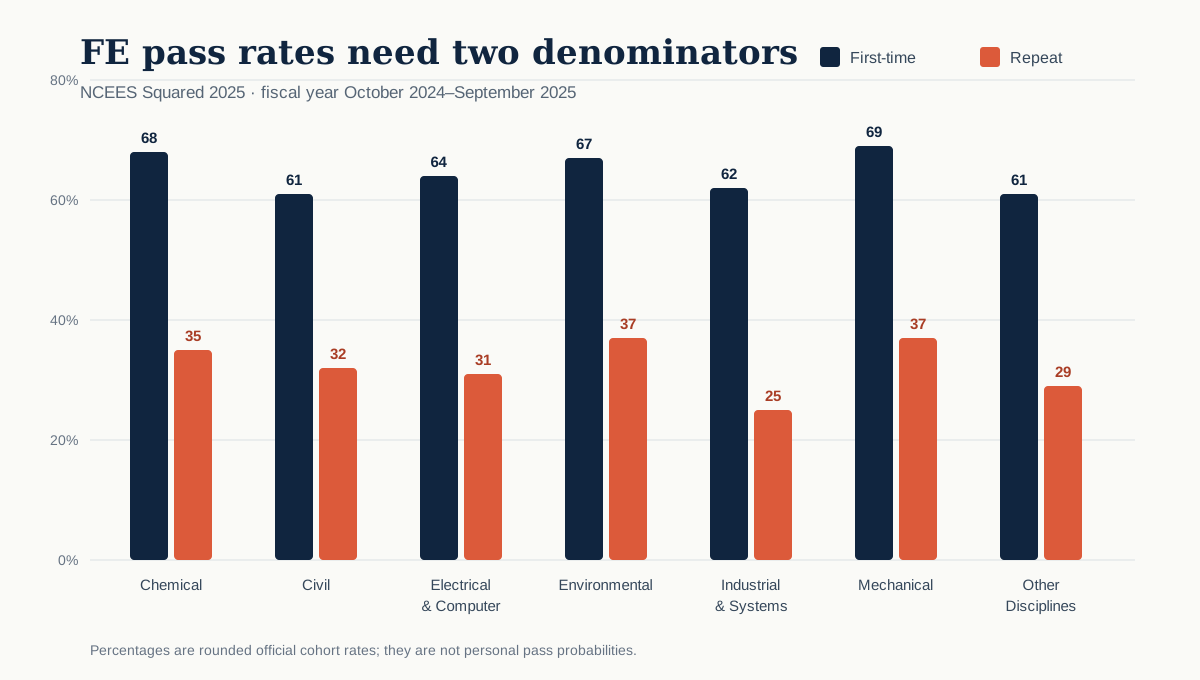
| Discipline | First-time attempts | Pass rate | Repeat attempts | Pass rate |
|---|---|---|---|---|
| FE Chemical | 1,873 | 68% | 316 | 35% |
| FE Civil | 16,639 | 61% | 9,863 | 32% |
| FE Electrical and Computer | 5,882 | 64% | 2,020 | 31% |
| FE Environmental | 2,543 | 67% | 1,092 | 37% |
| FE Industrial and Systems | 547 | 62% | 118 | 25% |
| FE Mechanical | 11,552 | 69% | 2,120 | 37% |
| FE Other Disciplines | 2,386 | 61% | 951 | 29% |
| Attempt volume | 41,422 | — | 16,480 | — |
Four questions before interpreting a rate
- Is this the first-time or repeat cohort?
- How many attempts sit behind the percentage?
- Which reporting period does the table cover?
- Does the proposed inference describe a cohort, or one person?
What the table does not establish
These rows do not rank discipline difficulty. Candidate education, preparation, time since coursework, and discipline selection differ, so the table cannot isolate a cause. It also cannot assign an individual a 61%, 69%, or 25% probability of passing.
First-time and repeat examinees are scored to the same standard. The NCEES scoring explanation says there is no predetermined percentage that must pass or fail. A lower repeat-cohort rate is an observed group result, not evidence that a retake is made harder.
Use candidate-level evidence next
A repeat candidate has a diagnostic report that is more specific than this population table. The diagnostic-to-retake guide shows how to rank areas without converting the 0–15 scale into guessed raw scores. FE Civil candidates can then record a full independent form on the 14-area FE Civil scorecard.
EngineerProof practice PDFs use original questions and do not reproduce the Pearson VUE interface or official NCEES items. A practice result is not a conversion to an NCEES result.
Sources, ownership, and corrections
NCEES owns and publishes the underlying statistics. EngineerProof is responsible for this transcription, arithmetic, visualization, and interpretation. Report a suspected error through the contact details on the EngineerProof about page.