Forms A–B · First edition
FE Electrical and Computer Practice Problems: 19 Free Questions with Solutions
19 free worked problems across 17 knowledge areas, with handbook references and explanations of every wrong choice. Prepare all 17 FE Electrical and Computer knowledge areas with free worked problems, a circuit-to-computing study plan, and two separate 110-question PDF forms.
- Problems
- 110 per form
- Free problems
- 19
- Forms
- 2
Choose a practice exam form
Forms are sold separately for USD 29 each.
Practice Exam, Form A
USD29
- 110 original problems and complete worked solutions
- Answer key and knowledge-area score sheet
- 131-page immediate private PDF download
14-day full refund · 90-day download access
Practice Exam, Form B
USD29
- 110 original problems and complete worked solutions
- Answer key and knowledge-area score sheet
- 102-page immediate private PDF download
14-day full refund · 90-day download access
Free worked samples
$0
- One complete problem and solution from every knowledge area
- No account or email required
- Read online or print the free PDF with worked solutions
Secure checkout by Stripe. Full refund within 14 days under the refund policy. Download access lasts 90 days and corrected releases remain available to buyers.
Circuit analysis, electronics, power systems, and digital systems come to 37 of the 110 problems on this form, and mathematics is weighted as heavily as circuit analysis itself — 12 problems each.
FE Electrical and Computer is one of the seven NCEES Fundamentals of Engineering (FE) exams. In most U.S. states, passing the FE exam with an accredited degree is the step to Engineer in Training (EIT) or Engineer Intern (EI) certification.
FE Electrical and Computer prep plan
Prepare all 17 knowledge areas in three passes
Use the current NCEES topic ranges below as the boundary. Mathematics and circuit analysis carry 12 Form A questions each; electronics, power systems, control systems, and digital systems add 32 more. Networks, computer systems, and software engineering still need separate practice. Start with the 17 free worked problems before buying another question set.
- Baseline: Solve one unfamiliar problem in every area with the electronic handbook and an approved calculator. Tag each miss as concept recall, equation lookup, circuit setup, model selection, digital or computing knowledge, units, or arithmetic.
- Repair: Study in linked blocks: mathematics with circuits; circuits with electronics, power, and controls; linear systems with signals and communications; and digital systems with the computer-side areas. Retest each weak block with a different problem.
- Rehearse: Take an unfamiliar 110-question form under the FE answering budget, then use the included area score sheet to choose the next repair block. Form A and Form B are sold separately so the second form can remain unseen.
What each resource is for
- Official scope
- NCEES FE exam information and specifications
- Handbook and official exam prep
- MyNCEES exam-prep resources
- Calculator check
- Allowed models, rules, and calculation drills
This plan is a way to organize the resources on this page. It is not an official NCEES schedule, required study time, or pass prediction.
Pages from each form
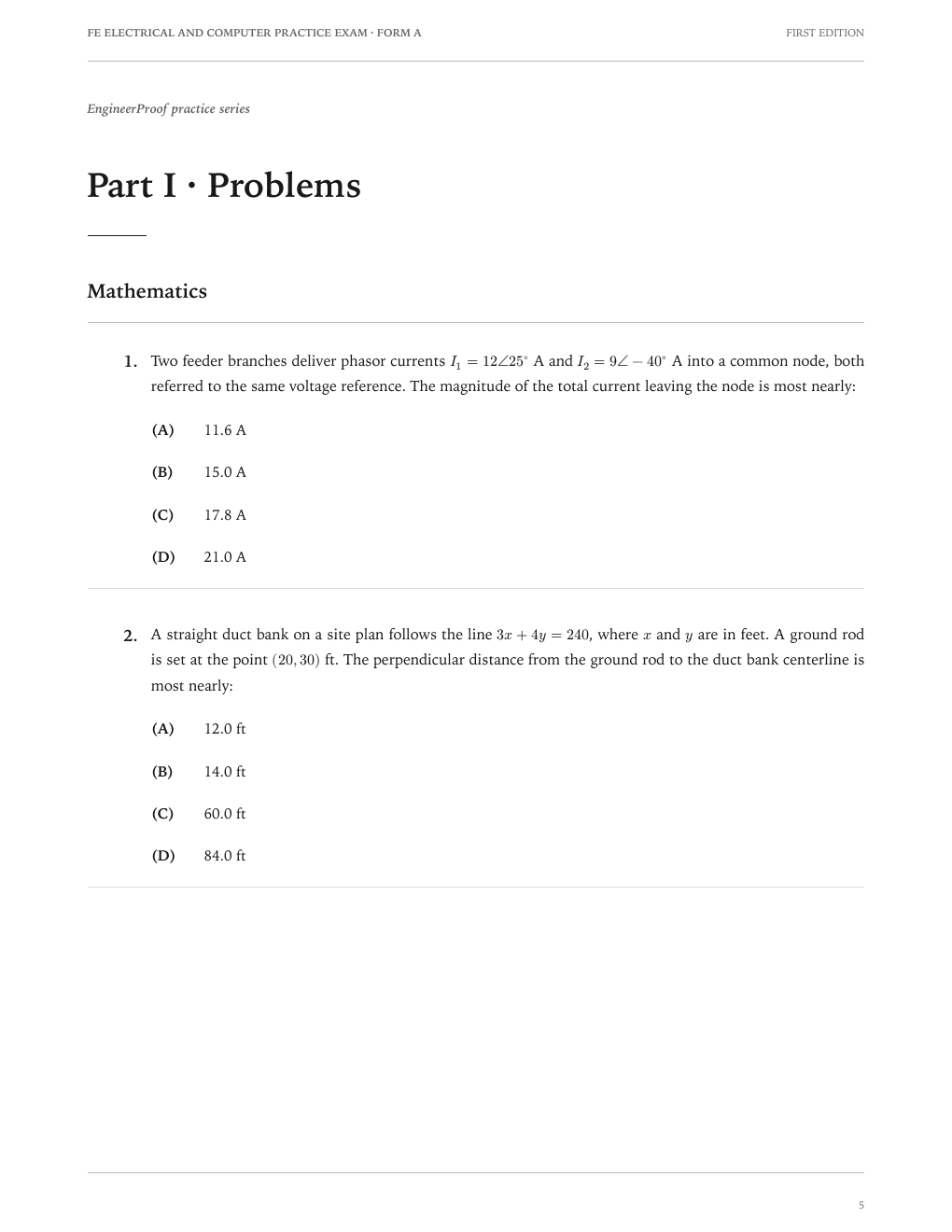
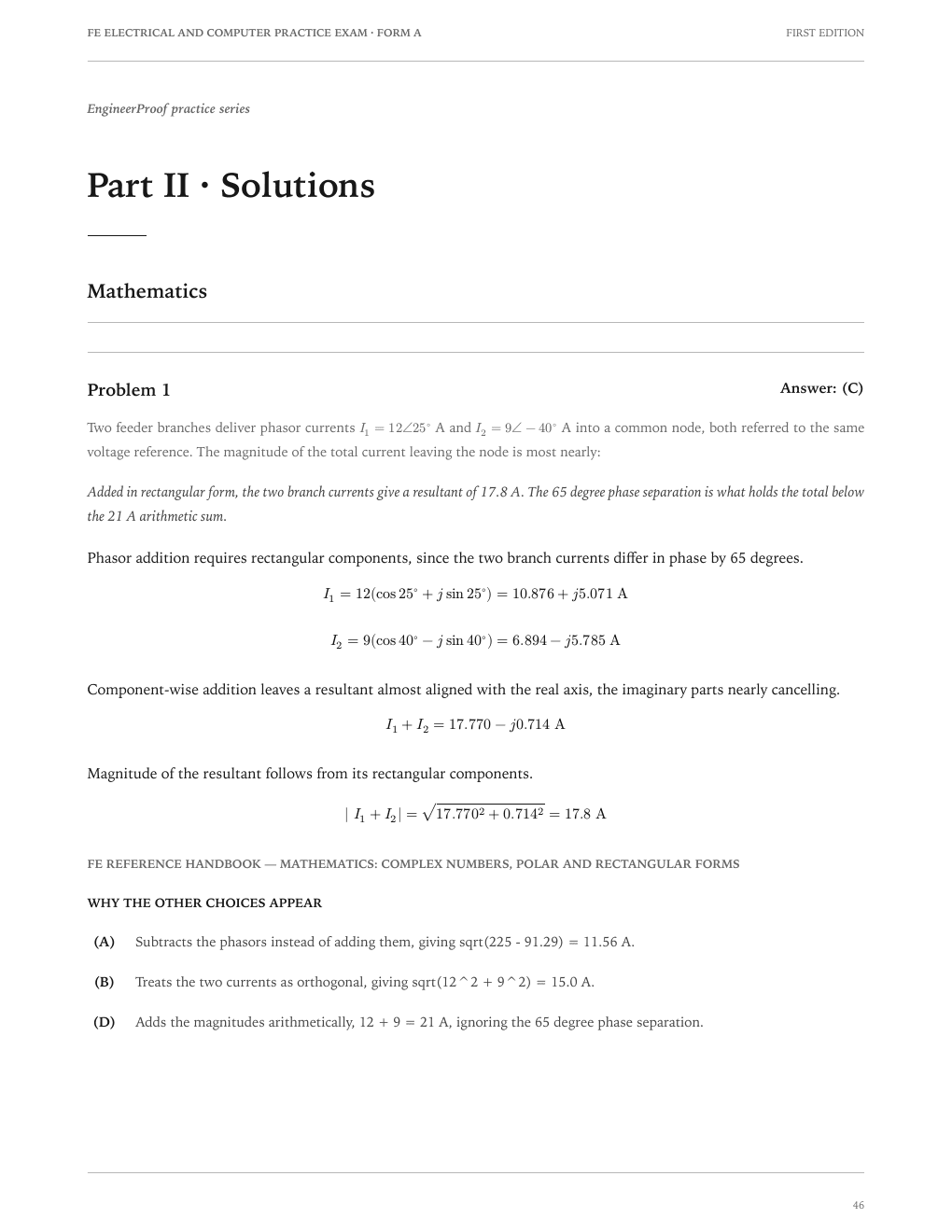
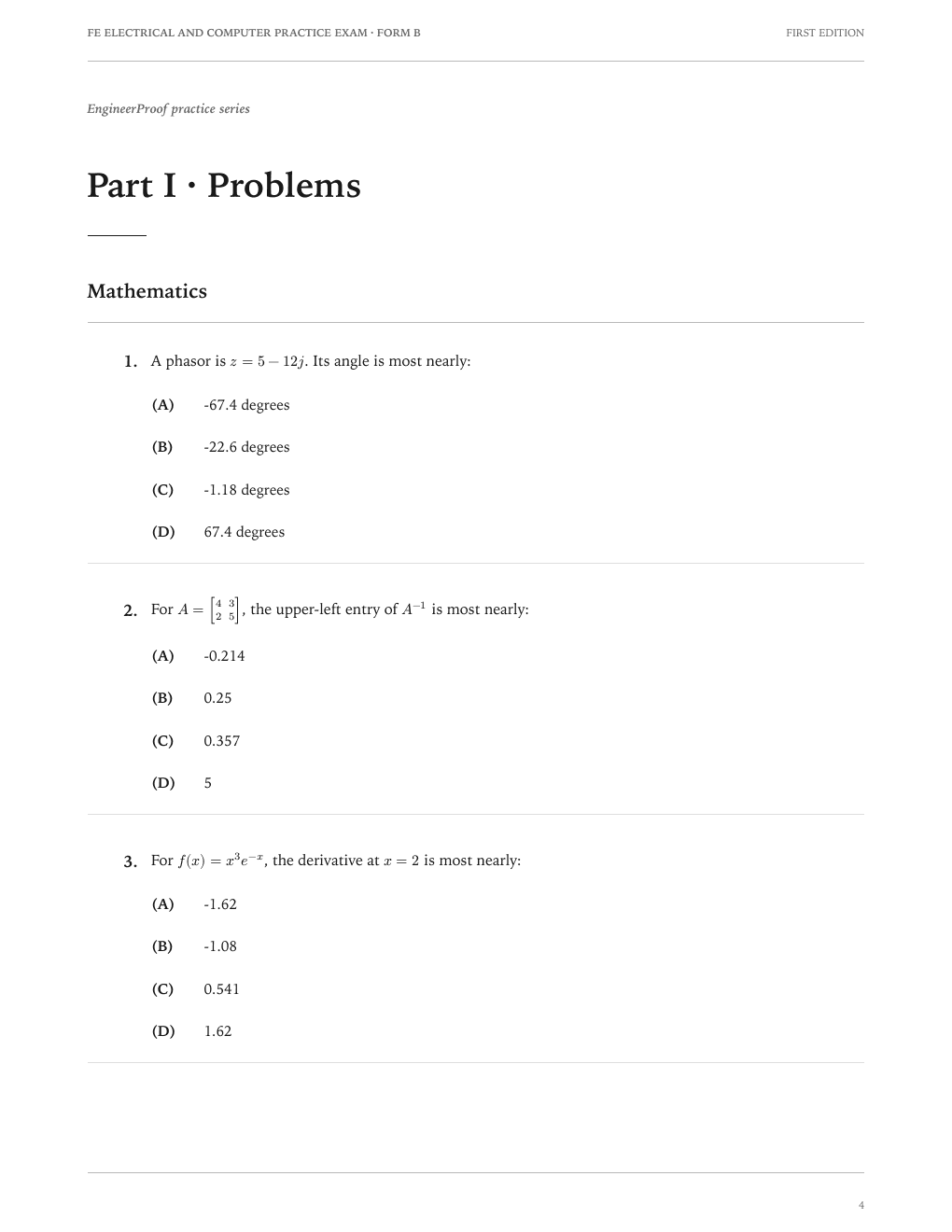
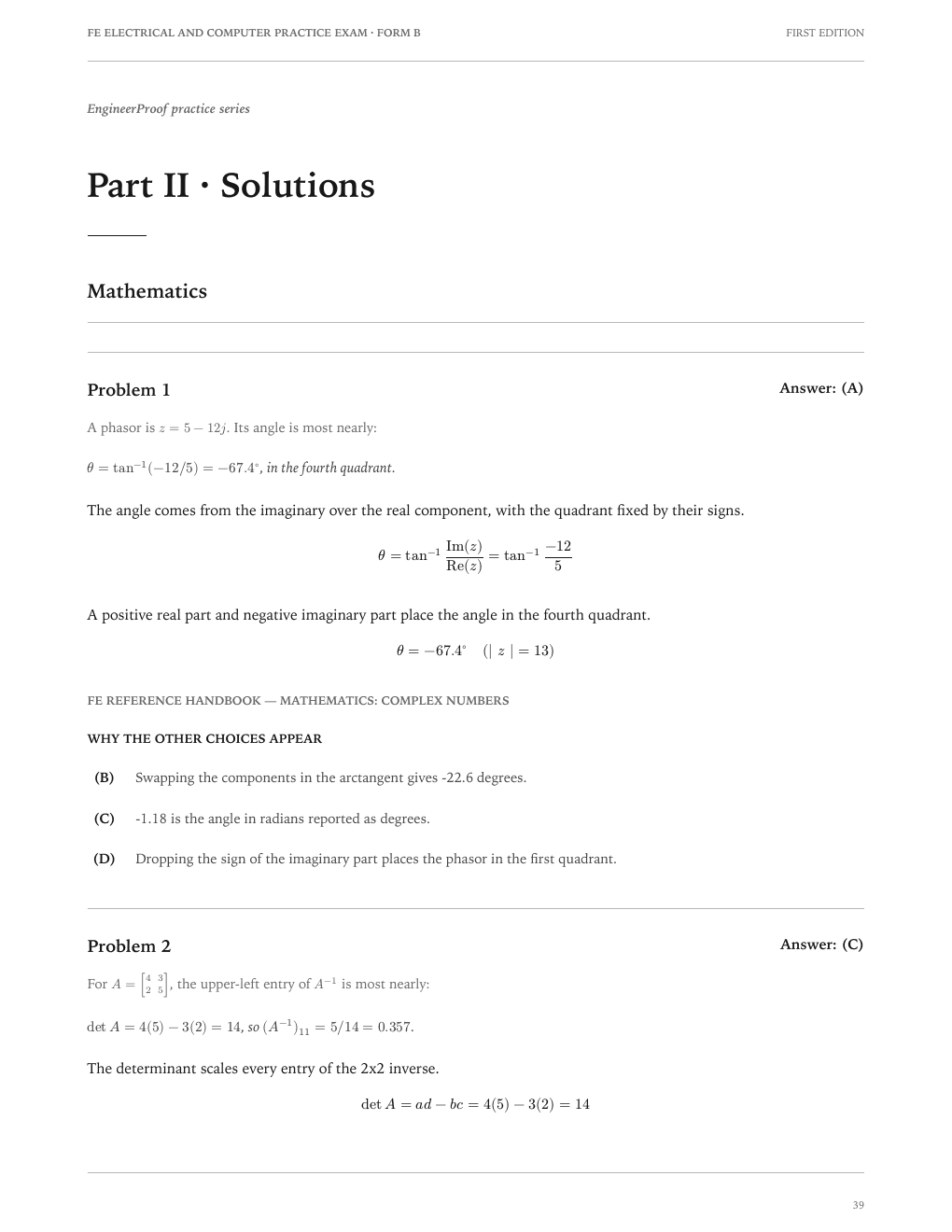
Direct renders from the current PDF releases, not illustrative mockups.
Form A
131 pages · Version 1.0.0

Form B
102 pages · Version 1.1.0

19 free FE Electrical and Computer practice problems with solutions
Work through all 17 knowledge areas. Each problem includes four choices, a complete solution, a handbook reference and an explanation of the wrong answers. No account or email is required.
The free sample PDF contains 17 Form A samples, one per area. The additional questions below are independent of the paid forms and are also in the free printable supplement.
Mathematics
1 free problem · Form A: 12 of 110 questions · NCEES range: 11-17
Two feeder branches deliver phasor currents A and A into a common node, both referred to the same voltage reference. The magnitude of the total current leaving the node is most nearly:
- (A)11.6 A
- (B)15.0 A
- (C)17.8 A
- (D)21.0 A
Show worked solution
Answer: (C)
Added in rectangular form, the two branch currents give a resultant of 17.8 A. The 65 degree phase separation is what holds the total below the 21 A arithmetic sum.
Phasor addition requires rectangular components, since the two branch currents differ in phase by 65 degrees.
Component-wise addition leaves a resultant almost aligned with the real axis, the imaginary parts nearly cancelling.
Magnitude of the resultant follows from its rectangular components.
FE Reference Handbook — Mathematics: Complex Numbers, Polar and Rectangular Forms
Why the other choices appear
- (A)Subtracts the phasors instead of adding them, giving sqrt(225 - 91.29) = 11.56 A.
- (B)Treats the two currents as orthogonal, giving sqrt(12² + 9²) = 15.0 A.
- (D)Adds the magnitudes arithmetically, 12 + 9 = 21 A, ignoring the 65 degree phase separation.
The complete practice exam contains 12 mathematics problems in Form A and 12 in Form B, with full solutions and a knowledge-area score sheet.
Compare Form A and Form B and buy a PDF · USD 29 eachAll knowledge areasProbability and Statistics
1 free problem · Form A: 5 of 110 questions · NCEES range: 4-6
A relay assembly line receives 65 percent of its relays from supplier X and 35 percent from supplier Y. Relays from supplier X are defective at a rate of 2.0 percent, and relays from supplier Y are defective at a rate of 5.0 percent. A relay drawn at random from stock fails incoming inspection. The probability that the failed relay came from supplier X is most nearly:
- (A)0.286
- (B)0.426
- (C)0.574
- (D)0.714
Show worked solution
Answer: (B)
Weighting each supplier's defect rate by its share leaves supplier X responsible for 0.0130 of the 0.0305 total defect probability, about 43 percent of all defective relays.
Supplier share and supplier-specific defect rate combine into the unconditional defect probability that serves as the denominator of the reverse conditional.
Bayes' theorem rescales the single branch belonging to supplier X against that total.
FE Reference Handbook — Engineering Probability and Statistics: Bayes' Theorem
Why the other choices appear
- (A)0.286 comes from normalizing the two defect rates alone, 0.020/(0.020+0.050), discarding the 65/35 supply shares.
- (C)0.574 is 0.0175/0.0305, the posterior probability for supplier Y, obtained by inverting the wrong branch.
- (D)0.714 is 0.050/(0.020+0.050), combining both errors: unweighted defect rates and the wrong supplier.
The complete practice exam contains 5 probability and statistics problems in Form A and 5 in Form B, with full solutions and a knowledge-area score sheet.
Compare Form A and Form B and buy a PDF · USD 29 eachAll knowledge areasEthics and Professional Practice
1 free problem · Form A: 4 of 110 questions · NCEES range: 4-6
A consulting firm holds concurrent-use seats of a circuit simulation package under an agreement permitting no more than the licensed number of simultaneous users. Usage logs for the past quarter show an average of simultaneous users and a peak of . Additional seats are sold at USD 1,450 per seat per year. The additional annual license cost required to bring the firm into compliance is most nearly:
- (A)USD 2,900 per year
- (B)USD 8,700 per year
- (C)USD 11,600 per year
- (D)USD 20,300 per year
Show worked solution
Answer: (C)
A concurrent-use cap is satisfied only at the logged peak of 14 users, so the firm buys the 8-seat shortfall for an added USD 11,600 each year.
Concurrent-use terms cap simultaneous users at the number of seats held, so the entitlement must cover the logged peak; sizing to the average of 8 leaves the firm in breach on every occasion demand climbs above the seat count.
The seats already licensed remain in force, so only the deficit between the required count and the existing entitlement is purchased.
The per-seat charge is a recurring subscription rate, which makes the compliance cost an ongoing yearly commitment rather than a one-time purchase.
FE Reference Handbook — Ethics and Professional Practice: NCEES Model Rules, Rules of Professional Conduct (licensee's obligation to employer and client; intellectual property and software license compliance)
Why the other choices appear
- (A)Sizes the purchase to the average of 8 simultaneous users, 8 - 6 = 2 seats at 1,450, giving 2,900; an average does not satisfy a cap on simultaneous users.
- (B)Prices the 6 seats already held, 6(1,450) = 8,700, instead of the shortfall above them.
- (D)Licenses all 14 peak users from zero, 14(1,450) = 20,300, ignoring the entitlement already in force.
The complete practice exam contains 4 ethics and professional practice problems in Form A and 4 in Form B, with full solutions and a knowledge-area score sheet.
Compare Form A and Form B and buy a PDF · USD 29 eachAll knowledge areasEngineering Economics
1 free problem · Form A: 5 of 110 questions · NCEES range: 5-8
Two 750 kVA transformers are compared over a 15-year study period at an interest rate of 8% per year. Unit A costs USD 60,000 installed, requires USD 4,500 per year for operation and maintenance, and has a salvage value of USD 8,000 at the end of year 15. Unit B costs USD 45,000 installed, requires USD 6,800 per year, and has no salvage value. The present worth advantage of Unit A over Unit B is most nearly:
- (A)USD 4,700
- (B)USD 7,200
- (C)USD 12,700
- (D)USD 19,700
Show worked solution
Answer: (B)
Unit A costs USD 15,000 more to install, but its lower annual cost and its salvage credit leave it about USD 7,200 ahead in present worth.
Costs arriving on different schedules become comparable only when the first cost, the annual series, and the end-of-life salvage are all referred to time zero over the same 15-year horizon.
Unit A carries the heavier purchase price but recovers part of it at retirement while committing to the smaller maintenance stream.
Unit B earns no salvage credit, so its cost stream is purchase price plus the discounted maintenance alone.
Fifteen years of the USD 2,300 per year maintenance penalty on Unit B swamp its USD 15,000 lower first cost, leaving Unit A ahead by about USD 7,200.
FE Reference Handbook — Engineering Economics: Uniform Series Present Worth Factor and Present Worth Analysis
Why the other choices appear
- (A)Omits the salvage credit on Unit A: 103,204 - (60,000 + 38,518) = 4,686.
- (C)Deducts the USD 8,000 salvage at face value instead of its present worth: 103,204 - (98,518 - 8,000) = 12,686.
- (D)Capitalizes only the USD 2,300 per year maintenance difference and ignores both the first-cost difference and salvage: 2,300(8.5595) = 19,687.
The complete practice exam contains 5 engineering economics problems in Form A and 5 in Form B, with full solutions and a knowledge-area score sheet.
Compare Form A and Form B and buy a PDF · USD 29 eachAll knowledge areasProperties of Electrical Materials
1 free problem · Form A: 4 of 110 questions · NCEES range: 4-6
Silicon at 300 K is doped with donors at and acceptors at . The intrinsic carrier concentration of silicon at this temperature is . The equilibrium hole concentration is most nearly:
- (A)
- (B)
- (C)
- (D)
Show worked solution
Answer: (A)
Compensation leaves a net donor density of , and the mass-action law puts the equilibrium hole concentration at about .
Compensated material carries a majority density equal to the net dopant excess, since each acceptor consumes one donor electron.
Mass action then fixes the minority population, which in heavily doped silicon sits many orders below the intrinsic level.
FE Reference Handbook — Properties of Electrical Materials: Intrinsic and Extrinsic Carrier Concentration (Mass Action Law)
Why the other choices appear
- (B)Takes the acceptor concentration as the majority density: .
- (C)Adds the acceptor density to the donor density instead of subtracting: .
- (D)Ignores compensation and divides by the donor density alone: .
The complete practice exam contains 4 properties of electrical materials problems in Form A and 4 in Form B, with full solutions and a knowledge-area score sheet.
Compare Form A and Form B and buy a PDF · USD 29 eachAll knowledge areasCircuit Analysis (DC and AC Steady State)
3 free problems · Form A: 12 of 110 questions · NCEES range: 11-17
Read the dedicated circuit analysis (dc and ac steady state) practice set
A 120 V DC source is connected through a 10 Ω series resistor to a parallel section. One branch of that section is a single 60 Ω resistor; the other branch is a 12 Ω resistor in series with an 18 Ω resistor. The voltage across the 18 Ω resistor is most nearly:
- (A)21.6 V
- (B)24.0 V
- (C)32.0 V
- (D)48.0 V
Show worked solution
Answer: (D)
Only 80 V reaches the parallel section, and 48 V of that appears across the 18 Ω resistor.
Reduction starts at the far end, where the 12 Ω and 18 Ω resistors carry a common current and combine before the parallel step.
With 30 Ω of total loop resistance, the source drives 4 A, and the 10 Ω resistor absorbs part of the supply voltage before the parallel section.
Splitting that section voltage between the two series resistors of the composite branch leaves the larger share on the 18 Ω element.
FE Reference Handbook — Electrical and Computer Engineering: Resistors in Series and Parallel, Voltage and Current Division
Why the other choices appear
- (A)Treats the two branches as being in series (60 + 30 = 90 Ω, total 100 Ω, 1.2 A), giving (1.2)(18) = 21.6 V.
- (B)Inverts the current-division ratio, 4 A times 30/90 = 1.33 A, giving (1.33)(18) = 24.0 V.
- (C)Solves for the drop across the 12 Ω resistor of the same branch, (2.67)(12) = 32.0 V.
Two more free problem types
Try a different setup before reading the solution. These additional original questions are separate from the sold practice forms, so solving them does not reveal another question from a full practice form.
A loaded DC voltage divider
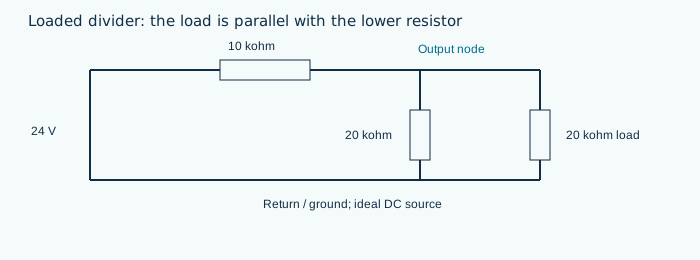
An ideal 24 V DC source feeds a 10-kilohm series resistor. From the output node to ground are a 20-kilohm divider resistor and a 20-kilohm load in parallel. What is the steady output voltage?
- (A)6 V
- (B)8 V
- (C)12 V
- (D)16 V
Show worked solution
Answer: (C)
The loaded output is 12 V; the load lowers it from the unloaded 16 V.
The load is in parallel with the lower divider resistor. Two equal 20-kilohm resistors have a 10-kilohm equivalent resistance.
The source therefore sees two equal 10-kilohm resistances in series.
The source current is 1.2 mA. At the node, each 20-kilohm branch carries 0.6 mA, which sums to the source current. The unloaded 16 V ignores the extra branch.
FE Reference Handbook: Electrical and Computer Engineering — series-parallel resistance, voltage division and Kirchhoff current law.
Why the other choices appear
- (A)This uses an incorrect equivalent resistance for the two parallel branches.
- (B)This gives three equal series resistors, although the lower resistors are parallel.
- (D)This is the unloaded divider voltage and neglects the load.
AC impedance: magnitude is not a scalar sum
An ideal 120 V rms sinusoidal source feeds a series circuit with resistance 30 ohms and net inductive reactance 40 ohms. What is the rms current magnitude?
- (A)1.71 A
- (B)2.40 A
- (C)3.00 A
- (D)4.00 A
Show worked solution
Answer: (B)
The rms current magnitude is 2.40 A. Current lags source voltage by about 53.13 degrees.
Resistance and reactance are perpendicular components of complex impedance, not two real resistances to add.
Divide the rms voltage magnitude by the impedance magnitude.
The resistor and reactance voltage magnitudes are 72 V and 96 V. Their vector magnitude sqrt(72 squared + 96 squared) is the stated 120 V. Rms quantities stay rms throughout.
FE Reference Handbook: Electrical and Computer Engineering — AC phasors, impedance and Ohm law.
Why the other choices appear
- (A)This divides by 30 + 40 and incorrectly treats complex impedance as a scalar sum.
- (C)This ignores resistance and divides only by reactance.
- (D)This ignores reactance and divides only by resistance.
Download all 14 additional questions, diagrams and complete solutions (free PDF). Download the editable practice review sheet (CSV).
Original questions and diagrams by EngineerProof, September 30, 2026. Personal study and unchanged redistribution with attribution are permitted. The questions are independent practice, not official NCEES material. Report a correction.
The complete practice exam contains 12 circuit analysis (dc and ac steady state) problems in Form A and 12 in Form B, with full solutions and a knowledge-area score sheet.
Compare Form A and Form B and buy a PDF · USD 29 eachAll knowledge areasLinear Systems
1 free problem · Form A: 6 of 110 questions · NCEES range: 5-8
A unity-feedback position servo has closed-loop transfer function , with in rad/s. For a step command, the percent overshoot of the output is most nearly:
- (A)9.5%
- (B)13.9%
- (C)37.2%
- (D)95.4%
Show worked solution
Answer: (C)
A damping ratio of 0.3 governs the peak entirely, giving roughly 37 percent overshoot regardless of the 20 rad/s natural frequency.
Matching the denominator against the standard second-order form fixes both parameters at once.
Overshoot of an underdamped step response is set by the damping ratio alone, since only rescales time.
With the exponent falls just below unity, leaving a peak more than one-third above the final value.
FE Reference Handbook — Control Systems: Second-Order Control-System Models, Percent Overshoot
Why the other choices appear
- (A)Setting instead of gives and .
- (B)Using the successive-peak exponent squares the correct factor: .
- (D)Taking rad/s directly from the constant term gives and .
The complete practice exam contains 6 linear systems problems in Form A and 6 in Form B, with full solutions and a knowledge-area score sheet.
Compare Form A and Form B and buy a PDF · USD 29 eachAll knowledge areasSignal Processing
1 free problem · Form A: 6 of 110 questions · NCEES range: 5-8
A causal discrete-time linear time-invariant system has the transfer function . The statement that correctly describes the region of convergence and the stability of this system is:
- (A)Region of convergence is ; the system is stable.
- (B)Region of convergence is ; the system is stable.
- (C)Region of convergence is ; the system is unstable.
- (D)Region of convergence is ; the system is unstable.
Show worked solution
Answer: (D)
Causality forces the region of convergence outside the outermost pole at 1.25, and that region excludes the unit circle, so the response grows without bound.
Causality admits only right-sided sequences, whose z-transforms converge in the exterior of a circle passing through the pole of largest magnitude.
Bounded-input bounded-output stability additionally demands that this exterior region contain the unit circle, which is impossible with a pole at radius 1.25.
FE Reference Handbook — Electrical and Computer Engineering: z-Transforms, Region of Convergence and Stability
Why the other choices appear
- (A)Using the innermost pole to bound the exterior region and then judging stability from that pole alone, ignoring the pole at 1.25.
- (B)Selecting the annular region, which belongs to the two-sided noncausal inverse transform; it is stable but contradicts the stated causality.
- (C)Reading the region as the interior of the smallest pole, the fully anticausal choice, which is inconsistent with a causal system.
The complete practice exam contains 6 signal processing problems in Form A and 6 in Form B, with full solutions and a knowledge-area score sheet.
Compare Form A and Form B and buy a PDF · USD 29 eachAll knowledge areasElectronics
1 free problem · Form A: 8 of 110 questions · NCEES range: 7-11
An 18 V unregulated supply feeds a 220 Ω series resistor followed by a 9.1 V Zener diode in shunt with the load. The Zener requires a minimum of 5.0 mA to remain in breakdown, and its breakdown characteristic may be treated as ideal. The maximum DC load current the regulator can deliver at rated output voltage is most nearly:
- (A)35.5 mA
- (B)40.5 mA
- (C)45.5 mA
- (D)81.8 mA
Show worked solution
Answer: (A)
Subtracting the 5.0 mA holding current from the 40.45 mA that the series resistor delivers leaves about 35.5 mA available to the load.
Series-resistor current is set entirely by the 18 V source and the clamped 9.1 V output, regardless of how that current later divides between diode and load.
Load current is whatever the Zener does not take, so the load is maximized at the instant the diode carries only its minimum breakdown current.
FE Reference Handbook — Electronics: Diodes, Zener Diode Model and Shunt Regulation
Why the other choices appear
- (B)Omits the 5.0 mA Zener holding current and assigns the entire 40.45 mA series current to the load.
- (C)Adds the 5.0 mA minimum diode current to the series current instead of subtracting it, 40.45 + 5.0 = 45.5 mA.
- (D)Places the full source voltage across the series resistor, ignoring the 9.1 V clamp, 18/220 = 81.8 mA.
The complete practice exam contains 8 electronics problems in Form A and 8 in Form B, with full solutions and a knowledge-area score sheet.
Compare Form A and Form B and buy a PDF · USD 29 eachAll knowledge areasPower Systems
1 free problem · Form A: 8 of 110 questions · NCEES range: 8-12
A run-of-river hydroelectric plant passes through its turbine at a net head of . The combined turbine-generator efficiency is , and the specific weight of water is . The electrical power delivered to the station bus is most nearly:
- (A)3,790 kW
- (B)4,460 kW
- (C)5,080 kW
- (D)5,980 kW
Show worked solution
Answer: (A)
The 3.29 million ft-lbf/s of hydraulic power, reduced by the combined turbine-generator efficiency and then converted to watts, puts about 3.8 MW on the bus.
Hydraulic power available at the runner is the weight flow rate carried through the net head.
Converting at per horsepower and charging the single combined efficiency against the shaft leaves the station output.
FE Reference Handbook — Fluid Mechanics: Pump Power Equation (hydraulic power, turbine form)
Why the other choices appear
- (B)Omitting the 0.85 efficiency and converting the gross 5979 hp gives (5979)(0.746) = 4460 kW.
- (C)Reporting the net shaft value 5082 hp as if the number were already kilowatts gives 5080.
- (D)Reporting the gross hydraulic value 5979 hp as if the number were already kilowatts gives 5980.
The complete practice exam contains 8 power systems problems in Form A and 8 in Form B, with full solutions and a knowledge-area score sheet.
Compare Form A and Form B and buy a PDF · USD 29 eachAll knowledge areasElectromagnetics
1 free problem · Form A: 5 of 110 questions · NCEES range: 4-6
A coaxial feeder 30 m long has an inner conductor of radius 1.2 mm and an outer conductor whose inner radius is 6.0 mm. The intervening space is filled with polyethylene of relative permittivity 2.25. The capacitance of the feeder is most nearly:
- (A)77.8 pF
- (B)1040 pF
- (C)1630 pF
- (D)2330 pF
Show worked solution
Answer: (D)
The 30 m run comes to about 2330 pF, set by the logarithm of the conductor radius ratio and the polyethylene permittivity.
Charge on the inner conductor produces a purely radial field, and integrating that field from inner to outer radius yields the logarithmic potential difference behind the coaxial capacitance expression.
Only the ratio of the radii enters, so the millimetre units require no conversion.
Polyethylene multiplies the air-filled value by its relative permittivity, and the 30 m length scales it linearly.
FE Reference Handbook — Electrical and Computer Engineering: Capacitors and Inductors, Capacitance of a Coaxial Cable
Why the other choices appear
- (A)Stopping at the per-unit-length value of 77.8 pF/m and never multiplying by the 30 m run.
- (B)Omitting the relative permittivity of the polyethylene gives 2333/2.25 = 1037 pF.
- (C)Reading 1.2 mm as a diameter makes and , giving 1631 pF.
The complete practice exam contains 5 electromagnetics problems in Form A and 5 in Form B, with full solutions and a knowledge-area score sheet.
Compare Form A and Form B and buy a PDF · USD 29 eachAll knowledge areasControl Systems
1 free problem · Form A: 7 of 110 questions · NCEES range: 6-9
A unity-feedback antenna position loop uses a PI controller driving a plant . The command is a ramp of constant rate 3.0 rad/s. The steady-state tracking error is most nearly:
- (A)0.20 rad
- (B)0.33 rad
- (C)0.60 rad
- (D)1.50 rad
Show worked solution
Answer: (C)
Integral action raises the loop to type 1, so the 3.0 rad/s ramp is tracked with a constant lag of 0.60 rad rather than a growing one.
Integral action inserts a pole at the origin, making the loop type 1, for which a ramp command produces a finite error set by the velocity error constant.
Only the integral gain survives the limit, so the proportional term contributes nothing to .
Error scales with the commanded rate, so the ramp slope must be carried through rather than assumed unity.
FE Reference Handbook — Control Systems: Steady-State Error and Static Error Constants
Why the other choices appear
- (A)Using the unit-ramp result rad and ignoring the 3.0 rad/s command slope.
- (B)Applying the type-0 position-error form rad, which discards the integrator.
- (D)Building from the proportional gain, s, giving rad.
The complete practice exam contains 7 control systems problems in Form A and 7 in Form B, with full solutions and a knowledge-area score sheet.
Compare Form A and Form B and buy a PDF · USD 29 eachAll knowledge areasCommunications
1 free problem · Form A: 6 of 110 questions · NCEES range: 5-8
A conventional double-sideband, full-carrier amplitude-modulated transmitter delivers a total average power of 15 kW to its antenna while modulated by a single sinusoidal tone at a modulation index of 0.80. The average power contained in one sideband is most nearly:
- (A)1.82 kW
- (B)2.40 kW
- (C)3.64 kW
- (D)11.36 kW
Show worked solution
Answer: (A)
The carrier absorbs 11.4 kW of the 15 kW transmitted, and each of the two sidebands takes 1.82 kW of the remainder.
Total power in a tone-modulated full-carrier signal divides between an unmodulated carrier and two sidebands, so the carrier level is recovered from the total once the index is known.
Each sideband carries one quarter of the carrier power scaled by the square of the index, the pair together making up the modulation-dependent remainder.
Sideband power is thus only 12 percent of the transmitted total even at 80 percent modulation, the well-known power penalty of retaining the carrier.
FE Reference Handbook — Communication Theory and Concepts: Amplitude Modulation, Power in a Double-Sideband Full-Carrier Signal
Why the other choices appear
- (B)Using the total power in place of the carrier power in the sideband expression: 0.16 x 15 = 2.40 kW.
- (C)Reporting the combined power of both sidebands: 2 x 1.82 = 3.64 kW.
- (D)Reporting the carrier power, 15/1.32 = 11.36 kW, rather than a sideband.
The complete practice exam contains 6 communications problems in Form A and 6 in Form B, with full solutions and a knowledge-area score sheet.
Compare Form A and Form B and buy a PDF · USD 29 eachAll knowledge areasComputer Networks
1 free problem · Form A: 4 of 110 questions · NCEES range: 4-6
A campus network is allocated the address block 10.40.96.0/19. The block is divided into equal-size subnets, each of which must accommodate at least 500 host addresses, and the number of subnets is maximized. The number of usable host addresses in each resulting subnet is:
- (A)254 addresses
- (B)500 addresses
- (C)508 addresses
- (D)510 addresses
Show worked solution
Answer: (D)
Nine host bits form the smallest field that meets the 500-host requirement, and the resulting /23 subnet leaves 510 usable addresses once the network and broadcast values are reserved.
Two addresses in every IPv4 subnet are unusable, the all-zeros network identifier and the all-ones broadcast address, so the host field must exceed the required host count by that margin.
Eight host bits fall short at 254 usable addresses, so nine bits is the smallest qualifying field and it fixes the subnet prefix.
The /19 block supplies 13 host bits, four of which become the subnet field, so sixteen equal /23 subnets fit and each carries the same capacity.
FE Reference Handbook — Electrical and Computer Engineering: Computer Networks, IPv4 Addressing and Subnet Masks
Why the other choices appear
- (A)Uses eight host bits rather than nine, giving 2⁸ - 2 = 254 usable addresses, which fails the 500-host requirement.
- (B)Takes the stated requirement itself as the subnet capacity, omitting the rounding of the host field up to the next power of two.
- (C)Subtracts four reserved addresses from the 512-address block instead of the two (network and broadcast) that are actually unusable, giving 508.
The complete practice exam contains 4 computer networks problems in Form A and 4 in Form B, with full solutions and a knowledge-area score sheet.
Compare Form A and Form B and buy a PDF · USD 29 eachAll knowledge areasDigital Systems
1 free problem · Form A: 9 of 110 questions · NCEES range: 8-12
An 8-bit two's complement adder in a motor controller receives the operands and . The signed decimal value left in the 8-bit result register is:
- (A)-109
- (B)-108
- (C)-19
- (D)147
Show worked solution
Answer: (A)
Two positive operands whose true sum exceeds overflow the format, and the retained pattern reads as -109.
Both words carry a clear sign bit, so each represents a positive quantity, and their true sum climbs past the ceiling that eight-bit two's complement can hold.
Column-by-column addition propagates a carry into the sign column but produces no carry out of it, the defining signature of two's complement overflow, so the hardware discards nothing yet stores a pattern that no longer matches the arithmetic sum.
Read back under the same convention, the leading one carries weight while the remaining set bits contribute 19, so the register reports a negative quantity even though both inputs were positive.
FE Reference Handbook — Electrical and Computer Engineering: Number Systems and Codes, Two's Complement Representation ($N_{\text{signed}} = -b_{n-1}2^{n-1} + \sum_{i=0}^{n-2} b_i 2^i$)
Why the other choices appear
- (B)Treating 10010011 as one's complement inverts it to 01101100 = 108 for a reading of -108, one unit short in magnitude because the added one is omitted.
- (C)Treating 10010011 as sign-magnitude uses the sign bit plus the 7-bit field 0010011 = 19, giving -19.
- (D)Reporting the unsigned value 128 + 16 + 2 + 1 = 147 ignores the sign bit and assumes a register wide enough to avoid overflow.
The complete practice exam contains 9 digital systems problems in Form A and 9 in Form B, with full solutions and a knowledge-area score sheet.
Compare Form A and Form B and buy a PDF · USD 29 eachAll knowledge areasComputer Systems
1 free problem · Form A: 5 of 110 questions · NCEES range: 5-8
A processor uses a two-level cache hierarchy. The L1 cache has an access time of 1.0 ns and a miss rate of 6%. An L1 miss is serviced by an L2 cache with an access time of 9 ns and a local miss rate of 25%. An L2 miss is serviced by main memory in 80 ns. The average memory access time seen by the processor is most nearly:
- (A)2.74 ns
- (B)5.80 ns
- (C)6.34 ns
- (D)21.54 ns
Show worked solution
Answer: (A)
Because the 25% L2 miss rate applies only to the 6% of references that already missed in L1, the mean latency is about 2.74 ns.
Multilevel caches compose serially: every reference pays the L1 hit time, and only the fraction that misses reaches the next level.
Quoted for the L2 alone, the 25% miss rate is a local rate and therefore weights only the traffic that reaches L2.
Weighting that 29 ns penalty by the 6% of references that miss in L1 gives the latency averaged over the whole reference stream.
FE Reference Handbook — Computer Systems: Memory Hierarchy, Average Memory Access Time
Why the other choices appear
- (B)Bypassing L2 entirely and charging main memory for every L1 miss: 1.0 + 0.06(80) = 5.80 ns.
- (C)Adding the L2 and main-memory times as parallel penalties both weighted by the L1 miss rate: 1.0 + 0.06(9) + 0.06(80) = 6.34 ns.
- (D)Treating the 25% L2 miss rate as a global rate applied to all references: 1.0 + 0.06(9) + 0.25(80) = 21.54 ns.
The complete practice exam contains 5 computer systems problems in Form A and 5 in Form B, with full solutions and a knowledge-area score sheet.
Compare Form A and Form B and buy a PDF · USD 29 eachAll knowledge areasSoftware Engineering
1 free problem · Form A: 4 of 110 questions · NCEES range: 4-6
A batch record-sorting routine in a utility billing system uses a comparison sort whose running time grows as , where is the number of records. Sorting 100{,}000 records requires 0.42 s on the target processor. On the same processor, the time required to sort 800{,}000 records is most nearly:
- (A)3.36 s
- (B)3.97 s
- (C)26.9 s
- (D)31.7 s
Show worked solution
Answer: (B)
An eightfold increase in record count costs a factor of 9.44 in time, since the logarithmic factor grows too, and the sort runs about 3.97 s.
Runtime for a comparison sort is proportional to , so the unknown machine constant cancels when two problem sizes are compared as a ratio.
The record count rises by a factor of eight while the logarithmic factor rises only from to .
Scaling the measured 0.42 s by that factor gives the projected batch time.
FE Reference Handbook — Software Engineering: Algorithms, Algorithm Efficiency (Big-O Notation)
Why the other choices appear
- (A)Treats the growth as purely linear in , giving s and discarding the logarithmic factor.
- (C)Assumes quadratic growth , giving s.
- (D)Combines quadratic and logarithmic growth as , giving s.
The complete practice exam contains 4 software engineering problems in Form A and 4 in Form B, with full solutions and a knowledge-area score sheet.
Compare Form A and Form B and buy a PDF · USD 29 eachAll knowledge areasWhat each download contains
- Edition
- First edition
- Form A
- 131 pages · Version 1.0.0
- Form B
- 102 pages · Version 1.1.0
- Questions
- 110 original problems per form
- Coverage
- 17 knowledge areas
- Question type
- Four-choice, single-answer
- Format
- Print-ready PDF, US Letter
Built against the NCEES FE Electrical and Computer specifications effective July 2020, current as of July 2026. Official exam format and appointment facts are available from NCEES. This printable form does not reproduce the Pearson VUE interface or interactive alternative item types.
Knowledge-area coverage
| Knowledge area | Form A | NCEES range |
|---|---|---|
| Mathematics | 12 | 11-17 |
| Probability and Statistics | 5 | 4-6 |
| Ethics and Professional Practice | 4 | 4-6 |
| Engineering Economics | 5 | 5-8 |
| Properties of Electrical Materials | 4 | 4-6 |
| Circuit Analysis (DC and AC Steady State) | 12 | 11-17 |
| Linear Systems | 6 | 5-8 |
| Signal Processing | 6 | 5-8 |
| Electronics | 8 | 7-11 |
| Power Systems | 8 | 8-12 |
| Electromagnetics | 5 | 4-6 |
| Control Systems | 7 | 6-9 |
| Communications | 6 | 5-8 |
| Computer Networks | 4 | 4-6 |
| Digital Systems | 9 | 8-12 |
| Computer Systems | 5 | 5-8 |
| Software Engineering | 4 | 4-6 |
Verification and corrections
Original problems, checked by a second calculation route
Every answer is reproduced with an alternate formula, a limiting case, a dimensional check, or a direct recomputation before publication. Official examination questions are confidential and are not reproduced or paraphrased.
Confirmed errors are published as versioned corrections. Buyers can re-download the corrected release at no charge. Read the full editorial method.
For a repeat attempt
Close the weak areas before another USD 225 appointment
FE Electrical and Computer repeat examinees passed at 31% versus 64% for first-time examinees in the cited NCEES data. Use the form's score sheet beside your diagnostic report, then read the FE Electrical and Computer retake plan or compare FE pass rates by discipline.
Before you buy
Questions about the PDF
Is this an official NCEES practice exam?
EngineerProof is not affiliated with, endorsed by, or sponsored by NCEES. FE and NCEES are registered trademarks of the National Council of Examiners for Engineering and Surveying, used solely to identify the examination for which these study materials are relevant. All problems and solutions in this publication are original works.
Does it reproduce the computer-based test interface?
No. This is a printable four-choice PDF. It does not include the Pearson VUE interface or interactive alternative item types such as point-and-click and drag-and-drop.
How is the PDF delivered?
Stripe returns you to a private download page after payment. The same 90-day link is sent to the checkout email.
Can I print the exam?
Yes. One purchase includes a personal license to download and print the PDF for your own study.
What if the book is not right for me?
Email inshihub.com@gmail.com within 14 days for a full refund. No reason is required.
USD 29 each