Form A · First edition
FE Industrial and Systems Practice Problems: 13 Free Questions with Solutions
13 free worked problems across 13 knowledge areas, with handbook references and explanations of every wrong choice. 110 original four-choice problems mapped to the current FE Industrial and Systems knowledge areas, with complete worked solutions.
- Problems
- 110
- Free problems
- 13
- 101 pages
Choose a practice exam form
Form A is USD 29.
Practice Exam, Form A
USD29
- 110 original problems and complete worked solutions
- Answer key and knowledge-area score sheet
- 101-page immediate private PDF download
14-day full refund · 90-day download access
Free worked samples
$0
- One complete problem and solution from every knowledge area
- No account or email required
- Read online or print the free PDF with worked solutions
Secure checkout by Stripe. Full refund within 14 days under the refund policy. Download access lasts 90 days and corrected releases remain available to buyers.
This form concentrates 68 of 110 problems in economics, probability, modeling, production, facilities, quality, and systems engineering, while retaining explicit coverage of management, safety, ergonomics, work measurement, mathematics, and engineering science.
FE Industrial and Systems is one of the seven NCEES Fundamentals of Engineering (FE) exams. In most U.S. states, passing the FE exam with an accredited degree is the step to Engineer in Training (EIT) or Engineer Intern (EI) certification.
Pages from Form A
Direct renders from the current PDF releases, not illustrative mockups.
Form A
101 pages · Version 1.1.0
13 free FE Industrial and Systems practice problems with solutions
Work through all 13 knowledge areas. Each problem includes four choices, a complete solution, a handbook reference and an explanation of the wrong answers. No account or email is required.
The free sample PDF contains 13 Form A samples, one per area.
Mathematics
1 free problem · Form A: 7 of 110 questions · NCEES range: 6-9
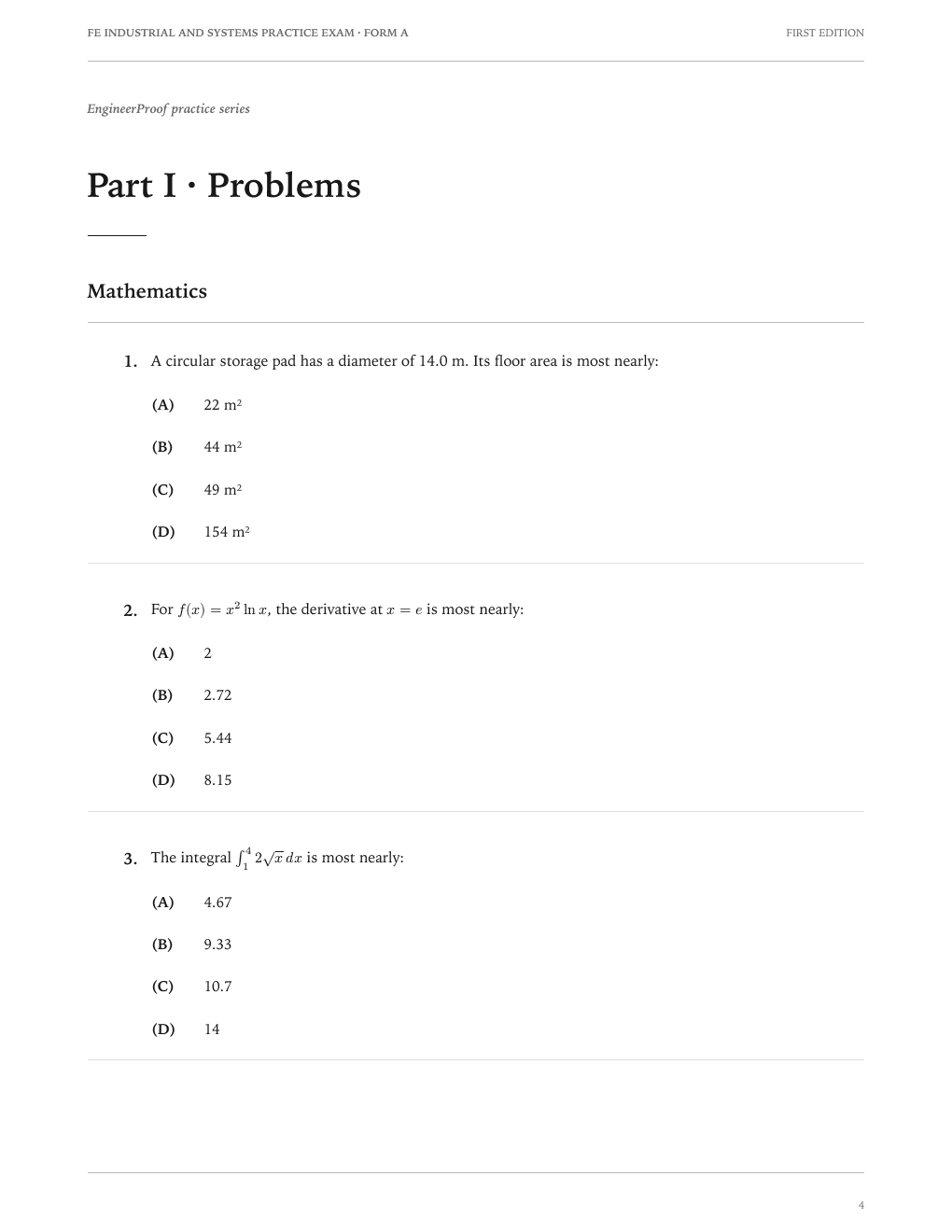
A circular storage pad has a diameter of 14.0 m. Its floor area is most nearly:
- (A)22 m²
- (B)44 m²
- (C)49 m²
- (D)154 m²
Show worked solution
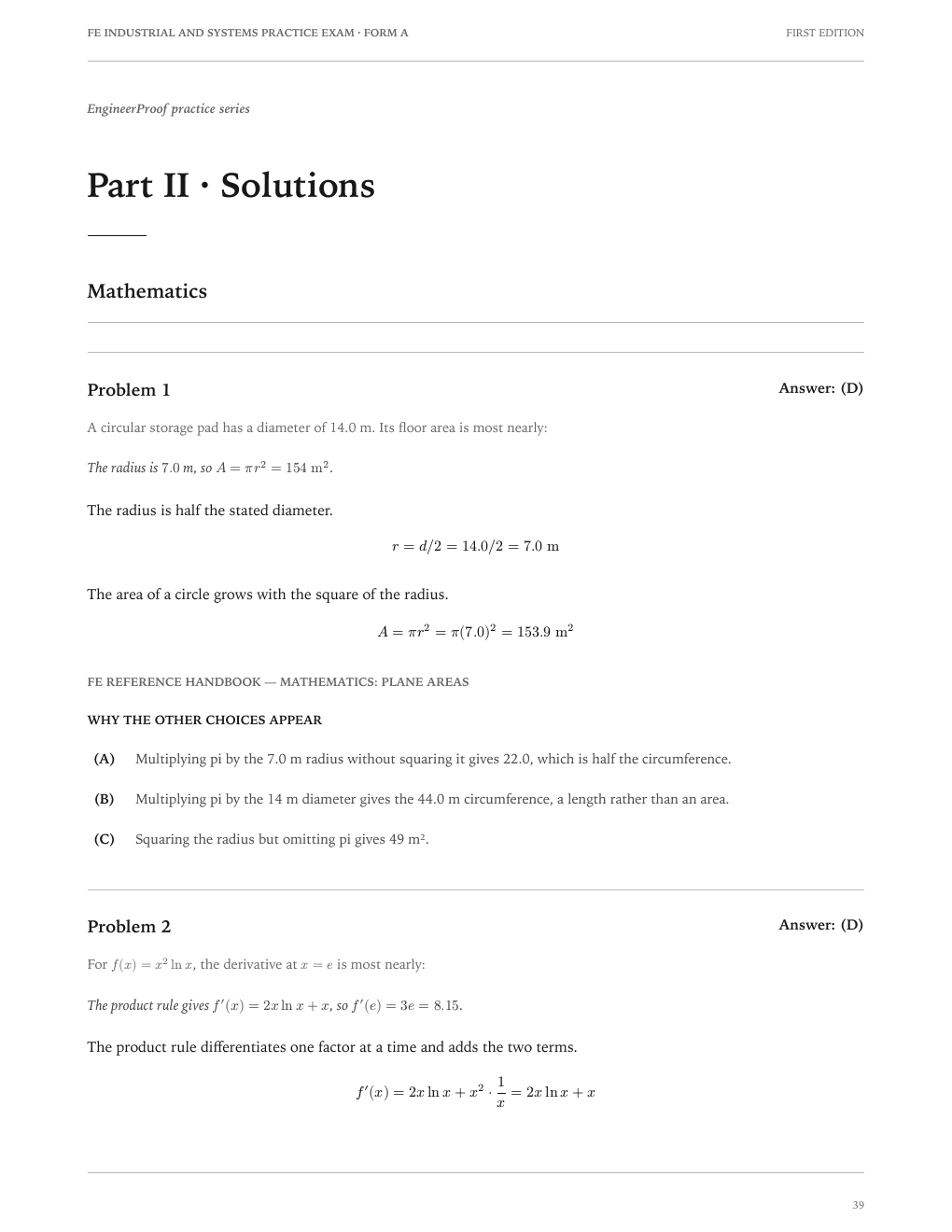
Answer: (D)
The radius is m, so .
The radius is half the stated diameter.
The area of a circle grows with the square of the radius.
FE Reference Handbook — Mathematics: Plane Areas
Why the other choices appear
- (A)Multiplying pi by the 7.0 m radius without squaring it gives 22.0, which is half the circumference.
- (B)Multiplying pi by the 14 m diameter gives the 44.0 m circumference, a length rather than an area.
- (C)Squaring the radius but omitting pi gives 49 m².
The complete practice exam contains 7 mathematics problems in Form A, with full solutions and a knowledge-area score sheet.
Compare Form A and buy a PDF · USD 29All knowledge areasEngineering Sciences
1 free problem · Form A: 5 of 110 questions · NCEES range: 4-6
A 60 kg cart is pushed along a level floor against a constant 25 N rolling resistance and accelerates at 1.5 m/s². The applied horizontal force is most nearly:
- (A)65 N
- (B)90 N
- (C)115 N
- (D)614 N
Show worked solution
Answer: (C)
Newton's second law gives , so N.
The push must supply the inertial force and the opposing rolling resistance.
Solving for the push adds the resistance to the inertial term.
FE Reference Handbook — Dynamics: Newton's Second Law
Why the other choices appear
- (A)Subtracting the resistance treats it as helping the push; it acts against the motion.
- (B)The product ma = 90 N is the net force; the push must also overcome the 25 N resistance.
- (D)Adding the 589 N weight instead of ma confuses the vertical floor reaction with the horizontal force that accelerates the cart.
The complete practice exam contains 5 engineering sciences problems in Form A, with full solutions and a knowledge-area score sheet.
Compare Form A and buy a PDF · USD 29All knowledge areasEthics and Professional Practice
1 free problem · Form A: 4 of 110 questions · NCEES range: 4-6
A line-balancing recommendation would increase output but disables a required machine guard. The engineer should:
- (A)Approve it for experienced operators only
- (B)Reject the unguarded configuration and escalate a compliant alternative
- (C)Hide the change in a trial run
- (D)Let production targets decide
Show worked solution
Answer: (B)
Public and worker safety takes precedence over the throughput gain.
The guard is an explicit hazard control, so disabling it creates foreseeable exposure.
A compliant redesign can be evaluated against the same production target without accepting the hazard.
FE Reference Handbook — Ethics: Safety, Health, and Welfare
Why the other choices appear
- (A)Experience does not remove the known guarding hazard.
- (C)Concealment prevents safety review and exposes workers.
- (D)Output goals cannot override protection of worker safety.
The complete practice exam contains 4 ethics and professional practice problems in Form A, with full solutions and a knowledge-area score sheet.
Compare Form A and buy a PDF · USD 29All knowledge areasEngineering Economics
1 free problem · Form A: 10 of 110 questions · NCEES range: 9-14
A project receives 25,000 USD at each year-end for four years. At 6% interest, present worth is most nearly:
- (A)86,628 USD
- (B)91,825 USD
- (C)100,000 USD
- (D)109,365 USD
Show worked solution
Answer: (A)
The uniform-series factor gives USD.
Four equal year-end receipts form a uniform series, so the P/A factor converts them to time zero.
Multiplying the annual receipt by the factor gives the present worth.
FE Reference Handbook — Engineering Economics: Present Worth
Why the other choices appear
- (B)Multiplying by an extra 1.06 treats the receipts as beginning-of-year payments.
- (C)Adding the four receipts ignores the time value of money.
- (D)The F/A factor gives the future worth at year 4, 109,365 USD, not the present worth.
The complete practice exam contains 10 engineering economics problems in Form A, with full solutions and a knowledge-area score sheet.
Compare Form A and buy a PDF · USD 29All knowledge areasProbability and Statistics
1 free problem · Form A: 11 of 110 questions · NCEES range: 10-15
An auditor selects 3 of 9 distinct jobs, and the order of selection does not matter. The number of possible audit sets is most nearly:
- (A)84 sets
- (B)165 sets
- (C)504 sets
- (D)60,480 sets
Show worked solution
Answer: (A)
The combination count is .
Order does not matter in an audit set, so the count is a combination of 9 jobs taken 3 at a time.
The 6! terms cancel, leaving three factors over 3!.
FE Reference Handbook — Probability: Combinations
Why the other choices appear
- (B)C(11,3) = 165 counts selections with repetition, which would let one job be chosen more than once.
- (C)9(8)(7) = 504 counts ordered selections, so each audit set is counted six times.
- (D)Dividing 9! by 3! alone omits the 6! for the jobs left out, giving 60,480.
The complete practice exam contains 11 probability and statistics problems in Form A, with full solutions and a knowledge-area score sheet.
Compare Form A and buy a PDF · USD 29All knowledge areasModeling and Quantitative Analysis
1 free problem · Form A: 10 of 110 questions · NCEES range: 9-14
A linear program maximizes subject to , , , and . The optimal objective value is most nearly:
- (A)24
- (B)25
- (C)34
- (D)37
Show worked solution
Answer: (D)
The optimum is the corner , where .
The corners of the feasible region come from intersecting the constraints.
Evaluating the objective at each corner identifies the maximum.
FE Reference Handbook — Industrial and Systems Engineering: Linear Programming
Why the other choices appear
- (A)Corner (0, 6) uses only y and gives 24; the objective rewards x more per unit.
- (B)Corner (5, 0) stops at the x bound and leaves 3 units of x + y <= 8 unused, giving 25.
- (C)Corner (2, 6), where y reaches its bound, gives 34; moving along x + y = 8 toward (5, 3) still raises Z.
The complete practice exam contains 10 modeling and quantitative analysis problems in Form A, with full solutions and a knowledge-area score sheet.
Compare Form A and buy a PDF · USD 29All knowledge areasEngineering Management
1 free problem · Form A: 8 of 110 questions · NCEES range: 8-12
A project has planned value 120,000 USD, earned value 102,000 USD, and actual cost 110,000 USD. The schedule performance index is most nearly:
- (A)-0.15
- (B)0.85
- (C)0.93
- (D)1.18
Show worked solution
Answer: (B)
.
Schedule performance compares the value of work completed with the value of work planned to date.
An index below 1 means less work was earned than planned.
FE Reference Handbook — Engineering Management: Earned Value
Why the other choices appear
- (A)(EV - PV)/PV = -0.15 is the schedule variance as a fraction of planned value, not the index.
- (C)EV/AC = 0.93 is the cost performance index; schedule performance uses planned value.
- (D)Inverting the ratio gives 1.18 and would wrongly show the work ahead of schedule.
The complete practice exam contains 8 engineering management problems in Form A, with full solutions and a knowledge-area score sheet.
Compare Form A and buy a PDF · USD 29All knowledge areasManufacturing, Service, and Other Production Systems
1 free problem · Form A: 10 of 110 questions · NCEES range: 9-14
A line holds an average of 90 units of work in process and completes 420 good units in a 7.0 h shift. The average flow time through the line is most nearly:
- (A)0.667 h
- (B)1.5 h
- (C)4.67 h
- (D)7 h
Show worked solution
Answer: (B)
Throughput is units/h, so Little's law gives h.
Throughput is the completion rate over the shift.
Little's law relates average work in process, throughput, and flow time.
FE Reference Handbook — Industrial and Systems Engineering: Little's Law
Why the other choices appear
- (A)Dividing throughput by work in process inverts Little's law and gives 0.667 h.
- (C)420/90 = 4.67 is the number of times the work in process turns over in a shift, not a time in hours.
- (D)Taking the 7.0 h shift as flow time assumes every unit spends the whole shift on the line.
The complete practice exam contains 10 manufacturing, service, and other production systems problems in Form A, with full solutions and a knowledge-area score sheet.
Compare Form A and buy a PDF · USD 29All knowledge areasFacilities and Supply Chain
1 free problem · Form A: 9 of 110 questions · NCEES range: 9-14
Department A sends 30 loads/day to Department B, which is 18 m east and 12 m north of A. Material moves along rectilinear aisles. The daily load-distance is most nearly:
- (A)450 load-m/day
- (B)540 load-m/day
- (C)649 load-m/day
- (D)900 load-m/day
Show worked solution
Answer: (D)
The rectilinear distance is m, so load-m/day.
Rectilinear aisles force travel along both coordinate directions.
Load-distance multiplies the flow by the travel distance.
FE Reference Handbook — Industrial and Systems Engineering: Facility Layout
Why the other choices appear
- (A)Averaging the two legs halves the travel distance.
- (B)Counting only the 18 m east leg omits the 12 m north travel.
- (C)The straight-line distance of 21.6 m ignores that loads must follow rectilinear aisles.
The complete practice exam contains 9 facilities and supply chain problems in Form A, with full solutions and a knowledge-area score sheet.
Compare Form A and buy a PDF · USD 29All knowledge areasHuman Factors, Ergonomics, and Safety
1 free problem · Form A: 8 of 110 questions · NCEES range: 8-12
A worker holds a 160 N box with its center 0.35 m in front of the L5/S1 joint. The 350 N upper-body weight acts 0.20 m in front of the same joint. The total flexion moment about L5/S1 is most nearly:
- (A)56 N m
- (B)102 N m
- (C)126 N m
- (D)178 N m
Show worked solution
Answer: (C)
N m.
Each weight contributes its own moment about L5/S1: force times horizontal distance.
Both weights act in front of the joint, so their moments add.
FE Reference Handbook — Industrial and Systems Engineering: Biomechanics
Why the other choices appear
- (A)Counting only the box omits the 70 N m from the upper-body weight.
- (B)Placing both weights at the trunk's 0.20 m arm understates the box moment.
- (D)Placing both weights at the box's 0.35 m arm overstates the upper-body moment.
The complete practice exam contains 8 human factors, ergonomics, and safety problems in Form A, with full solutions and a knowledge-area score sheet.
Compare Form A and buy a PDF · USD 29All knowledge areasWork Design
1 free problem · Form A: 8 of 110 questions · NCEES range: 7-11
The observed cycle time is 4.8 min, the performance rating is 110%, and the allowance is 15% of normal time. The standard time is most nearly:
- (A)5.02 min
- (B)5.28 min
- (C)5.52 min
- (D)6.07 min
Show worked solution
Answer: (D)
min, and min.
The rating converts the observed pace to the pace of a qualified worker.
The allowance, stated as a share of normal time, is added to the normal time.
FE Reference Handbook — Industrial and Systems Engineering: Work Measurement
Why the other choices appear
- (A)Dividing by the 110% rating treats a faster-than-normal operator as slow.
- (B)Stopping at the 5.28 min normal time omits the 15% allowance.
- (C)Applying the allowance to observed time skips the rating adjustment.
The complete practice exam contains 8 work design problems in Form A, with full solutions and a knowledge-area score sheet.
Compare Form A and buy a PDF · USD 29All knowledge areasQuality
1 free problem · Form A: 10 of 110 questions · NCEES range: 9-14
A process has mean 51.2 and standard deviation 1.5. The specification limits are 44 and 56. Its is most nearly:
- (A)0.53
- (B)1.07
- (C)1.33
- (D)1.60
Show worked solution
Answer: (B)
The upper limit is nearer, so .
Cpk uses the specification limit nearer to the mean, measured in units of 3 sigma.
The upper margin is 4.8 and the lower margin is 7.2, so the upper side governs.
FE Reference Handbook — Quality: Process Capability
Why the other choices appear
- (A)Dividing the 4.8 margin by 6 sigma instead of 3 sigma halves the index.
- (C)(USL - LSL)/6 sigma = 1.33 is Cp; it ignores the 1.2 shift of the mean toward the upper limit.
- (D)The lower side gives 1.60, but Cpk uses the nearer limit, which is the upper one.
The complete practice exam contains 10 quality problems in Form A, with full solutions and a knowledge-area score sheet.
Compare Form A and buy a PDF · USD 29All knowledge areasSystems Engineering, Analysis, and Design
1 free problem · Form A: 10 of 110 questions · NCEES range: 8-12
A system has component A (reliability 0.98), a redundant pair of identical B units (0.95 each) in active parallel, and component C (0.99), with the three stages in series. System reliability is most nearly:
- (A)0.9678
- (B)0.9892
- (C)0.9975
- (D)1.0000
Show worked solution
Answer: (A)
The B pair has , so .
The redundant pair fails only if both B units fail.
The three stages are in series, so their reliabilities multiply.
FE Reference Handbook — Industrial and Systems Engineering: Reliability
Why the other choices appear
- (B)Averaging the three stage reliabilities does not combine stages that must all work.
- (C)0.9975 is the reliability of the redundant pair alone.
- (D)Treating all four units as one parallel group ignores that A and C are each single points of failure.
The complete practice exam contains 10 systems engineering, analysis, and design problems in Form A, with full solutions and a knowledge-area score sheet.
Compare Form A and buy a PDF · USD 29All knowledge areasWhat each download contains
- Edition
- First edition
- Form A
- 101 pages · Version 1.1.0
- Questions
- 110 original problems
- Coverage
- 13 knowledge areas
- Question type
- Four-choice, single-answer
- Format
- Print-ready PDF, US Letter
Built against the NCEES FE Industrial and Systems specifications effective July 2020, current as of August 2026. Official exam format and appointment facts are available from NCEES. This printable form does not reproduce the Pearson VUE interface or interactive alternative item types.
Knowledge-area coverage
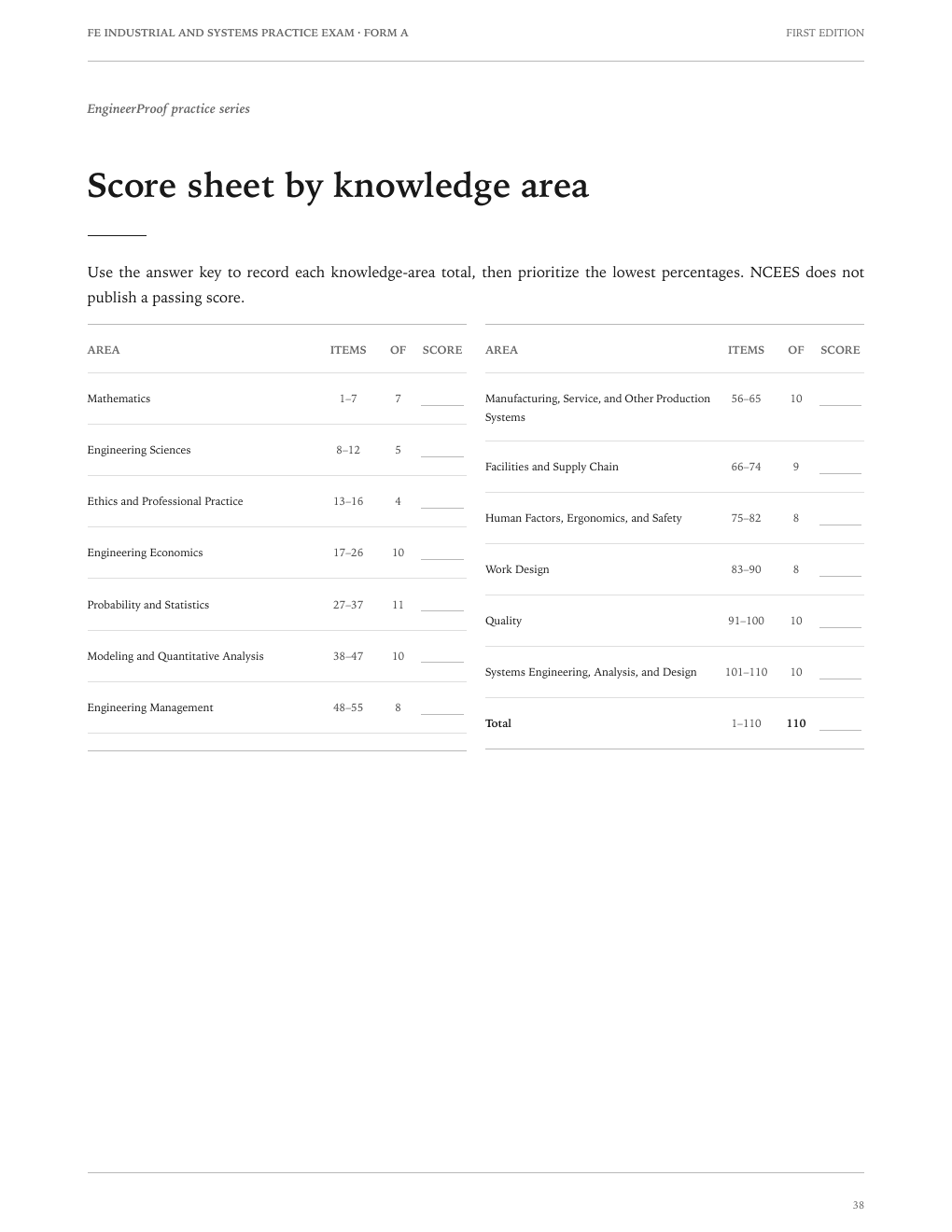
| Knowledge area | Form A | NCEES range |
|---|---|---|
| Mathematics | 7 | 6-9 |
| Engineering Sciences | 5 | 4-6 |
| Ethics and Professional Practice | 4 | 4-6 |
| Engineering Economics | 10 | 9-14 |
| Probability and Statistics | 11 | 10-15 |
| Modeling and Quantitative Analysis | 10 | 9-14 |
| Engineering Management | 8 | 8-12 |
| Manufacturing, Service, and Other Production Systems | 10 | 9-14 |
| Facilities and Supply Chain | 9 | 9-14 |
| Human Factors, Ergonomics, and Safety | 8 | 8-12 |
| Work Design | 8 | 7-11 |
| Quality | 10 | 9-14 |
| Systems Engineering, Analysis, and Design | 10 | 8-12 |
Verification and corrections
Original problems, checked by a second calculation route
Every answer is reproduced with an alternate formula, a limiting case, a dimensional check, or a direct recomputation before publication. Official examination questions are confidential and are not reproduced or paraphrased.
Confirmed errors are published as versioned corrections. Buyers can re-download the corrected release at no charge. Read the full editorial method.
For a repeat attempt
Close the weak areas before another USD 225 appointment
Use the form's score sheet beside your diagnostic report, then read the FE exam retake guide or compare FE pass rates by discipline.
Before you buy
Questions about the PDF
Is this an official NCEES practice exam?
EngineerProof is not affiliated with, endorsed by, or sponsored by NCEES. FE and NCEES are registered trademarks of the National Council of Examiners for Engineering and Surveying, used solely to identify the examination for which these study materials are relevant. All problems and solutions in this publication are original works.
Does it reproduce the computer-based test interface?
No. This is a printable four-choice PDF. It does not include the Pearson VUE interface or interactive alternative item types such as point-and-click and drag-and-drop.
How is the PDF delivered?
Stripe returns you to a private download page after payment. The same 90-day link is sent to the checkout email.
Can I print the exam?
Yes. One purchase includes a personal license to download and print the PDF for your own study.
What if the book is not right for me?
Email inshihub.com@gmail.com within 14 days for a full refund. No reason is required.
101 pages · Version 1.1.0