Forms A–B · First edition
FE Environmental Practice Problems: 17 Free Questions with Solutions
17 free worked problems across 15 knowledge areas, with handbook references and explanations of every wrong choice. Start with 15 free worked problems, then choose one of two separate 110-question PDF forms covering all 15 FE Environmental knowledge areas.
- Problems
- 110 per form
- Free problems
- 17
- Forms
- 2
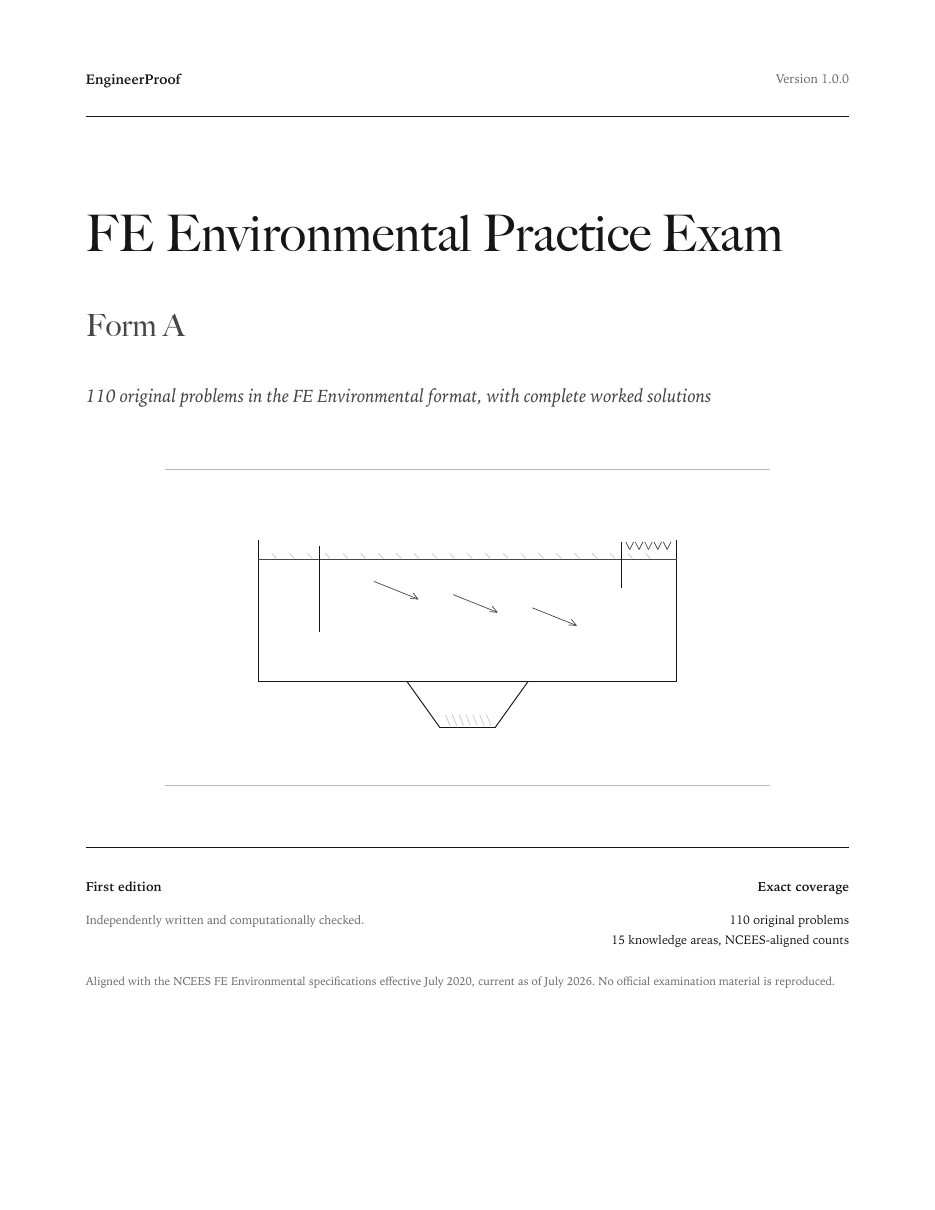
Choose a practice exam form
Forms are sold separately for USD 29 each.
Practice Exam, Form A
USD29
- 110 original problems and complete worked solutions
- Answer key and knowledge-area score sheet
- 131-page immediate private PDF download
14-day full refund · 90-day download access
Practice Exam, Form B
USD29
- 110 original problems and complete worked solutions
- Answer key and knowledge-area score sheet
- 104-page immediate private PDF download
14-day full refund · 90-day download access
Free worked samples
$0
- One complete problem and solution from every knowledge area
- No account or email required
- Read online or print the free PDF with worked solutions
Secure checkout by Stripe. Full refund within 14 days under the refund policy. Download access lasts 90 days and corrected releases remain available to buyers.
Water and wastewater, hydraulics, surface water hydrology, and groundwater account for 46 of the 110 problems here, and no area outside water reaches ten problems.
FE Environmental is one of the seven NCEES Fundamentals of Engineering (FE) exams. In most U.S. states, passing the FE exam with an accredited degree is the step to Engineer in Training (EIT) or Engineer Intern (EI) certification.
FE Environmental practice plan
Move from a 15-area diagnosis to a 110-question rehearsal
The current NCEES FE Environmental specification, effective July 2020, has 15 knowledge areas. Form A and Form B each contain 110 original four-choice problems with complete solutions. In both forms, fluid mechanics and hydraulics, surface water and hydrology, groundwater, and water and wastewater account for 46 of the 110 questions; the other 11 areas still appear and should not be skipped.
- Diagnose for free: Solve the 15 free worked problems, one from every knowledge area, with the electronic handbook and an approved calculator. The printable 20-page sample includes the same no-account starting point.
- Repair by system: Start with the weakest result, then connect the water sequence from hydraulics through hydrology and groundwater to treatment. Retest air, waste, risk, chemistry, energy, and the general engineering areas separately so the four larger water areas do not hide a smaller-area gap.
- Rehearse: Choose Form A or Form B at USD 29 each and take its 110 unfamiliar questions under the FE answering budget. Form A is 131 pages and Form B is 104 pages; keep the other form unseen for a later check.
What each resource is for
- Official scope
- NCEES FE exam information and specifications
- Handbook and official exam prep
- MyNCEES exam-prep resources
- Calculator check
- Allowed models, rules, and calculation drills
This plan is a way to organize the resources on this page. It is not an official NCEES schedule, required study time, or pass prediction.
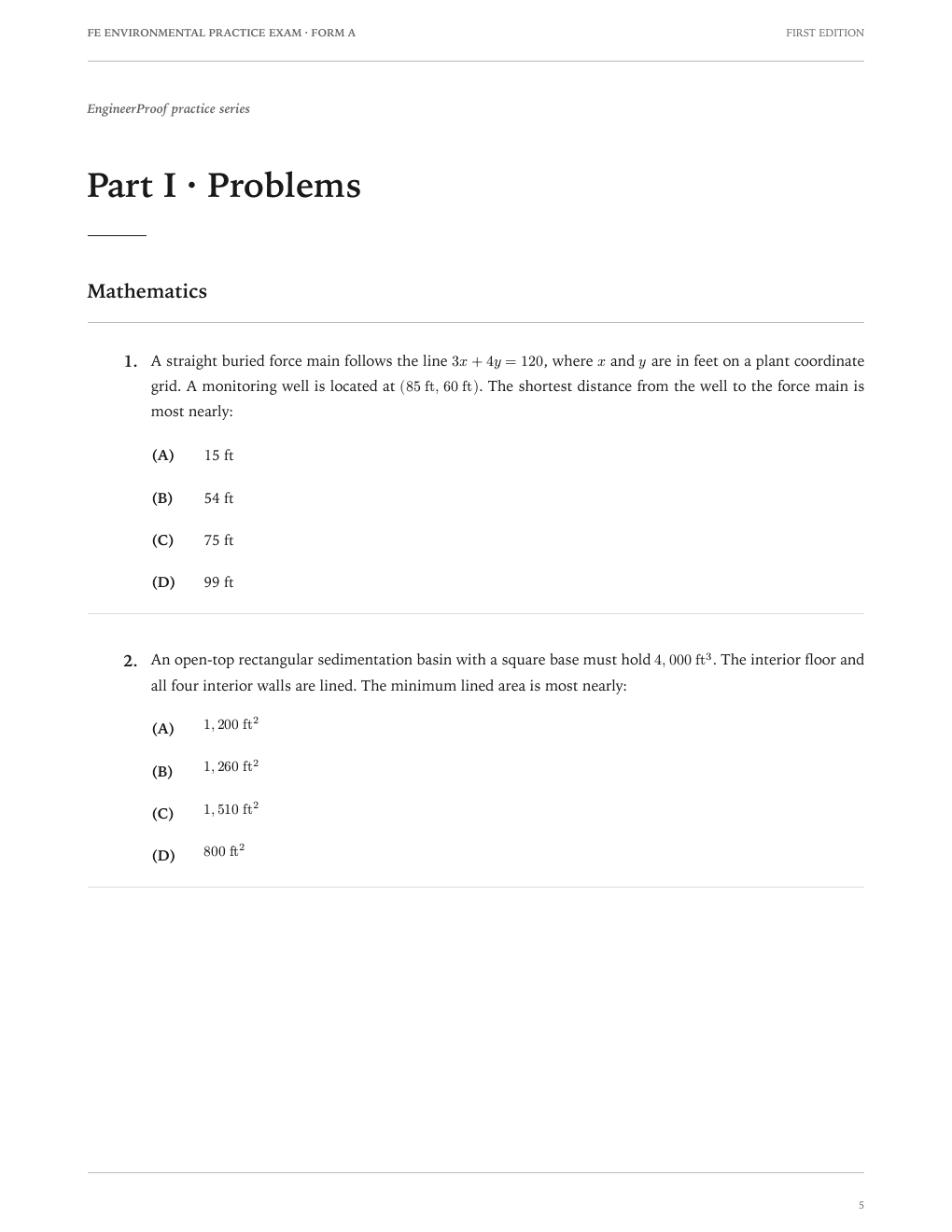
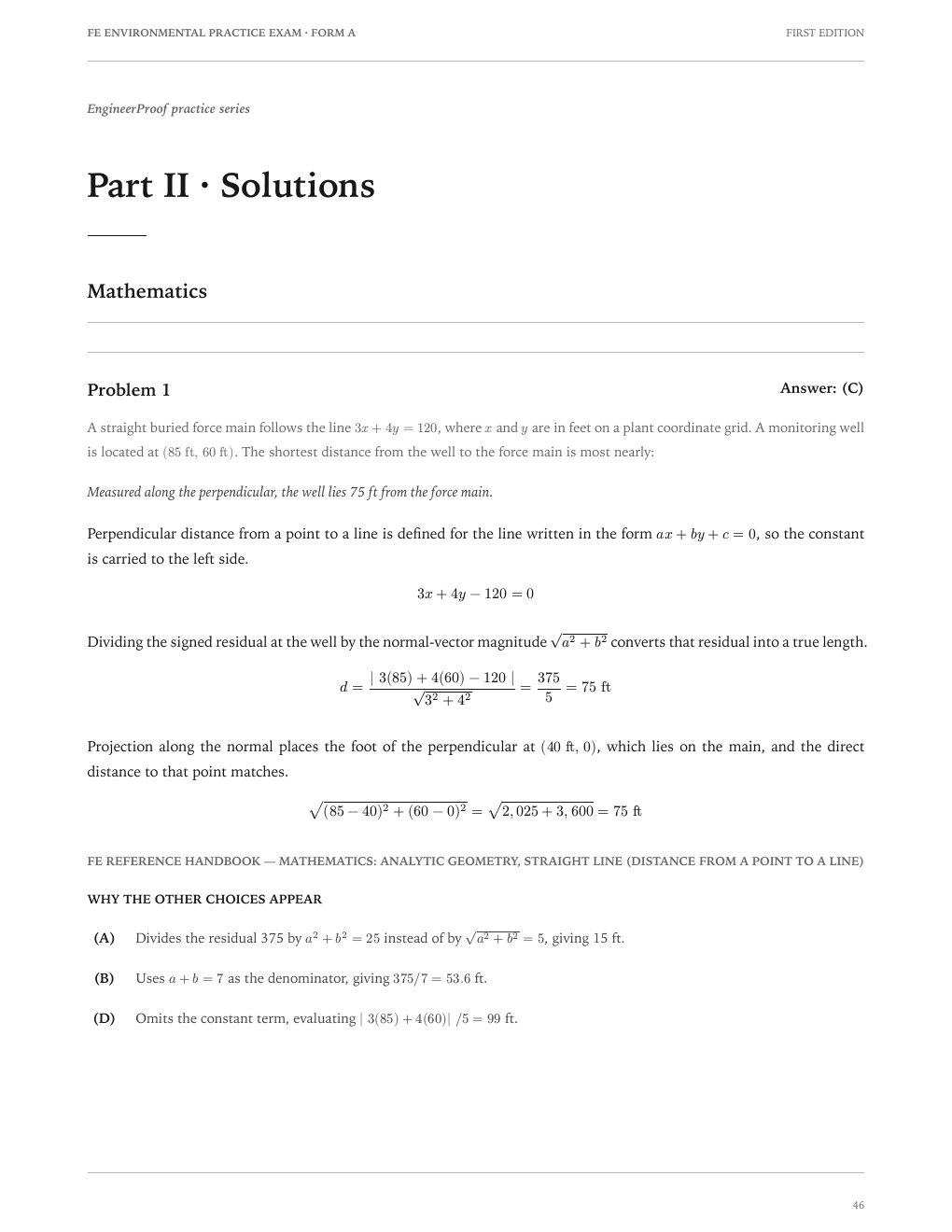
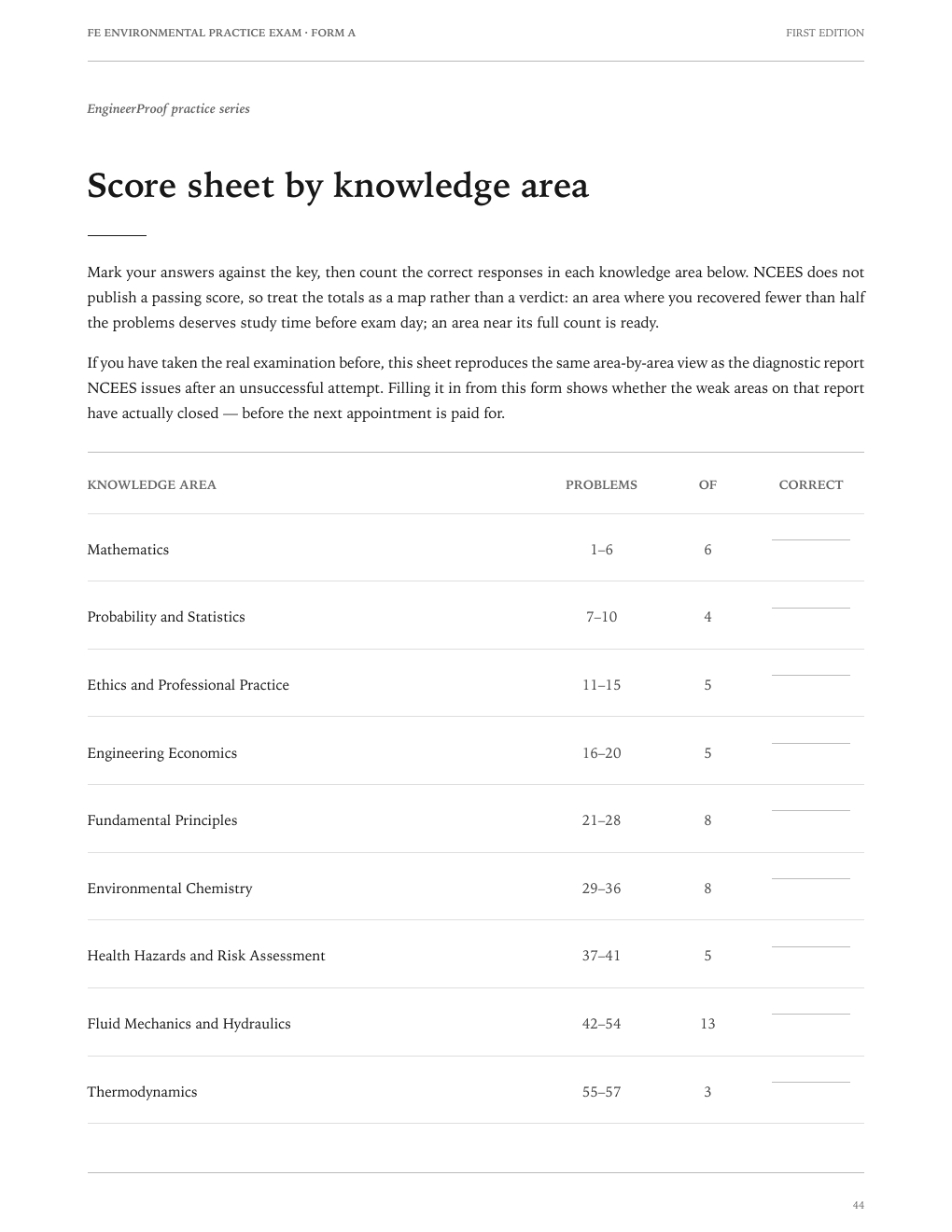
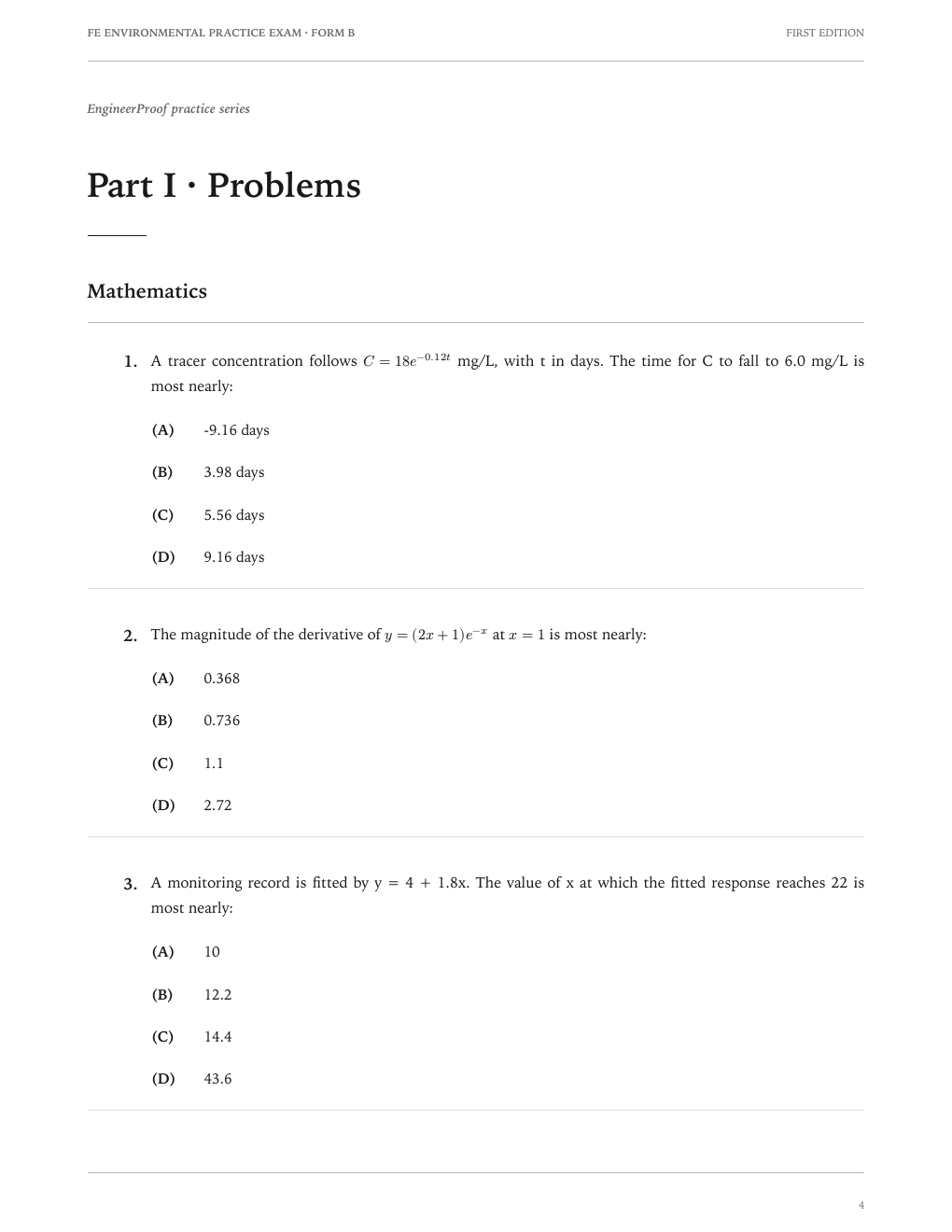
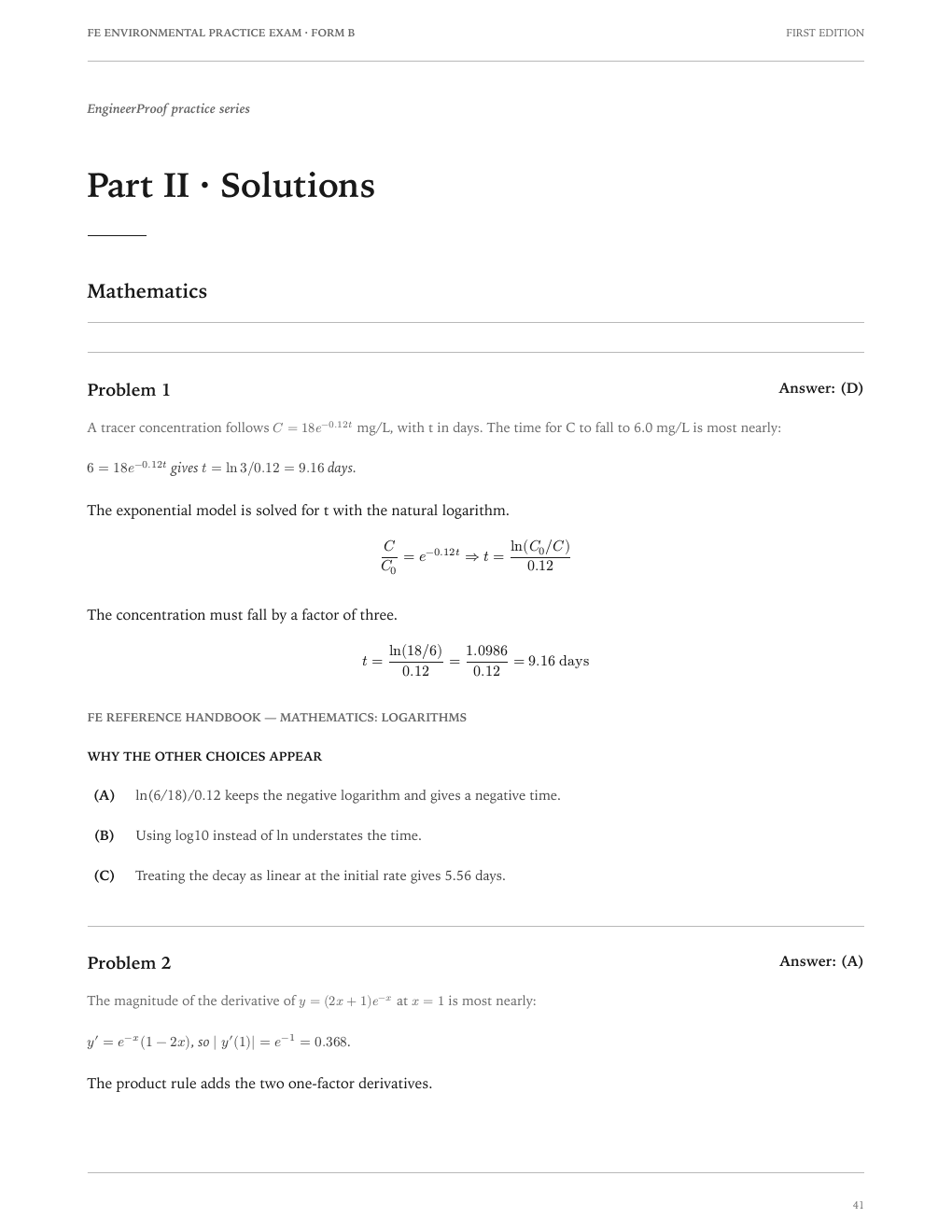
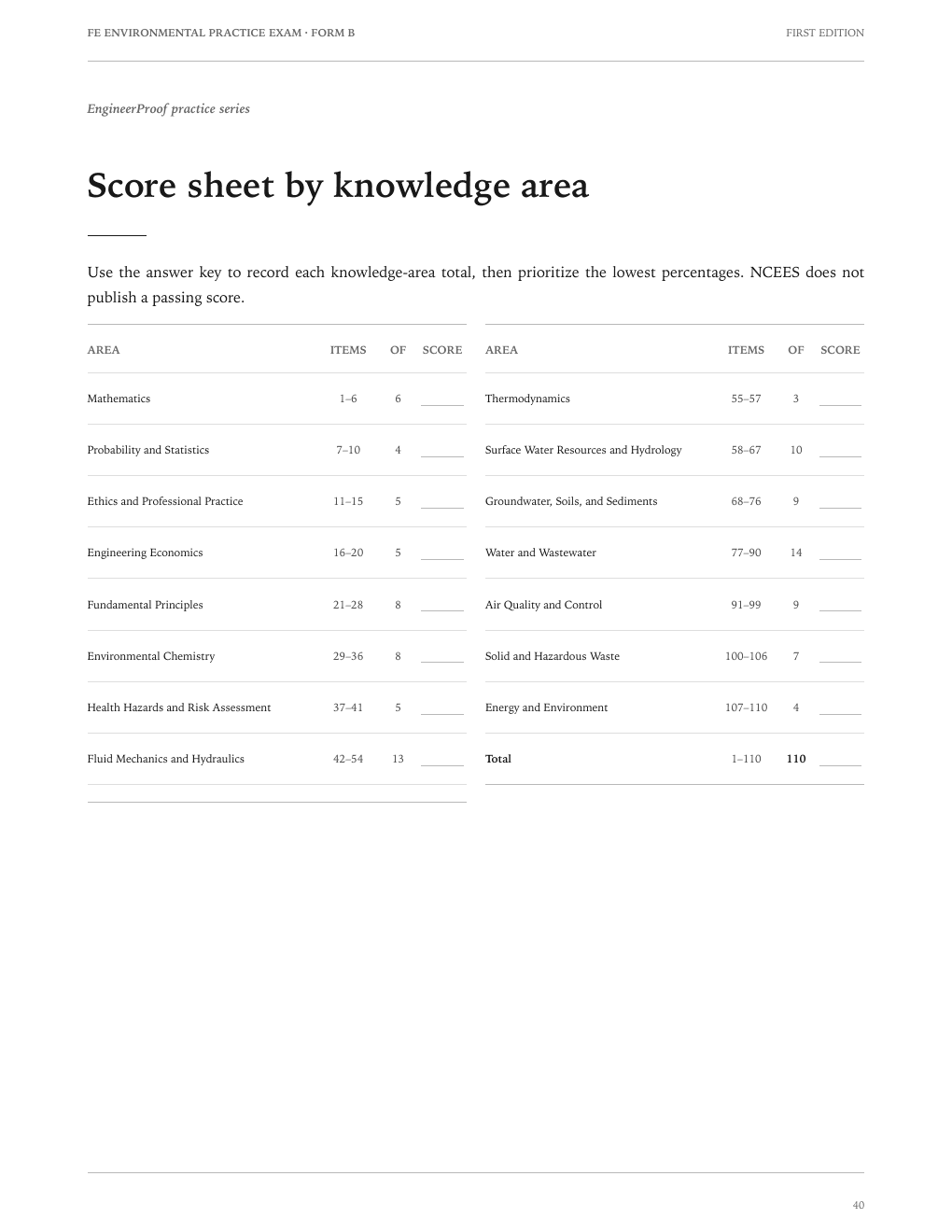
Pages from each form
Direct renders from the current PDF releases, not illustrative mockups.
Form A
131 pages · Version 1.0.0
Form B
104 pages · Version 1.1.0
17 free FE Environmental practice problems with solutions
Work through all 15 knowledge areas. Each problem includes four choices, a complete solution, a handbook reference and an explanation of the wrong answers. No account or email is required.
The free sample PDF contains 15 Form A samples, one per area. The additional questions below are independent of the paid forms and are also in the free printable supplement.
Mathematics
1 free problem · Form A: 6 of 110 questions · NCEES range: 5-8
A completely mixed lagoon of volume initially holds a contaminant at . Contaminant-free water enters at and the lagoon discharges at the same rate. Within the lagoon the contaminant also decays by a first-order reaction with . The contaminant concentration after 30 h is most nearly:
- (A)3.6 mg/L
- (B)8.9 mg/L
- (C)16.3 mg/L
- (D)22.0 mg/L
Show worked solution
Answer: (A)
Washout and reaction combine into a single first-order coefficient of , leaving about 3.6 mg/L after 30 h.
Washout and reaction both remove mass in proportion to the instantaneous concentration, so the unsteady mass balance collapses to one lumped rate constant.
Hydraulic washout at and reaction at are additive because both are first order in .
Exponential decay from the initial 40 mg/L over 30 h leaves
FE Reference Handbook — Mathematics: Differential Equations, First-Order Linear Homogeneous with Constant Coefficients
Why the other choices appear
- (B)Neglects the reaction and uses washout alone: mg/L.
- (C)Neglects washout and uses the decay constant alone: mg/L.
- (D)Subtracts the decay rate from the washout rate instead of adding: mg/L.
The complete practice exam contains 6 mathematics problems in Form A and 6 in Form B, with full solutions and a knowledge-area score sheet.
Compare Form A and Form B and buy a PDF · USD 29 eachAll knowledge areasProbability and Statistics
1 free problem · Form A: 4 of 110 questions · NCEES range: 4-6
A rapid field immunoassay screens groundwater samples for total coliform. Historically, 6% of samples drawn from the well field are contaminated. The assay returns a positive result for 95% of contaminated samples and for 4% of uncontaminated samples. The probability that a sample returning a positive result is actually contaminated is most nearly:
- (A)0.057
- (B)0.095
- (C)0.603
- (D)0.950
Show worked solution
Answer: (C)
About 60 percent of positive results are true detections, because at 6 percent prevalence the uncontaminated 94 percent of samples yields nearly as many false positives as there are true ones.
Positive results arise from two disjoint populations, so the conditioning denominator is the total positive rate, not the false-positive rate alone.
Bayes' theorem reweights the contaminated branch against that total to reverse the direction of conditioning.
Prevalence dominates the result: the clean fraction contributes 0.0376 of false-positive mass against only 0.0570 of true-positive mass, so nearly two of every five positives are spurious.
FE Reference Handbook — Engineering Probability and Statistics: Bayes' Theorem
Why the other choices appear
- (A)This is the joint probability P(C and +) = (0.95)(0.06) = 0.0570, reported without dividing by the total positive rate.
- (B)This is the marginal probability of a positive result, P(+) = 0.0946, which is only the denominator of the Bayes expression.
- (D)This is the sensitivity P(+|C) = 0.95, obtained by reversing the direction of conditioning.
The complete practice exam contains 4 probability and statistics problems in Form A and 4 in Form B, with full solutions and a knowledge-area score sheet.
Compare Form A and Form B and buy a PDF · USD 29 eachAll knowledge areasEthics and Professional Practice
1 free problem · Form A: 5 of 110 questions · NCEES range: 5-8
A licensed engineer prepares the noncompliance report required by an industrial facility's NPDES permit. The permit limits total suspended solids to a monthly average mass loading of 250 lb/day. For the reporting month the average discharge is 1.8 MGD at a total suspended solids concentration of 22 mg/L. The percentage by which the monthly average loading exceeds the permitted mass limit is most nearly:
- (A)24%
- (B)32%
- (C)76%
- (D)132%
Show worked solution
Answer: (B)
Loading of 330 lb/day against a 250 lb/day limit places the month 32 percent above the permitted mass discharge.
Mass loading, not concentration, is the permitted quantity, so flow and concentration combine through the standard 8.34 lb per million gallons per mg/L factor.
Exceedance in a noncompliance report is measured against the permit limit, which is the fixed regulatory reference, rather than against the observed loading.
Restating the limit as an equivalent permitted concentration of 16.7 mg/L against the measured 22 mg/L reproduces the same margin.
FE Reference Handbook — Environmental Engineering: Mass Loading Rate (Flow-Concentration Product) and Water/Wastewater Unit Conversions
Why the other choices appear
- (A)Divides the 80.3 lb/day excess by the measured loading instead of the permit limit: 80.3/330.3 = 24.3%.
- (C)Reports the limit as a fraction of the measured loading, 250/330.3 = 75.7%, mistaking that ratio for the exceedance.
- (D)Reports the full ratio of loading to limit, 330.3/250 = 132%, without subtracting the 100% baseline.
The complete practice exam contains 5 ethics and professional practice problems in Form A and 5 in Form B, with full solutions and a knowledge-area score sheet.
Compare Form A and Form B and buy a PDF · USD 29 eachAll knowledge areasEngineering Economics
1 free problem · Form A: 5 of 110 questions · NCEES range: 5-8
A 30,000 m/d water treatment plant must select a disinfection process for a 20-year study period. Ultraviolet disinfection has a capital cost of USD 850,000, annual operation and maintenance of USD 62,000, and a salvage value of USD 90,000 at the end of year 20. Sodium hypochlorite disinfection has a capital cost of USD 520,000, annual operation and maintenance of USD 105,000, and no salvage value. At an interest rate of 6% per year, the present worth advantage of the ultraviolet alternative is most nearly:
- (A)USD 163,000
- (B)USD 191,000
- (C)USD 253,000
- (D)USD 452,000
Show worked solution
Answer: (B)
Ultraviolet disinfection is cheaper in present worth by roughly USD 191,000, because USD 43,000 per year of avoided operating cost outweighs its USD 330,000 capital premium.
Equal 20-year lives permit a direct present-worth comparison of the two cost streams at 6% per year.
Salvage enters the ultraviolet stream as a single credit at year 20, discounted like any other future amount.
Hypochlorite buys a lower first cost at the price of a much heavier chemical and labor burden every year.
Discounted savings of 43,000 USD per year, plus the residual credit, more than repay the 330,000 USD capital premium.
FE Reference Handbook — Engineering Economics: Present Worth Analysis, Uniform Series Present Worth Factor
Why the other choices appear
- (A)Omits the year-20 salvage credit entirely, giving 1,724,342 - 1,561,135 = 163,000 USD.
- (C)Credits the full 90,000 USD salvage without discounting it, giving 1,724,342 - 1,471,135 = 253,000 USD.
- (D)Compounds the salvage forward with (F/P, 6%, 20) = 3.207 instead of discounting it, crediting 288,600 USD and giving 1,724,342 - 1,272,493 = 452,000 USD.
The complete practice exam contains 5 engineering economics problems in Form A and 5 in Form B, with full solutions and a knowledge-area score sheet.
Compare Form A and Form B and buy a PDF · USD 29 eachAll knowledge areasFundamental Principles
1 free problem · Form A: 8 of 110 questions · NCEES range: 7-11
An aerated lagoon is modeled as a completely mixed flow reactor at steady state. The lagoon receives 2,400 m/d with a soluble BOD of 180 mg/L, its liquid volume is 9,600 m, and soluble BOD is removed by a first-order reaction with d. The effluent soluble BOD is most nearly:
- (A)75 mg/L
- (B)105 mg/L
- (C)129 mg/L
- (D)166 mg/L
Show worked solution
Answer: (A)
Complete mixing forces the entire reactor to sit at its effluent concentration, and the steady-state balance then fixes that concentration at 75 mg/L.
Hydraulic residence time follows from the liquid volume and the throughput flow.
A steady-state balance sets the influent load equal to the effluent load plus the reaction loss, and because the tank contents are at the effluent concentration the reaction term uses rather than .
FE Reference Handbook — Environmental Engineering: Completely Mixed Flow Reactor, First-Order Reaction
Why the other choices appear
- (B)Reports the BOD removed, 180 - 75 = 105 mg/L, instead of the concentration leaving the lagoon.
- (C)Omits the unity term in the denominator, 180/[(0.35)(4.0)] = 129 mg/L.
- (D)Inverts the residence time to Q/V = 0.25 d, giving 180/[1 + (0.35)(0.25)] = 166 mg/L.
The complete practice exam contains 8 fundamental principles problems in Form A and 8 in Form B, with full solutions and a knowledge-area score sheet.
Compare Form A and Form B and buy a PDF · USD 29 eachAll knowledge areasEnvironmental Chemistry
1 free problem · Form A: 8 of 110 questions · NCEES range: 7-11
A laboratory acetate buffer contains 0.050 mol/L acetic acid and 0.030 mol/L sodium acetate, with . Strong acid is then added to a concentration of 0.010 mol/L with negligible volume change. The pH after the addition is most nearly:
- (A)4.28
- (B)4.36
- (C)4.54
- (D)5.24
Show worked solution
Answer: (A)
Converting a third of the acetate to acetic acid triples the acid-to-base ratio and pulls the pH down to about 4.28.
Added protons convert acetate to acetic acid mole for mole, so both members of the pair change before any equilibrium relation is written.
Henderson-Hasselbalch governs because both conjugate members survive the addition in large excess, which is precisely the buffer capacity being tested.
FE Reference Handbook — Chemistry: Acid-Base Equilibria (Henderson-Hasselbalch Equation)
Why the other choices appear
- (B)Reduces the acetate to 0.020 mol/L but leaves the acid at 0.050 mol/L, giving 4.76 + log(0.4) = 4.36.
- (C)Reports the buffer pH before the acid addition, 4.76 + log(0.030/0.050) = 4.54.
- (D)Inverts the ratio in the logarithm, giving 4.76 + log(0.060/0.020) = 5.24.
The complete practice exam contains 8 environmental chemistry problems in Form A and 8 in Form B, with full solutions and a knowledge-area score sheet.
Compare Form A and Form B and buy a PDF · USD 29 eachAll knowledge areasHealth Hazards and Risk Assessment
1 free problem · Form A: 5 of 110 questions · NCEES range: 4-6
A private well serving a residence contains tetrachloroethylene at 35 µg/L. An adult weighing 180 lb ingests 0.60 gal/day of this water 350 days per year for 26 years. The endpoint of interest is non-carcinogenic, so the averaging time equals the exposure duration. The chronic daily intake is most nearly:
- (A) mg/(kg-day)
- (B) mg/(kg-day)
- (C) mg/(kg-day)
- (D) mg/(kg-day)
Show worked solution
Answer: (D)
Because the averaging time equals the exposure duration, the two cancel and the intake reduces to a daily dose scaled by exposure frequency, about mg/(kg-day).
Intake equations are written on a body-mass basis, so the pound and gallon values must become kilograms and litres before anything else.
Averaging time for a threshold endpoint is the exposure duration itself, which fixes the denominator at 26 years expressed in days.
The exposure frequency of 350 d/yr leaves roughly 96 percent of the averaging period as exposed time, so the intake stays close to the daily dose during exposure.
FE Reference Handbook — Environmental Engineering: Risk Assessment, Chronic Daily Intake Equation
Why the other choices appear
- (A)Treats the given 180 and 0.60 as kilograms and litres with no conversion: mg/(kg-day).
- (B)Converts body weight to 81.65 kg but leaves the ingestion rate at 0.60 L/day: mg/(kg-day).
- (C)Averages over a 70-year lifetime (25,550 d) although the endpoint is non-carcinogenic: mg/(kg-day).
The complete practice exam contains 5 health hazards and risk assessment problems in Form A and 5 in Form B, with full solutions and a knowledge-area score sheet.
Compare Form A and Form B and buy a PDF · USD 29 eachAll knowledge areasFluid Mechanics and Hydraulics
1 free problem · Form A: 13 of 110 questions · NCEES range: 12-18
A centrifugal pump handles 0.075 of water. The 250 mm suction line carries a gauge reading of kPa; the 150 mm discharge line carries a gauge reading of kPa at a point 0.60 m above the suction gauge. Head loss between the two gauges is negligible. The total dynamic head developed by the pump is most nearly:
- (A)30.5 m
- (B)33.9 m
- (C)34.7 m
- (D)35.5 m
Show worked solution
Answer: (D)
Total dynamic head reaches 35.5 m, with the suction vacuum and the contraction to 150 mm both adding to the head rise.
Continuity fixes both velocities from the single discharge, and the reduced discharge bore nearly triples the velocity.
Pump head is the total head rise across the flanges, so the pressure, velocity, and elevation terms all enter.
A 25 kPa vacuum on the suction side enlarges the pressure difference to 335 kPa rather than shrinking it.
FE Reference Handbook — Fluid Mechanics: Energy Equation with Pump Head; Continuity Equation
Why the other choices appear
- (A)Reading the suction gauge as +25 kPa instead of a vacuum gives (310 − 25)/9.81 + 0.80 + 0.60 = 30.5 m.
- (B)Reversing the sign of the velocity-head difference gives 34.15 − 0.80 + 0.60 = 33.9 m.
- (C)Dropping the velocity-head difference leaves 34.15 + 0.60 = 34.7 m.
The complete practice exam contains 13 fluid mechanics and hydraulics problems in Form A and 13 in Form B, with full solutions and a knowledge-area score sheet.
Compare Form A and Form B and buy a PDF · USD 29 eachAll knowledge areasThermodynamics
1 free problem · Form A: 3 of 110 questions · NCEES range: 3-5
A morning sounding at a proposed incinerator site records air temperatures of at 10 m and at 160 m above grade. The dry adiabatic lapse rate is /km. Which of the following best describes the stability of the layer and the expected stack plume behavior?
- (A)Superadiabatic and unstable; looping plume
- (B)Neutral; coning plume
- (C)Subadiabatic and stable; fanning plume
- (D)Temperature inversion; ground-level fumigation
Show worked solution
Answer: (A)
The layer cools at /km, much steeper than the dry adiabatic /km, so displaced parcels stay buoyant and the plume loops.
Stability is judged by the environmental lapse rate measured across the sounding layer.
A parcel cooling at the dry adiabatic rate rises into air that has cooled faster, so it stays warmer and lighter than its surroundings and the strong vertical motion drives the plume into a looping pattern.
FE Reference Handbook — Environmental Engineering: Atmospheric Stability, Dry Adiabatic Lapse Rate
Why the other choices appear
- (B)Follows from treating any temperature decrease with height as adiabatic by default, without evaluating 2.3 °C over 0.150 km = 15.3 °C/km against 9.8 °C/km.
- (C)Comes from comparing the raw 2.3 °C temperature drop with the 9.8 °C/km rate without converting the 150 m layer thickness to kilometers.
- (D)Comes from reversing the two readings so temperature appears to rise with height.
The complete practice exam contains 3 thermodynamics problems in Form A and 3 in Form B, with full solutions and a knowledge-area score sheet.
Compare Form A and Form B and buy a PDF · USD 29 eachAll knowledge areasSurface Water Resources and Hydrology
1 free problem · Form A: 10 of 110 questions · NCEES range: 9-14
Three recording rain gauges serve a 45.0 km basin. Storm depths and the corresponding Thiessen polygon areas are: gauge 1, 62 mm over 14.0 km; gauge 2, 88 mm over 22.5 km; gauge 3, 45 mm over 8.5 km. The average storm depth over the basin is most nearly:
- (A)58.4 mm
- (B)62.0 mm
- (C)65.0 mm
- (D)71.8 mm
Show worked solution
Answer: (D)
Weighting each gauge by its polygon area gives 71.8 mm, well above the unweighted mean because the wettest station governs half the basin.
Area weighting governs here because the polygons differ by nearly a factor of three, and an unweighted mean would give the driest station equal standing.
Gauge 2 holds half the basin area and therefore controls the accumulated product.
The equivalent uniform depth sits above the 65 mm arithmetic mean precisely because the wettest gauge carries the largest polygon.
FE Reference Handbook — Water Resources and Environmental Engineering: Precipitation, Areal Average by Thiessen Polygon Weighting
Why the other choices appear
- (A)58.4 mm comes from inverting the weights, using 1/A_i instead of A_i: 13.634 / 0.23352 = 58.4 mm.
- (B)62.0 mm is the single nearest-station depth adopted for the whole basin instead of weighting all three gauges.
- (C)65.0 mm is the arithmetic mean of the three depths, (62 + 88 + 45)/3, with the polygon areas ignored.
The complete practice exam contains 10 surface water resources and hydrology problems in Form A and 10 in Form B, with full solutions and a knowledge-area score sheet.
Compare Form A and Form B and buy a PDF · USD 29 eachAll knowledge areasGroundwater, Soils, and Sediments
1 free problem · Form A: 9 of 110 questions · NCEES range: 8-12
Two monitoring wells screened in the same unconfined sand aquifer are 240 m apart along the direction of flow. The measured hydraulic heads are 96.4 m and 94.0 m. The aquifer has a hydraulic conductivity of 25 m/day, a total porosity of 0.38, and an effective porosity of 0.30. The average linear (seepage) velocity of the groundwater is most nearly:
- (A)0.075 m/day
- (B)0.25 m/day
- (C)0.66 m/day
- (D)0.83 m/day
Show worked solution
Answer: (D)
Water particles advance at about 0.83 m/day, because the Darcy flux of 0.25 m/day is carried only through the 30 percent of the cross section that is interconnected pore space.
Darcy's law supplies the specific discharge, a flux referred to the gross cross-sectional area rather than a particle speed.
Seepage velocity corrects that flux for the fraction of the section actually open to transport, which is the effective porosity and not the total porosity.
FE Reference Handbook — Water Resources and Environmental Engineering: Darcy's Law
Why the other choices appear
- (A)0.075 m/day results from multiplying the Darcy flux by the effective porosity instead of dividing, (0.25)(0.30).
- (B)0.25 m/day is the Darcy flux Ki reported directly, with the porosity correction omitted.
- (C)0.66 m/day divides the flux by the total porosity 0.38 rather than by the effective porosity 0.30.
The complete practice exam contains 9 groundwater, soils, and sediments problems in Form A and 9 in Form B, with full solutions and a knowledge-area score sheet.
Compare Form A and Form B and buy a PDF · USD 29 eachAll knowledge areasWater and Wastewater
3 free problems · Form A: 14 of 110 questions · NCEES range: 12-18
A granular media filter with a ft by ft plan area operates at a filtration rate of gpm/ft for a h run, then is backwashed at gpm/ft for min. The backwash water expressed as a percentage of the water filtered during the run is most nearly:
- (A)0.062 %
- (B)1.25 %
- (C)3.1 %
- (D)12.5 %
Show worked solution
Answer: (B)
Backwash consumes about percent of production: the wash rate is 4.5 times the filtration rate, but the run lasts 360 times as long as the wash.
Plan area cancels from both volumes, leaving a ratio of rate times duration in gallons per square foot.
Run length in minutes is , so gal/ft of wash water stands against gal/ft filtered.
FE Reference Handbook — Water and Wastewater: Granular Media Filtration, Filtration and Backwash Rates
Why the other choices appear
- (A)Inverts the rate ratio, computing (4.0/18)(10/3,600) = 6.2 x 10⁻⁴ = 0.062%.
- (C)Takes the run as 24 h, comparing 86,400 gal of backwash with 2,764,800 gal filtered.
- (D)Reads the run length as 6 h, a decimal slip that inflates the ratio tenfold to 12.5%.
Two more free problem types
Try a different setup before reading the solution. These additional original questions are separate from the sold practice forms, so solving them does not reveal another question from a full practice form.
A steady concentration balance before treatment
Two water streams enter a perfectly mixed junction: 2 L/s at 40 mg/L and 3 L/s at 10 mg/L of a conservative dissolved substance. There is no reaction, accumulation, or loss. What is the combined outlet concentration?
- (A)10 mg/L
- (B)22 mg/L
- (C)25 mg/L
- (D)40 mg/L
Show worked solution
Answer: (B)
The outlet concentration is 22 mg/L, a flow-weighted average.
Conservative solute mass flow is concentration multiplied by water flow. Sum the inlet solute loads and divide by the total flow.
The incoming solute load is 110 mg/s. Five litres per second at 22 mg/L carries exactly 110 mg/s; both flow and solute are conserved.
The result lies between 10 and 40 mg/L. Reaction, evaporation or incomplete mixing would require a different model; none is present in the stated junction.
FE Reference Handbook: Environmental Engineering — steady mass balance and conservative mixing.
Why the other choices appear
- (A)This ignores the higher-concentration inlet.
- (C)This takes an unweighted arithmetic average despite unequal flows.
- (D)This ignores dilution from the second inlet.
A plug-flow removal model and hydraulic time
A plug-flow contactor treats 0.020 cubic metres per second. A dissolved contaminant obeys first-order decay with k = 0.15 per minute. What minimum contactor volume achieves 90% removal under ideal plug-flow conditions?
- (A)7.20 m³
- (B)12.00 m³
- (C)18.42 m³
- (D)27.63 m³
Show worked solution
Answer: (C)
The required ideal plug-flow volume is about 18.42 cubic metres.
Ninety percent removal leaves an outlet-to-inlet ratio of 0.10, not 0.90. The ideal plug-flow decay law determines hydraulic residence time.
Convert flow to 1.2 cubic metres per minute so it matches the decay constant before multiplying by time.
The volume divided by flow gives 921.03 seconds, or 15.3506 minutes. Substitution gives exp(-0.15 times 15.3506) = 0.10. A completely mixed reactor would require a different volume formula.
FE Reference Handbook: Environmental Engineering — first-order kinetics and ideal plug-flow residence time.
Why the other choices appear
- (A)This uses a different residence time without solving the logarithmic relation.
- (B)This assumes ten minutes without enforcing 90% removal.
- (D)This adds an unsupported safety multiplier to the ideal model.
Download all 14 additional questions, diagrams and complete solutions (free PDF). Download the editable practice review sheet (CSV).
Original questions and diagrams by EngineerProof, September 30, 2026. Personal study and unchanged redistribution with attribution are permitted. The questions are independent practice, not official NCEES material. Report a correction.
The complete practice exam contains 14 water and wastewater problems in Form A and 14 in Form B, with full solutions and a knowledge-area score sheet.
Compare Form A and Form B and buy a PDF · USD 29 eachAll knowledge areasAir Quality and Control
1 free problem · Form A: 9 of 110 questions · NCEES range: 8-12
A cyclone receives gas at an inlet velocity of 18 m/s through a rectangular inlet 0.20 m wide, with 5 effective turns in the body. Gas viscosity is Pa·s and gas density is 1.2 kg/m³; particle density is 1,800 kg/m³. The cut diameter for 50% collection efficiency is most nearly:
- (A)5.66 µm
- (B)8.00 µm
- (C)12.7 µm
- (D)17.9 µm
Show worked solution
Answer: (A)
Centrifugal drift working against Stokes drag across the 0.20 m inlet width yields a cut diameter of about 5.7 µm.
Cut diameter follows from the particle that just traverses the inlet width under centrifugal drift opposed by Stokes drag during the effective number of turns.
Air viscosity in SI is Pa·s rather than the numerically similar poise value, and the gas density is only a 0.07 percent correction to the particle density.
Numerator and denominator combine to a cut size in the 5 to 10 µm band that defines high-efficiency cyclone duty and explains their use as precleaners.
FE Reference Handbook — Environmental Engineering: Air Pollution Control, Cyclone 50% Collection Efficiency for Particle Diameter
Why the other choices appear
- (B)Omits the factor 2 in the denominator, doubling the radicand to 6.405e-11 m² and giving 8.00 µm.
- (C)Leaves the number of effective turns out of the denominator, raising the radicand fivefold to 1.601e-10 m² and giving 12.65 µm.
- (D)Uses 1.81e-4 Pa·s for viscosity, the poise value read as a Pa·s value, raising the radicand tenfold and giving 17.9 µm.
The complete practice exam contains 9 air quality and control problems in Form A and 9 in Form B, with full solutions and a knowledge-area score sheet.
Compare Form A and Form B and buy a PDF · USD 29 eachAll knowledge areasSolid and Hazardous Waste
1 free problem · Form A: 7 of 110 questions · NCEES range: 7-11
A transfer station ships municipal solid waste to a regional landfill in transfer trailers with a 20 ton payload. The round-trip haul distance is 120 mi and the hauling contract pays USD 2.85 per mile of travel. Transfer station processing costs USD 7.40 per ton. The combined processing and haul cost is most nearly:
- (A)USD 15.95 per ton
- (B)USD 17.47 per ton
- (C)USD 24.50 per ton
- (D)USD 41.60 per ton
Show worked solution
Answer: (C)
Haul charges of 17.10 USD/ton over the round trip plus the 7.40 USD/ton processing fee total 24.50 USD/ton.
Haul payment is earned on every mile travelled, so the stated round-trip distance already covers the loaded and the empty leg.
Payload sets the accounting basis, because one trailer carries the whole load charge.
Transfer station processing is already quoted on a mass basis and adds without conversion.
FE Reference Handbook — Engineering Economics: Cost Estimation, Unit Cost Basis
Why the other choices appear
- (A)Halves the given distance to a one-way 60 mi haul: 60 x 2.85/20 + 7.40 = 15.95 USD/ton.
- (B)Treats the 7.40 USD/ton processing fee as a per-load charge: (342 + 7.40)/20 = 17.47 USD/ton.
- (D)Doubles an already round-trip mileage to account for the return leg twice: 2(342)/20 + 7.40 = 41.60 USD/ton.
The complete practice exam contains 7 solid and hazardous waste problems in Form A and 7 in Form B, with full solutions and a knowledge-area score sheet.
Compare Form A and Form B and buy a PDF · USD 29 eachAll knowledge areasEnergy and Environment
1 free problem · Form A: 4 of 110 questions · NCEES range: 4-6
A regional grid generates 3,200 GWh from coal at 0.95 t CO/MWh, 4,800 GWh from natural gas at 0.42 t CO/MWh, and 2,000 GWh from zero-emitting renewables in one year. The carbon intensity of the delivered electricity is most nearly:
- (A)457 kg CO/MWh
- (B)506 kg CO/MWh
- (C)590 kg CO/MWh
- (D)632 kg CO/MWh
Show worked solution
Answer: (B)
Fossil generation emits 5.06 million tonnes across the year, and spreading that over all 10,000 GWh delivered gives about 506 kg CO per MWh.
Only the two fossil sources emit, each contributing its generation times its own emission factor.
Renewable output carries no emissions but still reaches customers, so it belongs in the denominator, where it dilutes the fossil contribution.
FE Reference Handbook — Energy and Environment: Emission Factors and Carbon Intensity of Electricity Generation
Why the other choices appear
- (A)Averaging the three emission factors without weighting them by generation, t/MWh, gives 457 kg CO/MWh.
- (C)Interchanging the coal and gas generation shares, t/MWh, gives 590 kg CO/MWh.
- (D)Dividing the same emissions by fossil generation alone, t/MWh, gives 632 kg CO/MWh and describes the fossil fleet rather than the delivered mix.
The complete practice exam contains 4 energy and environment problems in Form A and 4 in Form B, with full solutions and a knowledge-area score sheet.
Compare Form A and Form B and buy a PDF · USD 29 eachAll knowledge areasWhat each download contains
- Edition
- First edition
- Form A
- 131 pages · Version 1.0.0
- Form B
- 104 pages · Version 1.1.0
- Questions
- 110 original problems per form
- Coverage
- 15 knowledge areas
- Question type
- Four-choice, single-answer
- Format
- Print-ready PDF, US Letter
Built against the NCEES FE Environmental specifications effective July 2020, current as of July 2026. Official exam format and appointment facts are available from NCEES. This printable form does not reproduce the Pearson VUE interface or interactive alternative item types.
Knowledge-area coverage
| Knowledge area | Form A | NCEES range |
|---|---|---|
| Mathematics | 6 | 5-8 |
| Probability and Statistics | 4 | 4-6 |
| Ethics and Professional Practice | 5 | 5-8 |
| Engineering Economics | 5 | 5-8 |
| Fundamental Principles | 8 | 7-11 |
| Environmental Chemistry | 8 | 7-11 |
| Health Hazards and Risk Assessment | 5 | 4-6 |
| Fluid Mechanics and Hydraulics | 13 | 12-18 |
| Thermodynamics | 3 | 3-5 |
| Surface Water Resources and Hydrology | 10 | 9-14 |
| Groundwater, Soils, and Sediments | 9 | 8-12 |
| Water and Wastewater | 14 | 12-18 |
| Air Quality and Control | 9 | 8-12 |
| Solid and Hazardous Waste | 7 | 7-11 |
| Energy and Environment | 4 | 4-6 |
Verification and corrections
Original problems, checked by a second calculation route
Every answer is reproduced with an alternate formula, a limiting case, a dimensional check, or a direct recomputation before publication. Official examination questions are confidential and are not reproduced or paraphrased.
Confirmed errors are published as versioned corrections. Buyers can re-download the corrected release at no charge. Read the full editorial method.
For a repeat attempt
Close the weak areas before another USD 225 appointment
FE Environmental repeat examinees passed at 37% versus 67% for first-time examinees in the cited NCEES data. Use the form's score sheet beside your diagnostic report, then read the FE Environmental retake plan or compare FE pass rates by discipline.
Before you buy
Questions about the PDF
Is this an official NCEES practice exam?
EngineerProof is not affiliated with, endorsed by, or sponsored by NCEES. FE and NCEES are registered trademarks of the National Council of Examiners for Engineering and Surveying, used solely to identify the examination for which these study materials are relevant. All problems and solutions in this publication are original works.
Does it reproduce the computer-based test interface?
No. This is a printable four-choice PDF. It does not include the Pearson VUE interface or interactive alternative item types such as point-and-click and drag-and-drop.
How is the PDF delivered?
Stripe returns you to a private download page after payment. The same 90-day link is sent to the checkout email.
Can I print the exam?
Yes. One purchase includes a personal license to download and print the PDF for your own study.
What if the book is not right for me?
Email inshihub.com@gmail.com within 14 days for a full refund. No reason is required.
USD 29 each