Form A · First edition
FE Chemical Practice Problems: 17 Free Questions with Solutions
17 free worked problems across 17 knowledge areas, with handbook references and explanations of every wrong choice. 110 original four-choice problems mapped to the current FE Chemical knowledge areas, with complete worked solutions.
- Problems
- 110
- Free problems
- 17
- 105 pages
Choose a practice exam form
Form A is USD 29.
Practice Exam, Form A
USD29
- 110 original problems and complete worked solutions
- Answer key and knowledge-area score sheet
- 105-page immediate private PDF download
14-day full refund · 90-day download access
Free worked samples
$0
- One complete problem and solution from every knowledge area
- No account or email required
- Read online or print the free PDF with worked solutions
Secure checkout by Stripe. Full refund within 14 days under the refund policy. Download access lasts 90 days and corrected releases remain available to buyers.
Material and energy balances, transport phenomena, thermodynamics, separations, reaction engineering, process design, controls, and safety account for 80 of this form's 110 problems.
FE Chemical is one of the seven NCEES Fundamentals of Engineering (FE) exams. In most U.S. states, passing the FE exam with an accredited degree is the step to Engineer in Training (EIT) or Engineer Intern (EI) certification.
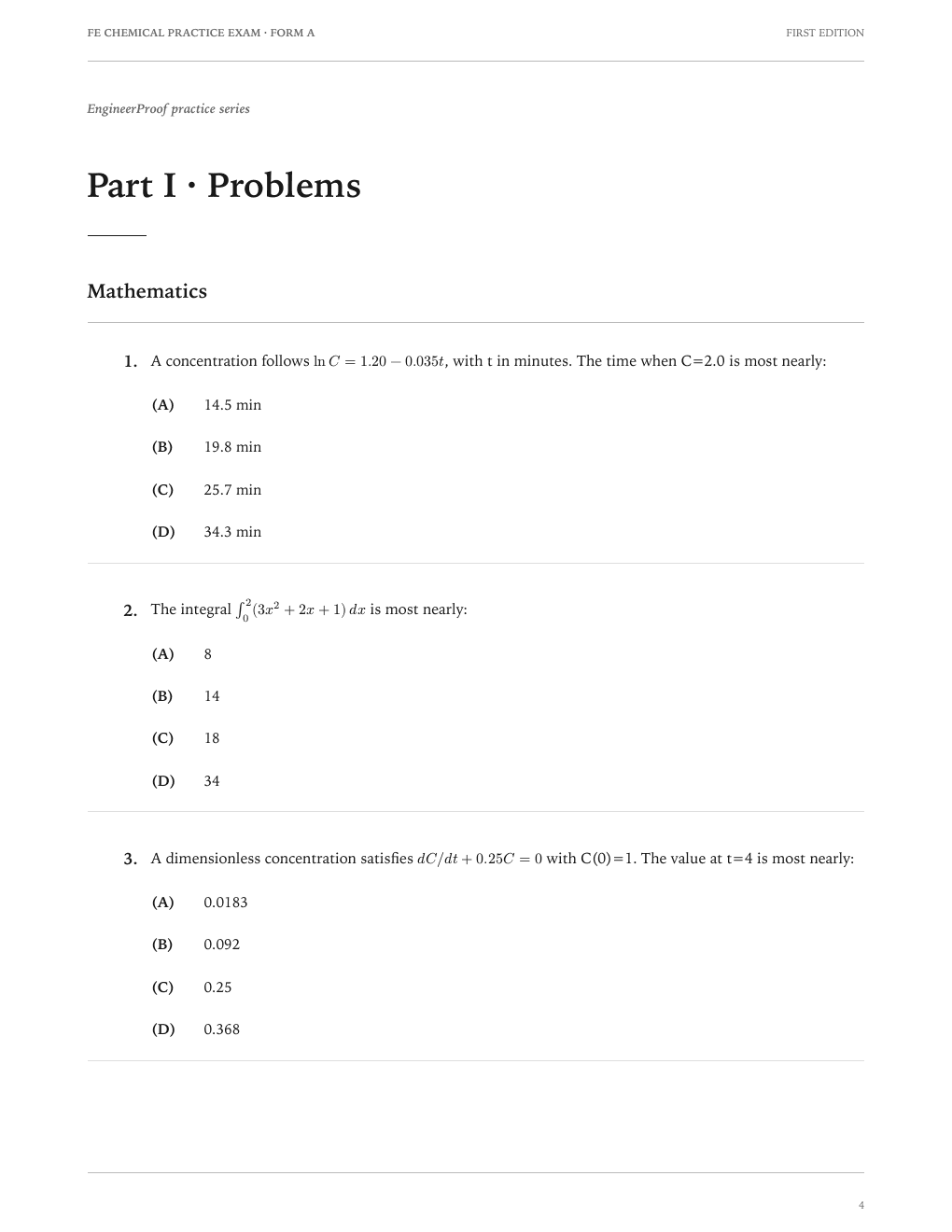
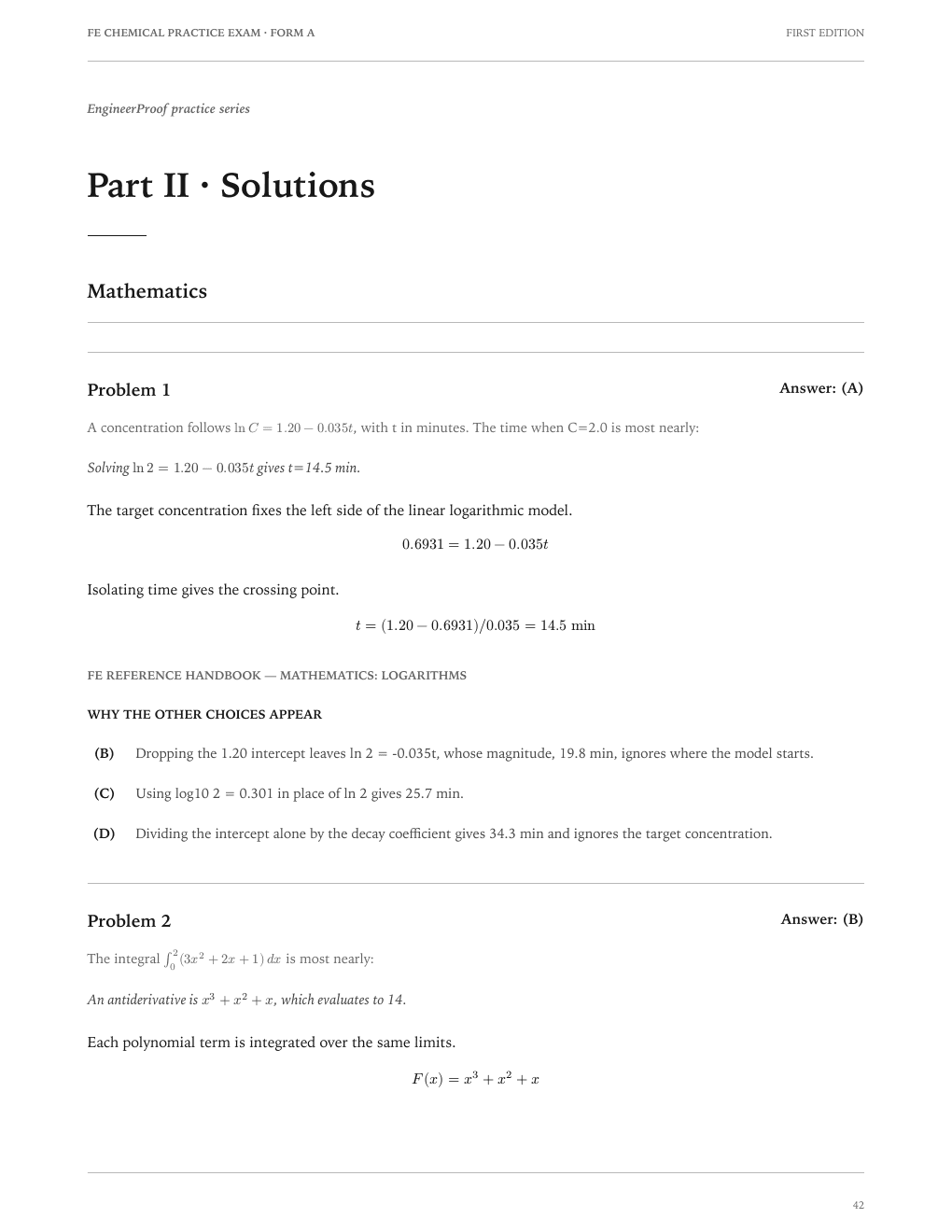
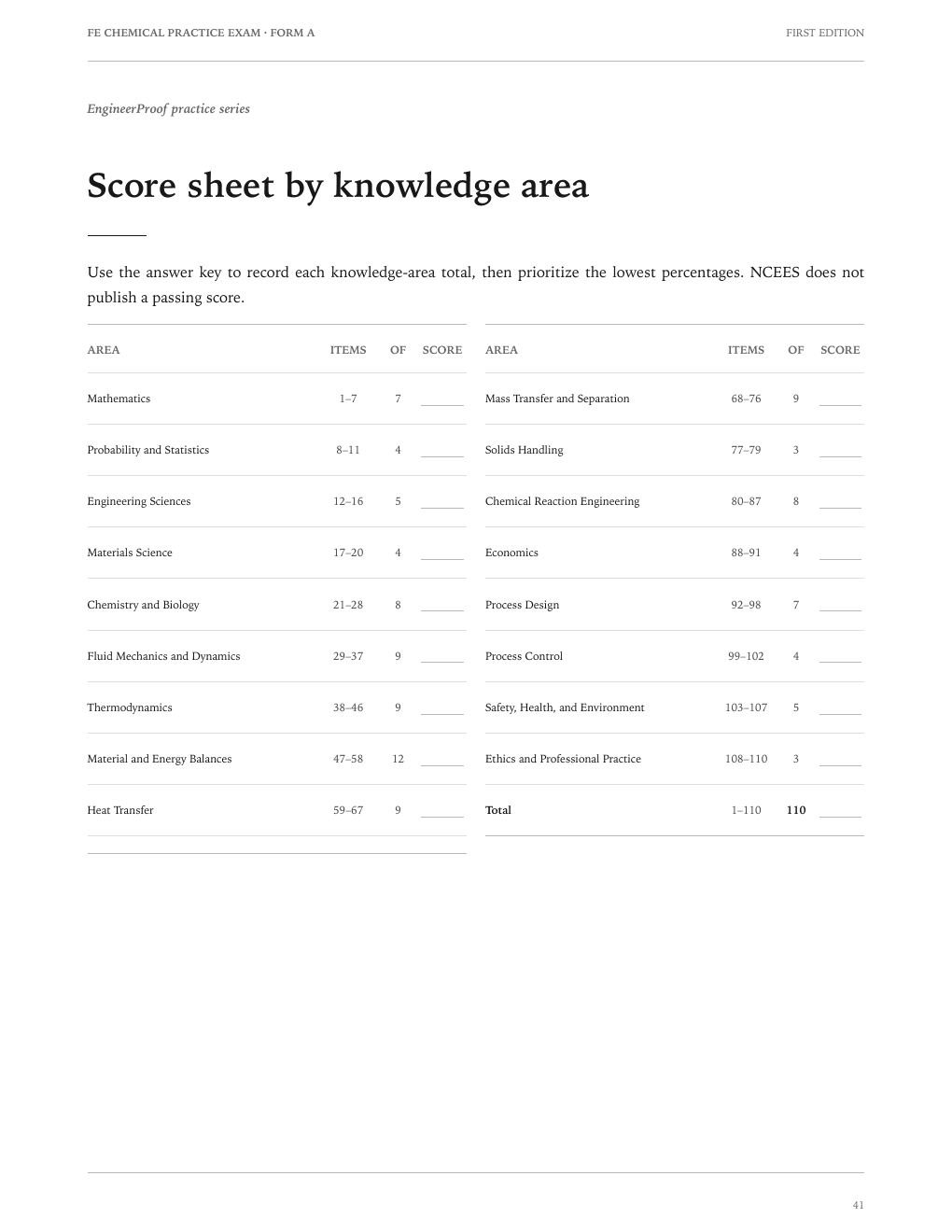
Pages from Form A
Direct renders from the current PDF releases, not illustrative mockups.
Form A
105 pages · Version 1.1.0
17 free FE Chemical practice problems with solutions
Work through all 17 knowledge areas. Each problem includes four choices, a complete solution, a handbook reference and an explanation of the wrong answers. No account or email is required.
The free sample PDF contains 17 Form A samples, one per area.
Mathematics
1 free problem · Form A: 7 of 110 questions · NCEES range: 6-9
A concentration follows , with t in minutes. The time when C=2.0 is most nearly:
- (A)14.5 min
- (B)19.8 min
- (C)25.7 min
- (D)34.3 min
Show worked solution
Answer: (A)
Solving gives t=14.5 min.
The target concentration fixes the left side of the linear logarithmic model.
Isolating time gives the crossing point.
FE Reference Handbook — Mathematics: Logarithms
Why the other choices appear
- (B)Dropping the 1.20 intercept leaves ln 2 = -0.035t, whose magnitude, 19.8 min, ignores where the model starts.
- (C)Using log10 2 = 0.301 in place of ln 2 gives 25.7 min.
- (D)Dividing the intercept alone by the decay coefficient gives 34.3 min and ignores the target concentration.
The complete practice exam contains 7 mathematics problems in Form A, with full solutions and a knowledge-area score sheet.
Compare Form A and buy a PDF · USD 29All knowledge areasProbability and Statistics
1 free problem · Form A: 4 of 110 questions · NCEES range: 4-6
A normally distributed assay has mean 50 and standard deviation 4. Using P(Z>1.5)=0.0668, the probability an assay exceeds 56 is most nearly:
- (A)0.0668
- (B)0.134
- (C)0.433
- (D)0.933
Show worked solution
Answer: (A)
The standardized value is (56-50)/4=1.5, so the requested upper-tail probability is 0.0668.
Standardization measures distance from the mean in standard deviations.
The supplied upper-tail area applies directly.
FE Reference Handbook — Probability: Normal Distribution
Why the other choices appear
- (B)Doubling the one-tail probability gives the two-tail probability outside plus-or-minus 1.5.
- (C)Subtracting the upper-tail area from one-half gives the area between mean and z=1.5.
- (D)Using the lower cumulative probability answers X less than 56.
The complete practice exam contains 4 probability and statistics problems in Form A, with full solutions and a knowledge-area score sheet.
Compare Form A and buy a PDF · USD 29All knowledge areasEngineering Sciences
1 free problem · Form A: 5 of 110 questions · NCEES range: 4-6
A 20 kg drum is pulled horizontally with 100 N while kinetic friction is 30 N. Its acceleration is most nearly:
- (A)3.5 m/s²
- (B)5 m/s²
- (C)6.5 m/s²
- (D)70 m/s²
Show worked solution
Answer: (A)
Net force is 70 N, so acceleration is 70/20=3.5 m/s².
Collinear forces combine before applying Newton's second law.
Mass converts net force to acceleration.
FE Reference Handbook — Engineering Sciences: Force, Mass, and Acceleration
Why the other choices appear
- (B)Ignoring friction gives 100/20=5 m/s².
- (C)Adding the friction to the applied force gives 130/20 = 6.5 m/s².
- (D)Reporting net force as acceleration omits mass.
The complete practice exam contains 5 engineering sciences problems in Form A, with full solutions and a knowledge-area score sheet.
Compare Form A and buy a PDF · USD 29All knowledge areasMaterials Science
1 free problem · Form A: 4 of 110 questions · NCEES range: 4-6
A fully restrained steel member is heated 60 degrees C. With E=200 GPa and thermal expansion coefficient 12e-6 per degree C, compressive thermal stress magnitude is most nearly:
- (A)144 MPa
- (B)288 MPa
- (C)720 MPa
- (D)1,440 MPa
Show worked solution
Answer: (A)
Full restraint converts free thermal strain alpha delta T into stress E alpha delta T=144 MPa compression.
The member's prevented free strain is alpha times temperature change.
Elastic stress balances that restrained strain.
FE Reference Handbook — Materials Science: Thermal Stress
Why the other choices appear
- (B)Using the areal coefficient 2α for a one-dimensional member doubles the stress to 288 MPa.
- (C)720 is the restrained strain in microstrain, 12e-6 × 60, not a stress in MPa.
- (D)Reading α as 12e-5 instead of 12e-6 gives 1,440 MPa.
The complete practice exam contains 4 materials science problems in Form A, with full solutions and a knowledge-area score sheet.
Compare Form A and buy a PDF · USD 29All knowledge areasChemistry and Biology
1 free problem · Form A: 8 of 110 questions · NCEES range: 7-11
A buffer contains 0.20 M acetate and 0.10 M acetic acid. With pK_a=4.76, pH is most nearly:
- (A)4.46
- (B)4.76
- (C)5.06
- (D)5.36
Show worked solution
Answer: (C)
Henderson-Hasselbalch gives pH=4.76+log(2)=5.06.
Buffer pH depends on the conjugate-base to weak-acid ratio.
The concentration ratio is two.
FE Reference Handbook — Chemistry: Buffers
Why the other choices appear
- (A)Inverting the base-to-acid ratio subtracts log 2 instead of adding it.
- (B)Equal pH and pKa applies only when base and acid concentrations are equal.
- (D)Squaring the 2:1 ratio, log 4 = 0.602, overstates the correction and gives 5.36.
The complete practice exam contains 8 chemistry and biology problems in Form A, with full solutions and a knowledge-area score sheet.
Compare Form A and buy a PDF · USD 29All knowledge areasFluid Mechanics and Dynamics
1 free problem · Form A: 9 of 110 questions · NCEES range: 8-12
A liquid of density 850 kg/m³ and viscosity 0.012 Pa s flows at 1.8 m/s in a 40 mm pipe. Reynolds number is most nearly:
- (A)6
- (B)2,550
- (C)5,100
- (D)5,100,000
Show worked solution
Answer: (C)
Re=rho V D/mu=5,100.
Pipe Reynolds number compares inertial and viscous effects.
The diameter is 0.040 m.
FE Reference Handbook — Fluid Mechanics: Reynolds Number
Why the other choices appear
- (A)Leaving out the density treats the dynamic viscosity as kinematic and gives 6.0.
- (B)Using the 20 mm radius instead of the diameter halves the Reynolds number.
- (D)Entering the diameter as 40 (millimetres) gives 5,100,000.
The complete practice exam contains 9 fluid mechanics and dynamics problems in Form A, with full solutions and a knowledge-area score sheet.
Compare Form A and buy a PDF · USD 29All knowledge areasThermodynamics
1 free problem · Form A: 9 of 110 questions · NCEES range: 8-12
An ideal-gas mixture at 500 kPa contains 30 mol% component A. Its partial pressure is most nearly:
- (A)150 kPa
- (B)214 kPa
- (C)350 kPa
- (D)500 kPa
Show worked solution
Answer: (A)
Dalton's law gives p_A=y_A P=0.30(500)=150 kPa.
Ideal-mixture partial pressure is proportional to mole fraction.
The component occupies 30% of the total moles.
FE Reference Handbook — Thermodynamics: Ideal-Gas Mixtures
Why the other choices appear
- (B)Using the mole ratio 30/70 instead of the mole fraction gives 214 kPa.
- (C)Using component B's 70% fraction gives B's partial pressure.
- (D)Reporting the total pressure ignores the mixture composition.
The complete practice exam contains 9 thermodynamics problems in Form A, with full solutions and a knowledge-area score sheet.
Compare Form A and buy a PDF · USD 29All knowledge areasMaterial and Energy Balances
1 free problem · Form A: 12 of 110 questions · NCEES range: 10-15
A steady mixer combines 100 kg/h solution containing 10 wt% solute with 50 kg/h solution containing 30 wt% solute. Product solute mass fraction is most nearly:
- (A)0.1
- (B)0.167
- (C)0.2
- (D)0.3
Show worked solution
Answer: (B)
Solute flow is 10+15=25 kg/h in 150 kg/h product, so mass fraction is 0.1667.
Total and solute balances both apply to the nonreactive mixer.
Product composition is component flow divided by total flow.
FE Reference Handbook — Material Balances: Steady Mixing
Why the other choices appear
- (A)Using only the dilute feed composition ignores the concentrated stream.
- (C)Taking an unweighted average ignores unequal feed flow rates.
- (D)Using only the concentrated feed composition ignores dilution.
The complete practice exam contains 12 material and energy balances problems in Form A, with full solutions and a knowledge-area score sheet.
Compare Form A and buy a PDF · USD 29All knowledge areasHeat Transfer
1 free problem · Form A: 9 of 110 questions · NCEES range: 8-12
A lumped solid initially at 200 degrees C cools in 25 degrees C air. Its time constant is 10 min. Temperature after 20 min is most nearly:
- (A)27.1 degrees C
- (B)48.7 degrees C
- (C)68.8 degrees C
- (D)131 degrees C
Show worked solution
Answer: (B)
The excess temperature decays as exp(-t/tau); after two time constants T=48.7 degrees C.
Lumped cooling is first order in temperature excess above ambient.
Here t/tau=2.
FE Reference Handbook — Heat Transfer: Lumped Transient Analysis
Why the other choices appear
- (A)Applying the decay to 200 degrees C instead of the 175 K excess over ambient gives 27.1 degrees C.
- (C)Treating the time constant as a half-life leaves a quarter of the excess, 68.8 degrees C.
- (D)Inverting t/τ to 0.5 gives 131 degrees C.
The complete practice exam contains 9 heat transfer problems in Form A, with full solutions and a knowledge-area score sheet.
Compare Form A and buy a PDF · USD 29All knowledge areasMass Transfer and Separation
1 free problem · Form A: 9 of 110 questions · NCEES range: 8-12
A solute diffuses through a stagnant liquid film 1.0 mm thick. Diffusivity is 1.0e-9 m²/s and concentration difference is 2.0 kmol/m³. Steady flux magnitude is most nearly:
- (A)2.0 × 10⁻⁹ kmol/(m² s)
- (B)2.0 × 10⁻⁶ kmol/(m² s)
- (C)2.0 × 10⁻³ kmol/(m² s)
- (D)2,000 kmol/(m² s)
Show worked solution
Answer: (B)
Fick's law gives N=D delta C/L=2.0e-6 kmol/(m² s).
A linear steady concentration profile gives constant diffusive flux.
The film thickness is 0.0010 m.
FE Reference Handbook — Mass Transfer: Fick's First Law
Why the other choices appear
- (A)Leaving out the film thickness gives D times delta C = 2.0 × 10⁻⁹.
- (C)Converting 2.0 kmol/m³ to 2,000 mol/m³ but keeping kmol in the unit gives 2.0 × 10⁻³.
- (D)Leaving out the diffusivity gives the concentration gradient, 2,000 kmol/m4.
The complete practice exam contains 9 mass transfer and separation problems in Form A, with full solutions and a knowledge-area score sheet.
Compare Form A and buy a PDF · USD 29All knowledge areasSolids Handling
1 free problem · Form A: 3 of 110 questions · NCEES range: 3-5
A powder has equal mass fractions of 100 micrometer and 400 micrometer particles of equal density and shape. Sauter mean diameter d32=1/sum(w_i/d_i) is most nearly:
- (A)100 micrometer
- (B)160 micrometer
- (C)250 micrometer
- (D)400 micrometer
Show worked solution
Answer: (B)
d32=1/(0.5/100+0.5/400)=160 micrometres.
The surface-volume mean weights inverse diameter by mass fraction for equal density.
The inverse mean is 0.00625 per micrometre.
FE Reference Handbook — Solids Handling: Particle Size Distributions
Why the other choices appear
- (A)Using only the fine fraction ignores coarse particles.
- (C)Taking an arithmetic mean does not give surface-volume mean diameter.
- (D)Using only the coarse fraction ignores the added surface from fines.
The complete practice exam contains 3 solids handling problems in Form A, with full solutions and a knowledge-area score sheet.
Compare Form A and buy a PDF · USD 29All knowledge areasChemical Reaction Engineering
1 free problem · Form A: 8 of 110 questions · NCEES range: 7-11
When reactant concentration doubles, measured initial rate increases by a factor of four at constant temperature. Reaction order in that reactant is most nearly:
- (A)0.5
- (B)1
- (C)2
- (D)4
Show worked solution
Answer: (C)
For r proportional to C^n, 4=2^n, so n=2.
Rate ratios eliminate the constant rate coefficient.
The observed ratios are four and two.
FE Reference Handbook — Reaction Engineering: Rate Laws and Order
Why the other choices appear
- (A)Taking the square root of the rate ratio gives concentration ratio, not order.
- (B)First order would double rate when concentration doubles.
- (D)Using the rate factor directly as order ignores exponentiation.
The complete practice exam contains 8 chemical reaction engineering problems in Form A, with full solutions and a knowledge-area score sheet.
Compare Form A and buy a PDF · USD 29All knowledge areasEconomics
1 free problem · Form A: 4 of 110 questions · NCEES range: 4-6
A product sells for USD 50/unit, variable cost is USD 30/unit, and annual fixed cost is USD 240,000. Break-even annual production is most nearly:
- (A)4,800 units/yr
- (B)8,000 units/yr
- (C)12,000 units/yr
- (D)600,000 units/yr
Show worked solution
Answer: (C)
Contribution margin is USD 20/unit, so break-even volume is 240,000/20=12,000 units/yr.
At break-even, total contribution equals fixed cost.
Selling price minus variable cost is USD 20/unit.
FE Reference Handbook — Economics: Break-Even Analysis
Why the other choices appear
- (A)Dividing the fixed cost by the selling price ignores the variable cost.
- (B)Dividing the fixed cost by the variable cost does not use the contribution margin.
- (D)USD 600,000 is the break-even revenue, 240,000/0.40, not a production volume.
The complete practice exam contains 4 economics problems in Form A, with full solutions and a knowledge-area score sheet.
Compare Form A and buy a PDF · USD 29All knowledge areasProcess Design
1 free problem · Form A: 7 of 110 questions · NCEES range: 7-11
A continuous process requires 30 min nominal liquid residence time at 0.020 m³/s. Ignoring holdup corrections, vessel working volume is most nearly:
- (A)0.6 m³
- (B)21.6 m³
- (C)36 m³
- (D)72 m³
Show worked solution
Answer: (C)
Working volume is flow times residence time: 0.020(1,800)=36 m³.
Nominal residence time is inventory divided by volumetric throughput.
Thirty minutes equals 1,800 seconds.
FE Reference Handbook — Process Design: Equipment Sizing
Why the other choices appear
- (A)Using 30 seconds instead of 30 minutes understates the volume sixtyfold.
- (B)Reading 30 min as 0.30 h (1,080 s) gives 21.6 m^3.
- (D)Using 3,600 s, one hour, instead of 1,800 s doubles the volume.
The complete practice exam contains 7 process design problems in Form A, with full solutions and a knowledge-area score sheet.
Compare Form A and buy a PDF · USD 29All knowledge areasProcess Control
1 free problem · Form A: 4 of 110 questions · NCEES range: 4-6
A process transfer function is . Its time constant is:
- (A)1 min
- (B)4 min
- (C)6 min
- (D)24 min
Show worked solution
Answer: (B)
Comparing G=K/(tau s+1) gives gain K=6 and time constant tau=4 min.
The standard first-order form exposes both parameters directly.
Coefficient comparison gives K=6 and tau=4.
FE Reference Handbook — Process Control: Transfer Functions
Why the other choices appear
- (A)The denominator constant is normalized to one and is not the time constant.
- (C)The numerator is gain, not time constant.
- (D)Multiplying the gain by the time constant, 6(4) = 24, does not identify either parameter.
The complete practice exam contains 4 process control problems in Form A, with full solutions and a knowledge-area score sheet.
Compare Form A and buy a PDF · USD 29All knowledge areasSafety, Health, and Environment
1 free problem · Form A: 5 of 110 questions · NCEES range: 5-8
A vapor leak enters ventilation air at 2.0 kg/h while clean air flow is 1,000 kg/h. Assuming dilute mixing, vapor mass fraction is most nearly:
- (A)5.6 × 10⁻⁷
- (B)0.002
- (C)0.2
- (D)500
Show worked solution
Answer: (B)
Mixed mass fraction is 2/(1,002)=0.001996, about 0.20 wt%.
A dilute steady enclosure balance places leak mass in total exhaust flow.
Total mixed flow is 1,002 kg/h.
FE Reference Handbook — Safety: Ventilation and Dispersion
Why the other choices appear
- (A)Converting only the leak to kg/s (2/3,600) before dividing by the air rate in kg/h mixes time units.
- (C)0.2 is the vapor content in percent, not a mass fraction.
- (D)Dividing the air flow by the leak inverts the ratio.
The complete practice exam contains 5 safety, health, and environment problems in Form A, with full solutions and a knowledge-area score sheet.
Compare Form A and buy a PDF · USD 29All knowledge areasEthics and Professional Practice
1 free problem · Form A: 3 of 110 questions · NCEES range: 3-5
A process engineer discovers that a relief-valve calculation used the wrong reaction heat and the installed valve may be undersized. Startup is scheduled. The engineer should:
- (A)Document the error, notify responsible management, and withhold approval until the hazard is resolved
- (B)Approve startup because the valve has not yet failed
- (C)Delete the calculation and repeat it after startup
- (D)Let the equipment vendor decide without disclosing the error
Show worked solution
Answer: (A)
A credible overpressure protection deficiency must be disclosed and resolved before professional startup approval.
Reaction heat directly affects runaway relief load, making the discovered input error material to safety.
A corrected independent relief calculation can verify capacity before startup and create an auditable decision basis.
FE Reference Handbook — Ethics: Public Safety and Objective Reporting
Why the other choices appear
- (B)Absence of a prior failure does not establish adequate relief capacity for a known scenario.
- (C)Deleting the calculation conceals evidence and allows an unresolved public-safety risk.
- (D)Vendor input may help, but the engineer must disclose the basis error and ensure responsible resolution.
The complete practice exam contains 3 ethics and professional practice problems in Form A, with full solutions and a knowledge-area score sheet.
Compare Form A and buy a PDF · USD 29All knowledge areasWhat each download contains
- Edition
- First edition
- Form A
- 105 pages · Version 1.1.0
- Questions
- 110 original problems
- Coverage
- 17 knowledge areas
- Question type
- Four-choice, single-answer
- Format
- Print-ready PDF, US Letter
Built against the NCEES FE Chemical specifications effective July 2020, current as of August 2026. Official exam format and appointment facts are available from NCEES. This printable form does not reproduce the Pearson VUE interface or interactive alternative item types.
Knowledge-area coverage
| Knowledge area | Form A | NCEES range |
|---|---|---|
| Mathematics | 7 | 6-9 |
| Probability and Statistics | 4 | 4-6 |
| Engineering Sciences | 5 | 4-6 |
| Materials Science | 4 | 4-6 |
| Chemistry and Biology | 8 | 7-11 |
| Fluid Mechanics and Dynamics | 9 | 8-12 |
| Thermodynamics | 9 | 8-12 |
| Material and Energy Balances | 12 | 10-15 |
| Heat Transfer | 9 | 8-12 |
| Mass Transfer and Separation | 9 | 8-12 |
| Solids Handling | 3 | 3-5 |
| Chemical Reaction Engineering | 8 | 7-11 |
| Economics | 4 | 4-6 |
| Process Design | 7 | 7-11 |
| Process Control | 4 | 4-6 |
| Safety, Health, and Environment | 5 | 5-8 |
| Ethics and Professional Practice | 3 | 3-5 |
Verification and corrections
Original problems, checked by a second calculation route
Every answer is reproduced with an alternate formula, a limiting case, a dimensional check, or a direct recomputation before publication. Official examination questions are confidential and are not reproduced or paraphrased.
Confirmed errors are published as versioned corrections. Buyers can re-download the corrected release at no charge. Read the full editorial method.
For a repeat attempt
Close the weak areas before another USD 225 appointment
Use the form's score sheet beside your diagnostic report, then read the FE exam retake guide or compare FE pass rates by discipline.
Before you buy
Questions about the PDF
Is this an official NCEES practice exam?
EngineerProof is not affiliated with, endorsed by, or sponsored by NCEES. FE and NCEES are registered trademarks of the National Council of Examiners for Engineering and Surveying, used solely to identify the examination for which these study materials are relevant. All problems and solutions in this publication are original works.
Does it reproduce the computer-based test interface?
No. This is a printable four-choice PDF. It does not include the Pearson VUE interface or interactive alternative item types such as point-and-click and drag-and-drop.
How is the PDF delivered?
Stripe returns you to a private download page after payment. The same 90-day link is sent to the checkout email.
Can I print the exam?
Yes. One purchase includes a personal license to download and print the PDF for your own study.
What if the book is not right for me?
Email inshihub.com@gmail.com within 14 days for a full refund. No reason is required.
105 pages · Version 1.1.0