Forms A–B · First edition
FE Mechanical Practice Problems: 18 Free Questions with Solutions
18 free worked problems across 14 knowledge areas, with handbook references and explanations of every wrong choice. Prepare all 14 FE Mechanical knowledge areas with free worked problems, a three-pass study plan, and two separate 110-question PDF forms.
- Problems
- 110 per form
- Free problems
- 18
- Forms
- 2
Choose a practice exam form
Forms are sold separately for USD 29 each.
Practice Exam, Form A
USD29
- 110 original problems and complete worked solutions
- Answer key and knowledge-area score sheet
- 129-page immediate private PDF download
14-day full refund · 90-day download access
Practice Exam, Form B
USD29
- 110 original problems and complete worked solutions
- Answer key and knowledge-area score sheet
- 107-page immediate private PDF download
14-day full refund · 90-day download access
Free worked samples
$0
- One complete problem and solution from every knowledge area
- No account or email required
- Read online or print the free PDF with worked solutions
Secure checkout by Stripe. Full refund within 14 days under the refund policy. Download access lasts 90 days and corrected releases remain available to buyers.
Thermodynamics, fluid mechanics, dynamics, and mechanical design together account for 42 of the 110 problems here, matching the weight NCEES gives them.
FE Mechanical is one of the seven NCEES Fundamentals of Engineering (FE) exams. In most U.S. states, passing the FE exam with an accredited degree is the step to Engineer in Training (EIT) or Engineer Intern (EI) certification.
FE Mechanical prep plan
Prepare all 14 knowledge areas in three passes
Start from the current NCEES topic ranges shown on this page. The larger ranges include dynamics, fluid mechanics, thermodynamics, and mechanical design, but every listed area can appear. Use the free worked problems to diagnose your starting point before buying another question set.
- Baseline: Solve one unfamiliar problem in each area with the electronic handbook and an approved calculator. Record whether the miss came from the concept, equation lookup, setup, units, or arithmetic.
- Repair: Study the weakest areas first, then solve a different problem without copying the earlier steps. Keep handbook searches and calculator settings in the same workflow you will use on exam day.
- Rehearse: Take an unfamiliar 110-question form under the FE answering budget, then use the included area score sheet to choose the next repair block. Form A and Form B are sold separately so the second form can remain unseen.
What each resource is for
- Official scope
- NCEES FE exam information and specifications
- Handbook and official exam prep
- MyNCEES exam-prep resources
- Calculator check
- Allowed models, rules, and calculation drills
- Free diagnosis
- 14 worked Mechanical problems, one per knowledge area
This plan is a way to organize the resources on this page. It is not an official NCEES schedule, required study time, or pass prediction.
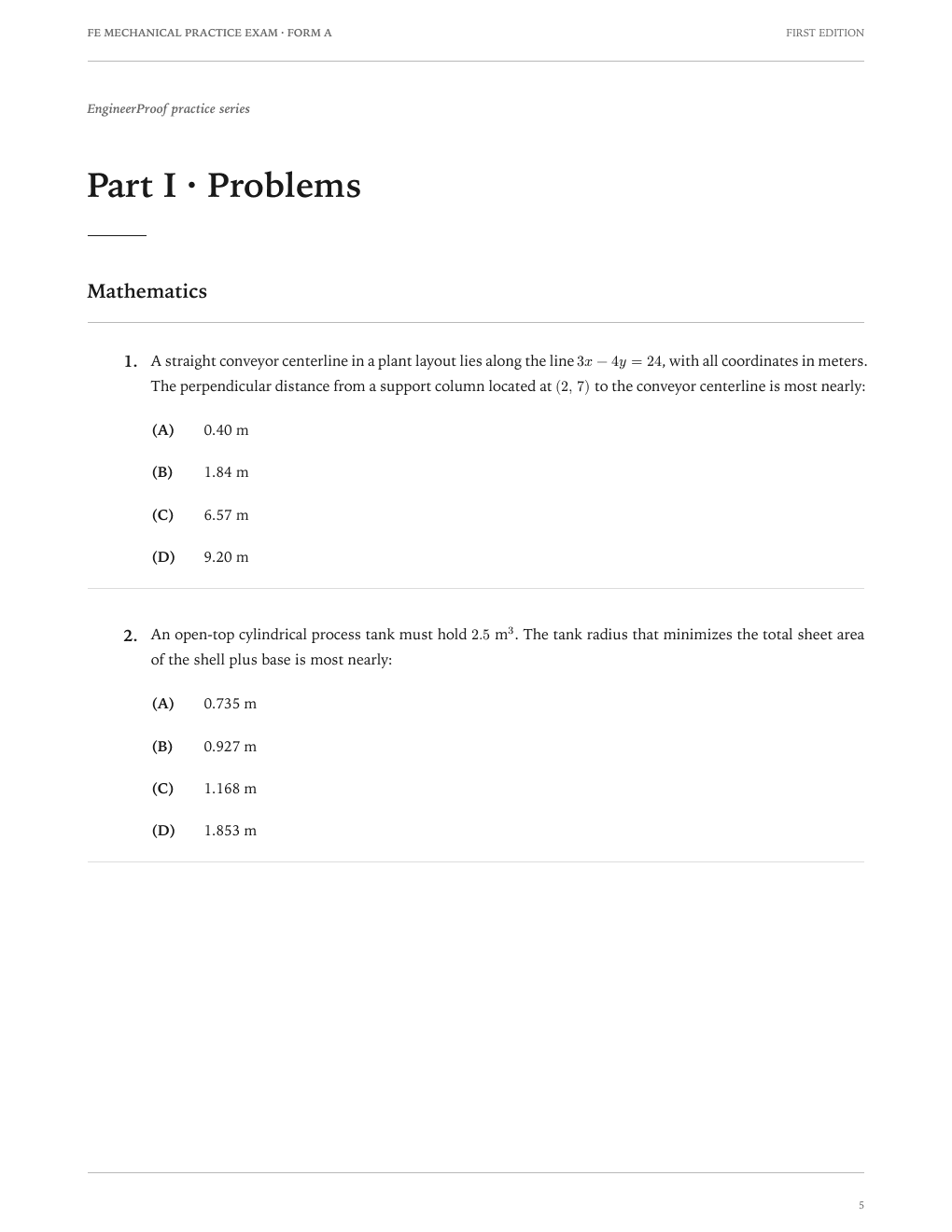
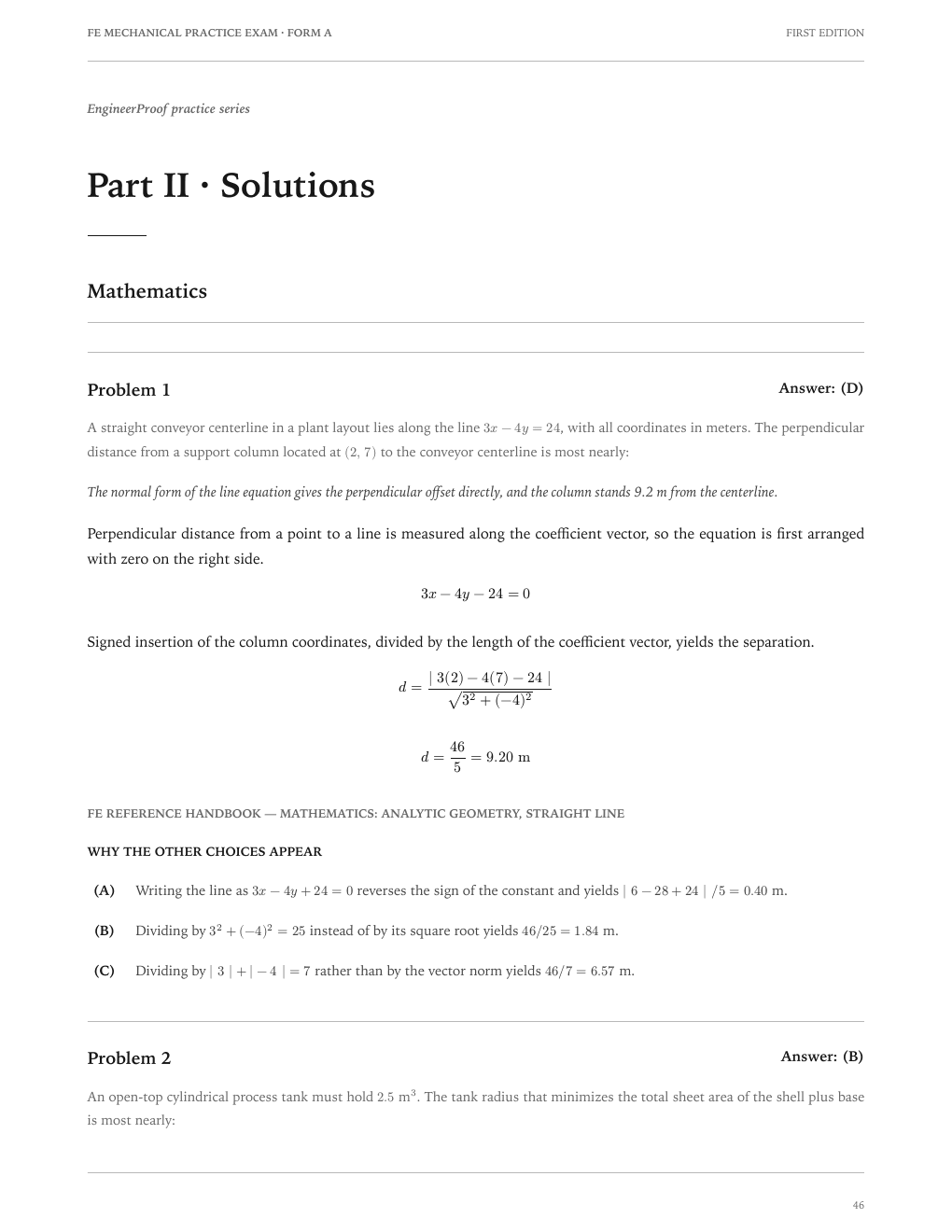
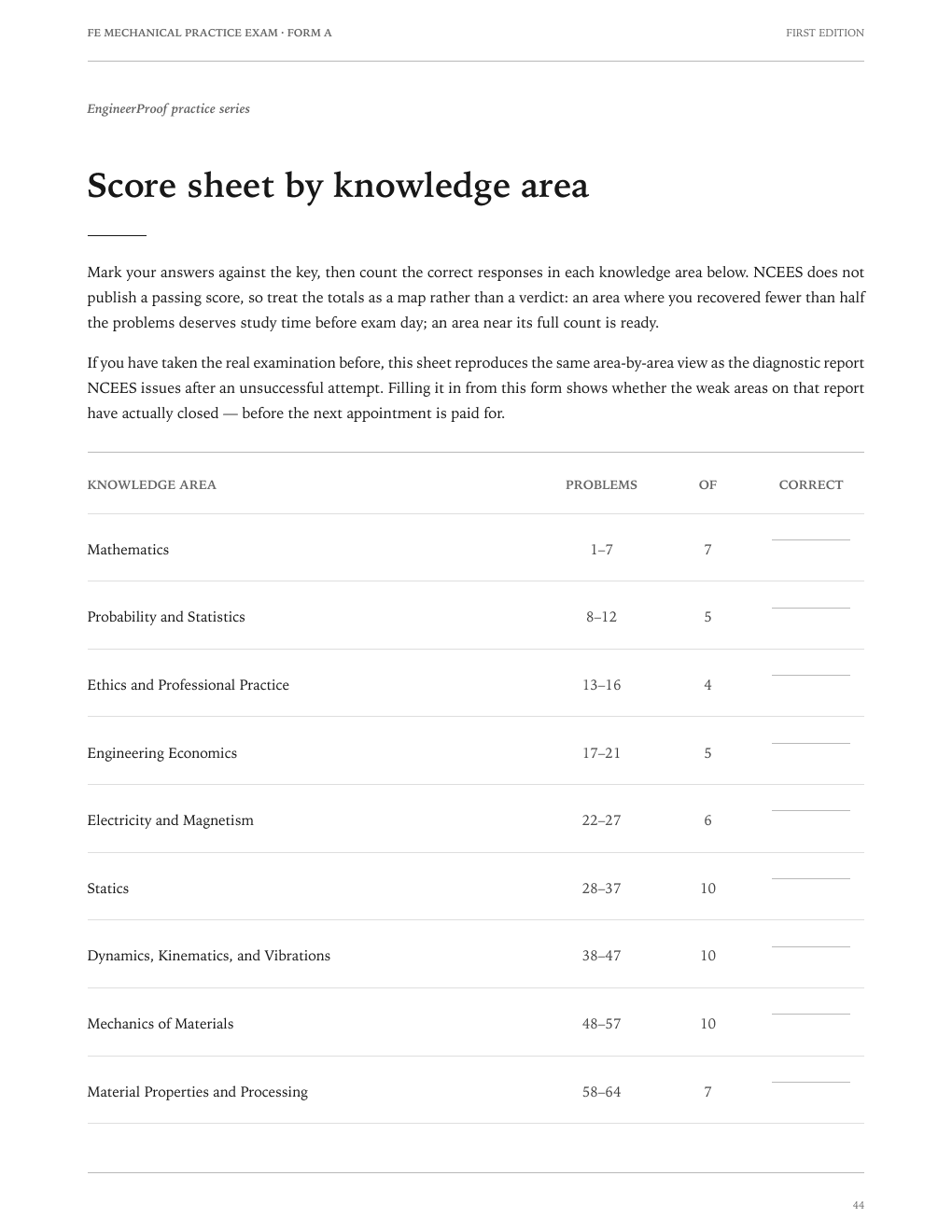
Pages from each form
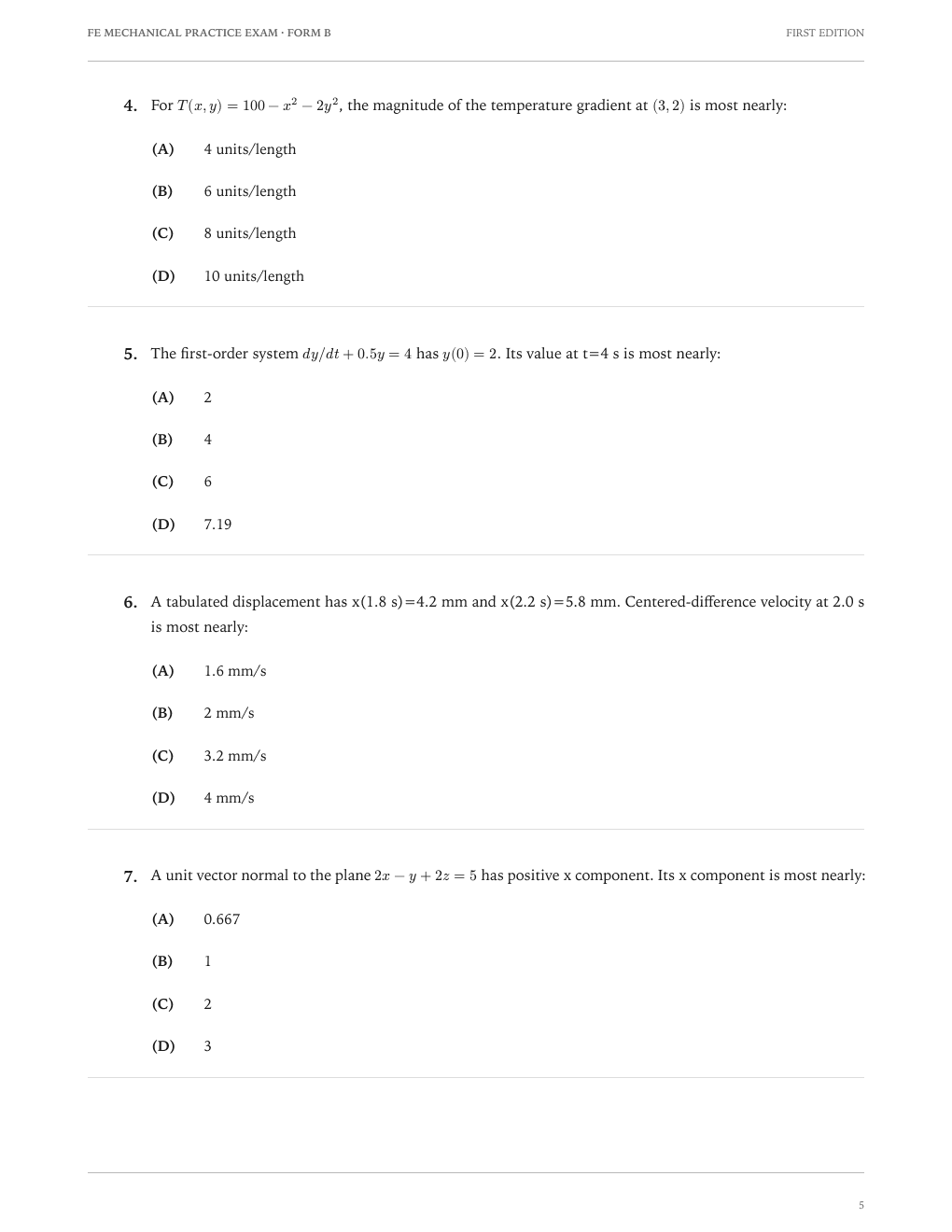
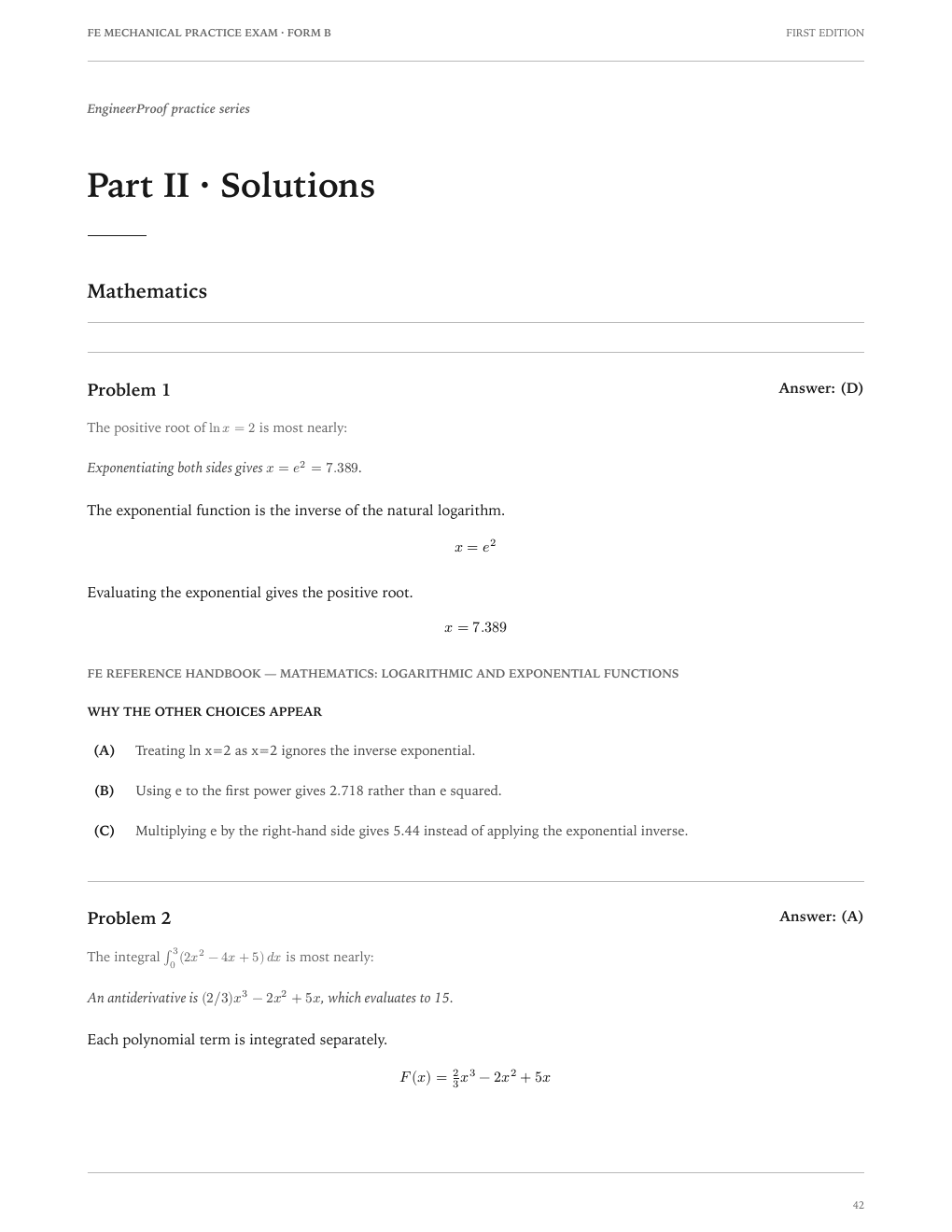
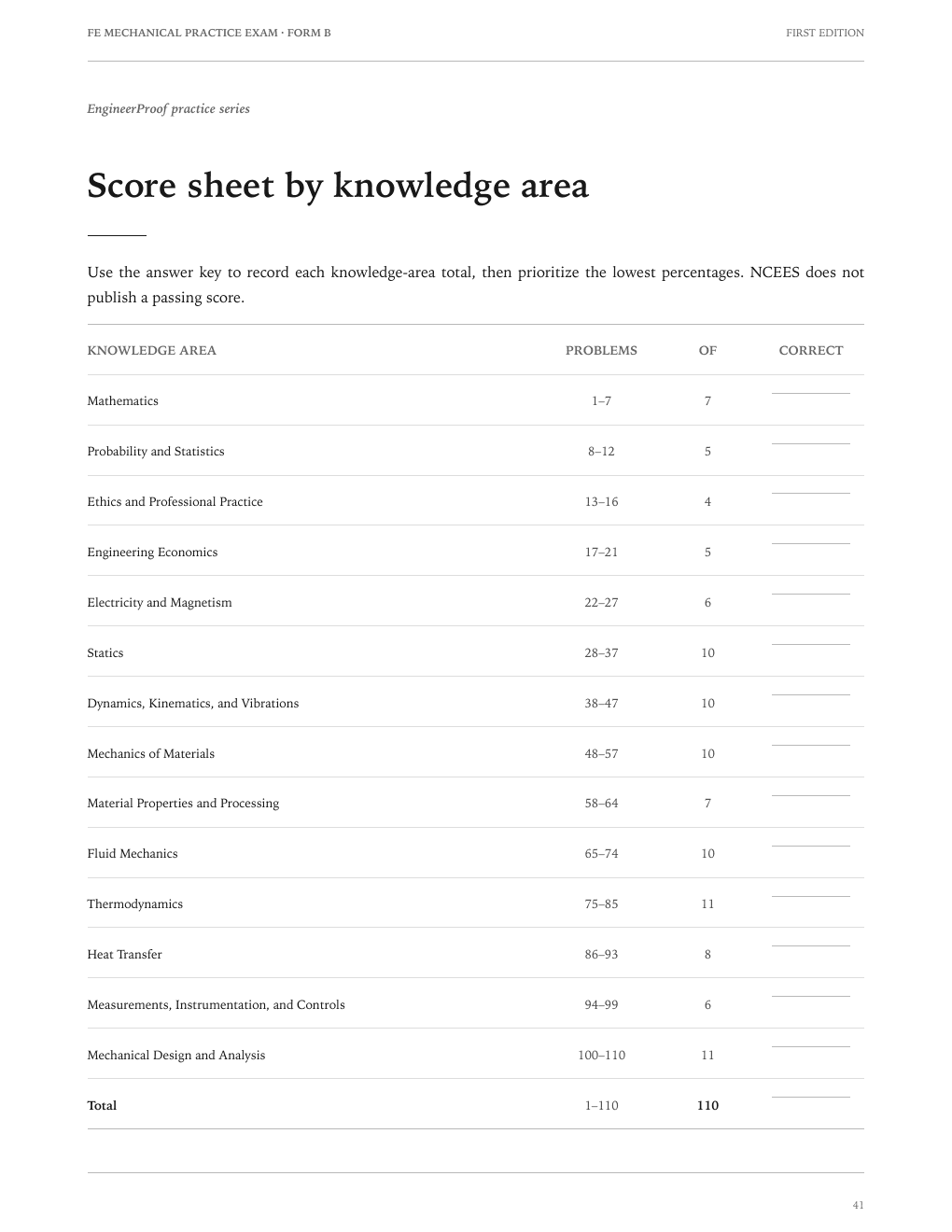
Direct renders from the current PDF releases, not illustrative mockups.
Form A
129 pages · Version 1.0.0
Form B
107 pages · Version 1.0.0
18 free FE Mechanical practice problems with solutions
Work through all 14 knowledge areas. Each problem includes four choices, a complete solution, a handbook reference and an explanation of the wrong answers. No account or email is required.
The free sample PDF contains 14 Form A samples, one per area. The additional questions below are independent of the paid forms and are also in the free printable supplement.
Mathematics
3 free problems · Form A: 7 of 110 questions · NCEES range: 6-9
A right circular conical hopper stands apex down, ft deep with an ft top diameter. Granular material is fed in at a steady ft/min. When the material depth is ft, the rate at which the surface level rises is most nearly:
- (A)0.106 ft/min
- (B)0.141 ft/min
- (C)0.424 ft/min
- (D)1.273 ft/min
Show worked solution
Answer: (C)
Because the free surface at 6 ft depth spans only 28.3 ft, a 12 ft/min feed lifts the level about 0.42 ft/min.
Similar triangles fix the surface radius at half the depth, which collapses the cone volume to a function of depth alone.
Differentiating in time links the two rates, and the instantaneous depth of 6 ft closes the problem.
FE Reference Handbook — Mathematics: Derivatives and Indefinite Integrals; Mensuration of Areas and Volumes, Right Circular Cone
Why the other choices appear
- (A)Taking instead of gives ft/min.
- (B)Dropping the from the cone volume gives and ft/min.
- (D)Carrying the into the rate equation as with ft gives ft/min.
Two more free problem types
Try a different setup before reading the solution. These additional original questions are separate from the sold practice forms, so solving them does not reveal another question from a full practice form.
Separate an exponential model from its time constant
A temperature model is , with T in degrees C and t in minutes. A measurement gives T(10) = 45. Under this model, at what time after t = 0 does T reach 35 degrees C?
- (A)6.44 min
- (B)10.00 min
- (C)17.56 min
- (D)25.00 min
Show worked solution
Answer: (C)
The model reaches 35 degrees C at about 17.56 minutes.
The excess temperature above the 25-degree surroundings falls from 50 to 20 in ten minutes. Solve for the rate parameter before extrapolating.
At 35 degrees C the excess temperature is 10, so the exponential ratio is one fifth.
Substitute the time into the given model: 25 + 50 exp(-k t) = 35. The time exceeds ten minutes, as it must for a lower temperature.
FE Reference Handbook: Mathematics — exponential functions and first-order differential equations.
Why the other choices appear
- (A)This reverses the logarithm ratio.
- (B)The stated ten-minute observation is 45 degrees, not 35.
- (D)This assumes a linear cooling rate instead of exponential decay.
Numerical integration from measured flow
A pump flow rate is measured at t = 0, 2, and 4 minutes as 2, 6, and 4 cubic metres per minute, respectively. Using the composite trapezoidal rule with these two equal intervals, what volume is pumped from t = 0 to t = 4 minutes?
- (A)12 m³
- (B)16 m³
- (C)18 m³
- (D)24 m³
Show worked solution
Answer: (C)
The trapezoidal estimate is 18 cubic metres.
Integrate flow rate over time. Each two-minute interval uses the average of its endpoint rates.
In the composite form, interior readings receive twice the endpoint weight.
The average rate over all four minutes is 4.5 cubic metres per minute. Multiplying by four independently recovers 18 cubic metres. This is a numerical estimate; it is exact only if the rate varies linearly within each interval.
FE Reference Handbook: Mathematics — numerical integration, trapezoidal rule.
Why the other choices appear
- (A)This adds the three rates without incorporating time intervals.
- (B)This uses only the two endpoints and discards the middle reading.
- (D)This applies the maximum rate for all four minutes.
Download all 14 additional questions, diagrams and complete solutions (free PDF). Download the editable practice review sheet (CSV).
Original questions and diagrams by EngineerProof, September 30, 2026. Personal study and unchanged redistribution with attribution are permitted. The questions are independent practice, not official NCEES material. Report a correction.
The complete practice exam contains 7 mathematics problems in Form A and 7 in Form B, with full solutions and a knowledge-area score sheet.
Compare Form A and Form B and buy a PDF · USD 29 eachAll knowledge areasProbability and Statistics
1 free problem · Form A: 5 of 110 questions · NCEES range: 4-6
A bearing assembly line draws 65 percent of its bearings from supplier A and 35 percent from supplier B. Supplier A ships 2.0 percent defective units; supplier B ships 5.0 percent defective units. A bearing drawn at random from the line is found to be defective. The probability that it came from supplier B is most nearly:
- (A)0.350
- (B)0.426
- (C)0.574
- (D)0.714
Show worked solution
Answer: (C)
Supplier B ships the smaller volume but the higher defect rate, and weighting each rate by its production share assigns about 57 percent of the defective bearings to supplier B.
Defective units arise from two mutually exclusive supplier streams, so the overall defect rate is the share-weighted sum of the two individual rates.
Reversing the direction of conditioning divides supplier B's joint contribution by that overall rate.
FE Reference Handbook — Engineering Probability and Statistics: Bayes' Theorem
Why the other choices appear
- (A)Reports the prior production share P(B) = 0.350 without updating on the observed defect.
- (B)Computes the complementary posterior P(A|D) = 0.0130/0.0305 = 0.426, the wrong supplier.
- (D)Forms the ratio of defect rates alone, 0.050/(0.020 + 0.050) = 0.714, omitting the production shares.
The complete practice exam contains 5 probability and statistics problems in Form A and 5 in Form B, with full solutions and a knowledge-area score sheet.
Compare Form A and Form B and buy a PDF · USD 29 eachAll knowledge areasEthics and Professional Practice
3 free problems · Form A: 4 of 110 questions · NCEES range: 4-6
Read the dedicated ethics and professional practice practice set
A licensed professional engineer is asked to apply a seal to a structural connection design package prepared by an unlicensed designer employed at a different firm. The engineer did not direct or control the preparation of the design but has since reviewed the calculations and found them technically acceptable. Under the NCEES Model Rules, applying the seal is:
- (A)Permissible, because the calculations were reviewed and found acceptable
- (B)Permissible, provided the originating designer is credited on the drawings
- (C)Permissible, provided the engineer accepts liability for the design in writing
- (D)Not permissible, because the work was not performed under responsible charge
Show worked solution
Answer: (D)
The seal certifies work prepared by the licensee or under the licensee's responsible charge, and after-the-fact review establishes no such direct control.
Sealing is a certification that the documents were prepared by the licensee personally or under the licensee's responsible charge, which requires direct control and personal supervision while the work is being performed.
Review conducted after completion supplies no control over the assumptions, load paths, and detailing decisions already made, so the responsible-charge test fails even though the reviewer is competent in the subject matter.
Attribution on the title block and a written assumption of liability are contractual devices that never create the supervisory relationship the seal represents, leaving the package unsealable by this engineer.
FE Reference Handbook — Ethics and Professional Practice: NCEES Model Rules, Rules of Professional Conduct (Responsible Charge and Sealing of Documents)
Why the other choices appear
- (A)Substitutes technical review for responsible charge, treating a competence check as equivalent to supervision of the work.
- (B)Assumes credit to the originating designer cures the defect, but disclosure of authorship does not transfer supervisory control to the sealing licensee.
- (C)Assumes liability may be purchased by contract, whereas the seal attests to how the work was produced, not to who pays for its failure.
Two more free problem types
Try a different setup before reading the solution. These additional original questions are separate from the sold practice forms, so solving them does not reveal another question from a full practice form.
When a safety judgment is overruled
An engineer identifies a credible structural hazard in equipment to be opened to the public. The employer overrules the engineer's documented recommendation to correct it. Under NCEES Model Rules 240.15 A, what is the most appropriate next action?
- (A)Accept the employer decision because the employer owns the equipment.
- (B)Notify the employer or client and an appropriate authority about the danger.
- (C)Remain silent until an accident demonstrates the hazard.
- (D)Publish confidential drawings on social media before contacting anyone.
Show worked solution
Answer: (B)
Notify the employer or client and an appropriate authority when public safety is endangered by an overruled professional judgment.
The scenario establishes a credible public hazard and an overruled professional judgment. Section 240.15 A.1 makes public health, safety, and welfare the foremost duty.
Section 240.15 A.3 requires notification to the employer or client and an appropriate authority in this circumstance. Document the engineering facts and follow applicable jurisdiction procedures.
The model rule supplies the exam reasoning. It does not justify indiscriminate release of confidential drawings; actual legal duties depend on the jurisdiction and facts.
NCEES Model Rules, August 2025: 240.15 A.1 and A.3; B.4 confidentiality.
Why the other choices appear
- (A)Ownership does not remove the public-safety duty.
- (C)Waiting for harm disregards the known hazard and notification duty.
- (D)Notification to an appropriate authority is not a general license to expose confidential project material.
A financial interest in a vendor
An engineer is evaluating two vendors for a client. The engineer owns a substantial financial interest in one vendor. Both bids meet the technical specification. Under NCEES Model Rules 240.15 B, what should the engineer do before advising the client?
- (A)Disclose the financial interest and its potential influence to the client.
- (B)Keep the interest private because both bids satisfy the specification.
- (C)Choose the other vendor so disclosure is unnecessary.
- (D)Accept an undisclosed commission if the favored vendor offers the lower price.
Show worked solution
Answer: (A)
Disclose the known or potential conflict of interest; satisfying the specification does not eliminate the appearance of influence.
The vendor ownership could influence, or appear to influence, the recommendation. The disclosure duty does not require proof that the engineer has already made a biased decision.
Section 240.15 B.6 calls for disclosure to employers or clients of interests or circumstances that may affect judgment or service quality.
Selecting another vendor alone does not communicate the existing interest. An undisclosed commission also introduces a separate gratuity issue under B.5. The question asks for the required first disclosure, not a blanket permission to proceed with every conflict.
NCEES Model Rules, August 2025: 240.15 B.5–B.6.
Why the other choices appear
- (B)Technical compliance does not remove a financial conflict.
- (C)Changing the choice without disclosure conceals the known interest.
- (D)Price does not justify undisclosed vendor compensation.
Download all 14 additional questions, diagrams and complete solutions (free PDF). Download the editable practice review sheet (CSV).
Original questions and diagrams by EngineerProof, September 30, 2026. Personal study and unchanged redistribution with attribution are permitted. The questions are independent practice, not official NCEES material. Report a correction.
Source for these two ethics scenarios: NCEES Model Rules, August 2025, section 240.15. The rules are a model; check the applicable jurisdiction for an actual professional decision.
The complete practice exam contains 4 ethics and professional practice problems in Form A and 4 in Form B, with full solutions and a knowledge-area score sheet.
Compare Form A and Form B and buy a PDF · USD 29 eachAll knowledge areasEngineering Economics
1 free problem · Form A: 5 of 110 questions · NCEES range: 4-6
A municipal pumping station rated at has a first cost of USD 480{,}000, annual maintenance of USD 18{,}000, and a major overhaul costing USD 60{,}000 at the end of every eighth year of service. The station is to be maintained in service indefinitely. At an interest rate of 6% per year, the capitalized cost is most nearly:
- (A)USD 780,000
- (B)USD 881,000
- (C)USD 905,000
- (D)USD 941,000
Show worked solution
Answer: (B)
Converting the eight-year overhaul to an annual equivalent of USD 6{,}062 lifts the perpetual annual charge to USD 24{,}062, which capitalized at 6% and added to the first cost gives roughly USD 881{,}000.
Capitalized cost is the present worth of a perpetual annual disbursement, so every recurring outlay must first be expressed as an equivalent uniform annual amount.
The overhaul repeats on an eight-year cycle, so a sinking fund accumulated over each cycle carries it, not a capital recovery charge.
Total perpetual annual cost divided by the interest rate is the fund that must stand behind the station beyond its first cost.
FE Reference Handbook — Engineering Economics: Capitalized Costs; Sinking Fund Factor (A/F)
Why the other choices appear
- (A)Omits the overhaul entirely and capitalizes only maintenance: 480,000 + 18,000/0.06 = 780,000.
- (C)Prorates the overhaul arithmetically as 60,000/8 = 7,500 per year instead of using the sinking-fund factor: 480,000 + 25,500/0.06 = 905,000.
- (D)Uses (A/P, 6%, 8) = 0.16104 in place of (A/F, 6%, 8), giving 9,662 per year and 480,000 + 27,662/0.06 = 941,000.
The complete practice exam contains 5 engineering economics problems in Form A and 5 in Form B, with full solutions and a knowledge-area score sheet.
Compare Form A and Form B and buy a PDF · USD 29 eachAll knowledge areasElectricity and Magnetism
1 free problem · Form A: 6 of 110 questions · NCEES range: 5-8
A 48 V ideal DC source feeds node A through a 6 series resistor, and a 12 resistor connects node A to the source return. A variable resistive load is then connected between node A and the return. The maximum power the load can absorb is most nearly:
- (A)64 W
- (B)144 W
- (C)256 W
- (D)576 W
Show worked solution
Answer: (A)
Matching the load to the 4 Thevenin resistance caps the transfer at 64 W, one quarter of .
Maximum transfer requires the load to equal the Thevenin resistance at the terminals, which is the 6 source branch in parallel with the 12 element.
Half the Thevenin voltage lands on a matched load, which is why the ceiling depends on the equivalent source alone and not on any particular load value.
FE Reference Handbook — Electricity and Magnetism: Thevenin Equivalent Circuit and Maximum Power Transfer
Why the other choices appear
- (B)Using the 48 V source voltage in place of the 32 V Thevenin voltage gives W.
- (C)Omitting the matched-load factor of 4 gives W.
- (D)Committing both errors together gives W.
The complete practice exam contains 6 electricity and magnetism problems in Form A and 6 in Form B, with full solutions and a knowledge-area score sheet.
Compare Form A and Form B and buy a PDF · USD 29 eachAll knowledge areasStatics
1 free problem · Form A: 10 of 110 questions · NCEES range: 9-14
A vertical mast is fixed at the origin with its top at point A, 12 m above the base. Two guy cables run from A to ground anchors: cable AB to anchor B, located 9 m from the base along the positive axis, and cable AC to anchor C, located 5 m from the base along the negative axis. The tension is 3.0 kN in AB and 2.6 kN in AC. The magnitude of the resultant of the two cable forces acting at A is most nearly:
- (A)2.06 kN
- (B)3.97 kN
- (C)4.80 kN
- (D)5.22 kN
Show worked solution
Answer: (D)
The two tensions combine to a resultant of 5.22 kN at A, of which 4.8 kN acts vertically downward along the mast.
Each cable force is its tension scaled by the unit vector along its own leg, so the anchor geometry alone fixes the direction cosines.
Concurrent forces must be added component by component before any magnitude is extracted.
FE Reference Handbook — Statics: Force (Vector Components and Resultant)
Why the other choices appear
- (A)Magnitude of the horizontal components only, kN, discarding the vertical resultant.
- (B)Root-sum-square of the two tension magnitudes, kN, as if the cables were mutually perpendicular.
- (C)Sum of the vertical components alone, kN.
The complete practice exam contains 10 statics problems in Form A and 10 in Form B, with full solutions and a knowledge-area score sheet.
Compare Form A and Form B and buy a PDF · USD 29 eachAll knowledge areasDynamics, Kinematics, and Vibrations
1 free problem · Form A: 10 of 110 questions · NCEES range: 10-15
Gravel leaves the end of a horizontal conveyor at 24 ft/s. The discharge point is 18 ft above the surface of the stockpile, and air resistance is negligible. The horizontal distance from the discharge point to the point of impact is most nearly:
- (A)17.9 ft
- (B)25.4 ft
- (C)26.8 ft
- (D)46.0 ft
Show worked solution
Answer: (B)
The 18 ft drop takes 1.06 s, and the constant 24 ft/s horizontal velocity carries the gravel about 25.4 ft in that time.
Horizontal and vertical motion are uncoupled, so the drop height alone fixes the time of flight.
Zero horizontal acceleration holds the discharge speed constant over that interval.
FE Reference Handbook — Dynamics: Particle Kinematics, Projectile Motion
Why the other choices appear
- (A)Uses h rather than 2h in the fall-time expression, giving t = sqrt(18/32.2) = 0.748 s and x = 17.9 ft.
- (C)Omits the square root on the fall time, taking t = 2h/g = 1.118 s so that x = 26.8 ft.
- (D)Applies the SI gravitational constant 9.81 to USCS data, giving t = sqrt(36/9.81) = 1.916 s and x = 46.0 ft.
The complete practice exam contains 10 dynamics, kinematics, and vibrations problems in Form A and 10 in Form B, with full solutions and a knowledge-area score sheet.
Compare Form A and Form B and buy a PDF · USD 29 eachAll knowledge areasMechanics of Materials
1 free problem · Form A: 10 of 110 questions · NCEES range: 9-14
A stepped tie rod of high-strength alloy steel with a 690 MPa yield strength hangs from a rigid ceiling and carries a 40 kN axial tensile load at its lower end. The upper segment is 900 mm long with a 20 mm diameter; the lower segment is 600 mm long with a 14 mm diameter. The modulus of elasticity is 200 GPa. The total elongation of the rod is most nearly:
- (A)0.21 mm
- (B)0.95 mm
- (C)1.35 mm
- (D)1.95 mm
Show worked solution
Answer: (C)
Axial flexibility varies inversely with area, so the 14 mm segment supplies more than half of the 1.35 mm total elongation.
Both segments transmit the full 40 kN, so their elongations add and each cross-sectional area must be evaluated separately.
The higher of the two axial stresses occurs in the slender segment and stays well below the 690 MPa yield strength, so the linear elastic relation governs throughout.
Deformation scales inversely with area, so the slender lower segment stretches more even though it is shorter, and the two contributions sum to the downward movement of the loaded end relative to the ceiling.
FE Reference Handbook — Mechanics of Materials: Uniaxial Loading and Deformation, δ = PL/(AE)
Why the other choices appear
- (A)Subtracting the segment elongations instead of adding them, 0.780 - 0.573 = 0.21 mm.
- (B)Carrying the 20 mm diameter over the full 1500 mm length, giving 0.95 mm.
- (D)Carrying the 14 mm diameter over the full 1500 mm length, giving 1.95 mm.
The complete practice exam contains 10 mechanics of materials problems in Form A and 10 in Form B, with full solutions and a knowledge-area score sheet.
Compare Form A and Form B and buy a PDF · USD 29 eachAll knowledge areasMaterial Properties and Processing
1 free problem · Form A: 7 of 110 questions · NCEES range: 7-11
The engineering stress-strain response of a hot-rolled structural steel is idealized by two straight segments: a linear elastic rise from the origin to yield at MPa and strain, followed by a straight line to fracture at MPa and strain. The modulus of toughness is most nearly:
- (A)
- (B)
- (C)
- (D)
Show worked solution
Answer: (C)
Nearly all of the area under the curve lies in the plastic trapezoid, so the modulus of toughness is about .
Modulus of toughness is the total energy per unit volume absorbed to fracture, which is the area under the engineering stress-strain curve; the idealized curve splits into an elastic triangle and a plastic trapezoid.
Yield strain is small, so the elastic triangle contributes a negligible share of the total.
Stress rises linearly from yield to fracture, so the plastic region is a trapezoid whose height is the mean of the two stress levels.
FE Reference Handbook — Materials Science and Engineering: Engineering Stress-Strain Curve, Modulus of Toughness
Why the other choices appear
- (A)Counts only the elastic triangle, , which is the modulus of resilience rather than the toughness.
- (B)Treats the plastic region as a triangle of height equal to the ultimate strength, .
- (D)Takes the area as a full rectangle of ultimate strength times fracture strain, .
The complete practice exam contains 7 material properties and processing problems in Form A and 7 in Form B, with full solutions and a knowledge-area score sheet.
Compare Form A and Form B and buy a PDF · USD 29 eachAll knowledge areasFluid Mechanics
1 free problem · Form A: 10 of 110 questions · NCEES range: 10-15
A horizontal venturi meter in a chilled-water line has an inlet diameter of mm and a throat diameter of mm. The measured pressure drop from inlet to throat is kPa, the meter coefficient is , and the water density is kg/m. The volumetric flow rate is most nearly:
- (A)32.4 L/s
- (B)33.5 L/s
- (C)34.1 L/s
- (D)37.4 L/s
Show worked solution
Answer: (B)
With a diameter ratio of the velocity-of-approach factor is , yielding a throat velocity of m/s and about L/s.
Continuity locks the inlet speed to the throat speed through the area ratio, and the horizontal energy balance converts the measured pressure drop into a single throat velocity.
Retaining the term keeps the upstream kinetic energy in the balance, which at raises the velocity by about percent.
Throat area converts that velocity into discharge.
FE Reference Handbook — Fluid Mechanics: Flow Measurement, Venturi Meters (with the Continuity Equation)
Why the other choices appear
- (A)Drops the velocity-of-approach factor and uses m/s, giving L/s.
- (C)Omits the meter coefficient , using the ideal throat velocity m/s to obtain L/s.
- (D)Writes the correction as instead of , raising the velocity to m/s and the flow to L/s.
The complete practice exam contains 10 fluid mechanics problems in Form A and 10 in Form B, with full solutions and a knowledge-area score sheet.
Compare Form A and Form B and buy a PDF · USD 29 eachAll knowledge areasThermodynamics
1 free problem · Form A: 11 of 110 questions · NCEES range: 10-15
A rigid vessel of volume m contains 2.0 kg of water at 1.0 MPa. At 1.0 MPa the saturation properties are m/kg, m/kg, kJ/kg, and kJ/kg. The total internal energy of the contents is most nearly:
- (A)1,520 kJ
- (B)2,810 kJ
- (C)4,330 kJ
- (D)5,170 kJ
Show worked solution
Answer: (C)
The specific volume of m/kg places the water at 77% quality, which carries about 4,330 kJ of internal energy.
Dividing the vessel volume by the charge mass fixes the specific volume, and its position between and confirms a two-phase state.
Quality measures how far that specific volume has advanced across the saturation span.
Internal energy follows the same lever rule between the liquid and vapor values, and the vessel holds 2.0 kg.
FE Reference Handbook — Thermodynamics: Properties for Two-Phase (Saturated) Systems, Quality
Why the other choices appear
- (A)Treats the contents as saturated liquid, kJ.
- (B)Drops and keeps only the evaporation term, kJ.
- (D)Treats the contents as saturated vapor, kJ.
The complete practice exam contains 11 thermodynamics problems in Form A and 11 in Form B, with full solutions and a knowledge-area score sheet.
Compare Form A and Form B and buy a PDF · USD 29 eachAll knowledge areasHeat Transfer
1 free problem · Form A: 8 of 110 questions · NCEES range: 7-11
A composite panel consists of a 12 mm thick stainless steel plate ( W/(m·K)) bonded to an 8 mm thick aluminum plate ( W/(m·K)). The bond has a thermal contact resistance of . Under steady one-dimensional conduction the exposed steel face is held at 210 °C and the exposed aluminum face at 90 °C. The heat flux through the panel is most nearly:
- (A)76 kW/m²
- (B)110 kW/m²
- (C)142 kW/m²
- (D)150 kW/m²
Show worked solution
Answer: (B)
The bonded joint contributes nearly one quarter of the series resistance, holding the flux to about 110 kW/m².
Series resistances per unit area govern the panel, and the bonded joint enters the chain exactly as a solid layer does.
One-dimensional steady flow drives the entire 120 K face-to-face difference through that single chain.
The joint absorbs 27 K of the drop against only 4.9 K for the aluminum, so discarding contact resistance would overstate the flux by about 30 percent.
FE Reference Handbook — Heat Transfer: Conduction Through a Plane Wall and Thermal Resistances in Series
Why the other choices appear
- (A)Uses the steel conductivity for the aluminum layer as well, raising the total to 1.583e-3 m²·K/W and giving 75.8 kW/m².
- (C)Omits the contact resistance, leaving 8.44e-4 m²·K/W and 142 kW/m².
- (D)Counts only the steel layer, 120 divided by 8.0e-4, giving 150 kW/m².
The complete practice exam contains 8 heat transfer problems in Form A and 8 in Form B, with full solutions and a knowledge-area score sheet.
Compare Form A and Form B and buy a PDF · USD 29 eachAll knowledge areasMeasurements, Instrumentation, and Controls
1 free problem · Form A: 6 of 110 questions · NCEES range: 5-8
A single active foil gauge of gauge factor 2.10 is bonded along the axis of a steel tie rod ( GPa) and wired as one arm of a quarter-bridge excited at 10.0 V DC. The bridge is balanced at no load; under load the bridge output is 1.05 mV. The axial stress in the rod is most nearly:
- (A)20 MPa
- (B)40 MPa
- (C)84 MPa
- (D)176 MPa
Show worked solution
Answer: (B)
The bridge output corresponds to 200 microstrain in the active arm, or 40 MPa of axial stress in the steel rod.
A single active arm unbalances the bridge by one quarter of the fractional resistance change, so the output-to-excitation ratio carries a factor of four.
Hooke's law in uniaxial tension converts the surface strain to stress, since the rod remains elastic.
FE Reference Handbook — Instrumentation, Measurement, and Controls: Strain Gauge and Wheatstone Bridge
Why the other choices appear
- (A)Uses the half-bridge factor of 2 instead of 4, giving 100 microstrain and 20 MPa.
- (C)Omits the gauge factor entirely, giving 4(1.05 mV)/(10.0 V) = 420 microstrain and 84 MPa.
- (D)Multiplies by the gauge factor instead of dividing, giving 882 microstrain and 176 MPa.
The complete practice exam contains 6 measurements, instrumentation, and controls problems in Form A and 6 in Form B, with full solutions and a knowledge-area score sheet.
Compare Form A and Form B and buy a PDF · USD 29 eachAll knowledge areasMechanical Design and Analysis
1 free problem · Form A: 11 of 110 questions · NCEES range: 10-15
A ductile steel bracket has a yield strength of 46 ksi. At the critical point the plane stress state is ksi, ksi, and ksi. Using the maximum distortion energy theory, the factor of safety against yielding is most nearly:
- (A)1.79
- (B)1.99
- (C)2.18
- (D)2.56
Show worked solution
Answer: (A)
A von Mises stress of 25.7 ksi against the 46 ksi yield strength gives a factor of safety of roughly 1.79.
Distortion energy collapses the biaxial state into one equivalent uniaxial stress, and for plane stress all three in-plane components enter directly.
Yielding becomes a single scalar comparison; the compressive increases rather than relieving it, which holds the margin below two.
FE Reference Handbook — Mechanical Design and Analysis: Static Loading Failure Theories, Distortion Energy Theory
Why the other choices appear
- (B)Factor of 3 omitted from the shear term: ksi gives .
- (C)Sign of taken as positive: ksi gives .
- (D)Shear and transverse components ignored, checking alone: .
The complete practice exam contains 11 mechanical design and analysis problems in Form A and 11 in Form B, with full solutions and a knowledge-area score sheet.
Compare Form A and Form B and buy a PDF · USD 29 eachAll knowledge areasWhat each download contains
- Edition
- First edition
- Form A
- 129 pages · Version 1.0.0
- Form B
- 107 pages · Version 1.0.0
- Questions
- 110 original problems per form
- Coverage
- 14 knowledge areas
- Question type
- Four-choice, single-answer
- Format
- Print-ready PDF, US Letter
Built against the NCEES FE Mechanical specifications effective July 2020, current as of July 2026. Official exam format and appointment facts are available from NCEES. This printable form does not reproduce the Pearson VUE interface or interactive alternative item types.
Knowledge-area coverage
| Knowledge area | Form A | NCEES range |
|---|---|---|
| Mathematics | 7 | 6-9 |
| Probability and Statistics | 5 | 4-6 |
| Ethics and Professional Practice | 4 | 4-6 |
| Engineering Economics | 5 | 4-6 |
| Electricity and Magnetism | 6 | 5-8 |
| Statics | 10 | 9-14 |
| Dynamics, Kinematics, and Vibrations | 10 | 10-15 |
| Mechanics of Materials | 10 | 9-14 |
| Material Properties and Processing | 7 | 7-11 |
| Fluid Mechanics | 10 | 10-15 |
| Thermodynamics | 11 | 10-15 |
| Heat Transfer | 8 | 7-11 |
| Measurements, Instrumentation, and Controls | 6 | 5-8 |
| Mechanical Design and Analysis | 11 | 10-15 |
Verification and corrections
Original problems, checked by a second calculation route
Every answer is reproduced with an alternate formula, a limiting case, a dimensional check, or a direct recomputation before publication. Official examination questions are confidential and are not reproduced or paraphrased.
Confirmed errors are published as versioned corrections. Buyers can re-download the corrected release at no charge. Read the full editorial method.
For a repeat attempt
Close the weak areas before another USD 225 appointment
FE Mechanical repeat examinees passed at 37% versus 69% for first-time examinees in the cited NCEES data. Use the form's score sheet beside your diagnostic report, then read the FE Mechanical retake plan or compare FE pass rates by discipline.
Before you buy
Questions about the PDF
Is this an official NCEES practice exam?
EngineerProof is not affiliated with, endorsed by, or sponsored by NCEES. FE and NCEES are registered trademarks of the National Council of Examiners for Engineering and Surveying, used solely to identify the examination for which these study materials are relevant. All problems and solutions in this publication are original works.
Does it reproduce the computer-based test interface?
No. This is a printable four-choice PDF. It does not include the Pearson VUE interface or interactive alternative item types such as point-and-click and drag-and-drop.
How is the PDF delivered?
Stripe returns you to a private download page after payment. The same 90-day link is sent to the checkout email.
Can I print the exam?
Yes. One purchase includes a personal license to download and print the PDF for your own study.
What if the book is not right for me?
Email inshihub.com@gmail.com within 14 days for a full refund. No reason is required.
USD 29 each