FE Civil practice workflow
Turn a 110-question FE Civil practice test into an area scorecard
A full-form total compresses fourteen different knowledge areas into one number. Keep the total, but make the next study decision from an area scorecard. For every area, record solution quality, first-pass progress, and independent verification. Those three measurements separate a knowledge gap from a pacing or checking problem.
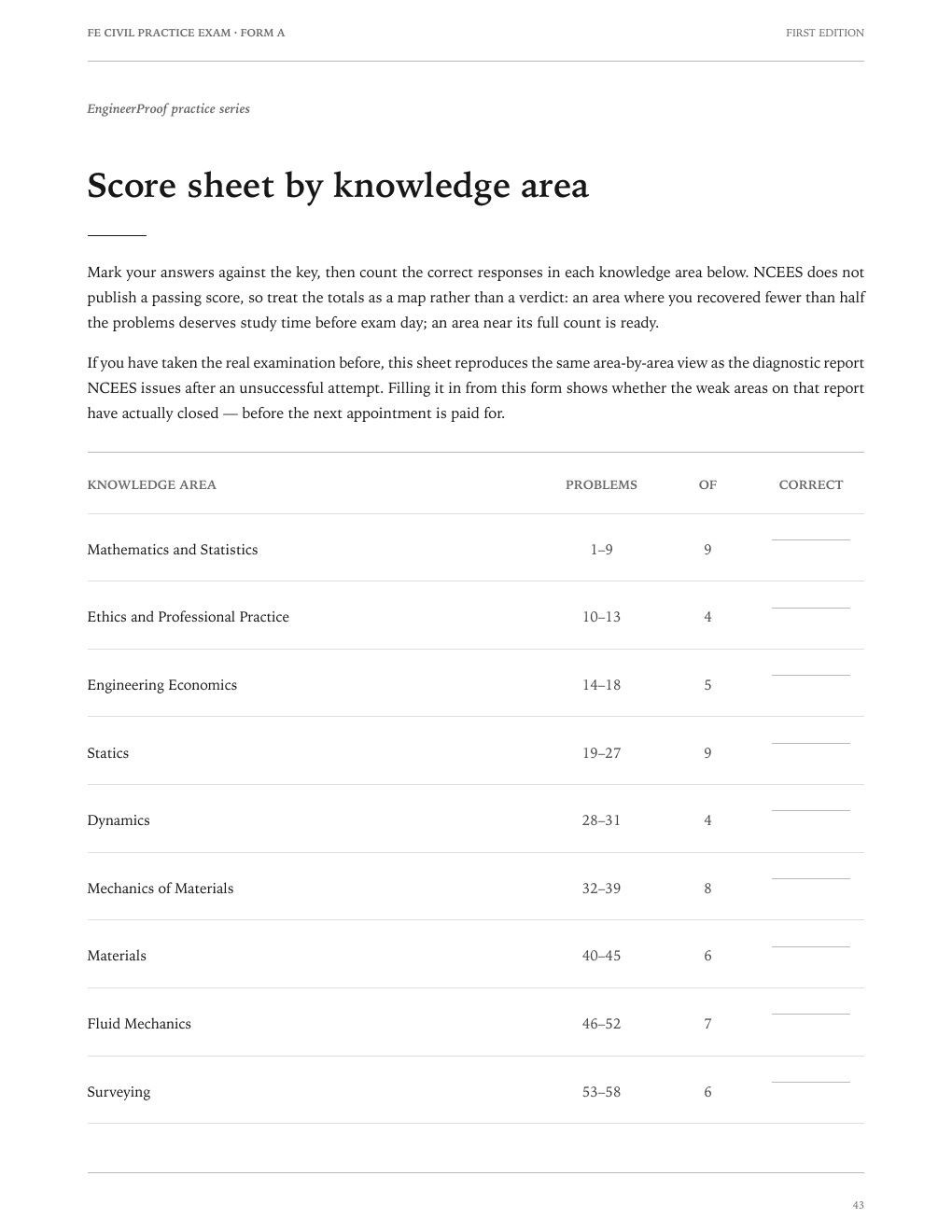
Record three measures
| Measure | Formula | Question it answers |
|---|---|---|
| Accuracy | correct ÷ attempted | Were attempted solutions correct? |
| First-pass completion | reached on first pass ÷ area questions | Did the timing plan expose the whole area? |
| Verification | independently checked ÷ attempted | How often did a second route challenge the first answer? |
“Verified” means a genuinely independent check: units, a limiting case, equilibrium, a second formula, or direct substitution. Reading the same arithmetic again does not count.
Worked example
This example is fictional. It shows why two areas with similar-looking correct counts can require different work.
| Area | Correct / attempted | Accuracy | First pass | Verified |
|---|---|---|---|---|
| Structural Engineering | 7 / 10 | 70% | 83% | 60% |
| Statics | 8 / 9 | 89% | 100% | 89% |
Structural Engineering needs error classification and a timing check: two questions were not reached, three attempted answers were wrong, and four attempted answers lacked an independent check. Statics first needs inspection of the single miss. Repeating the same quantity of work in both areas would discard that evidence.
The current 14-area allocation
Form A contains 110 original four-choice questions. The counts below come from the current local product manifest; the ranges are the NCEES specification ranges against which the form was built.
| Knowledge area | Form A | NCEES range |
|---|---|---|
| Mathematics and Statistics | 9 | 8-12 |
| Ethics and Professional Practice | 4 | 4-6 |
| Engineering Economics | 5 | 5-8 |
| Statics | 9 | 8-12 |
| Dynamics | 4 | 4-6 |
| Mechanics of Materials | 8 | 7-11 |
| Materials | 6 | 5-8 |
| Fluid Mechanics | 7 | 6-9 |
| Surveying | 6 | 6-9 |
| Water Resources and Environmental Engineering | 11 | 10-15 |
| Structural Engineering | 12 | 10-15 |
| Geotechnical Engineering | 12 | 10-15 |
| Transportation Engineering | 9 | 9-14 |
| Construction Engineering | 8 | 8-12 |
| Total | 110 | — |
Use the first 48 hours for triage
- Label each miss by its earliest cause: concept, reference search, model, units, execution, or time.
- Rank low-accuracy areas alongside exposure. One miss in a four-item area and three misses in a twelve-item area are not interchangeable.
- Reconstruct the three most informative misses on blank paper without looking at the prior solution.
- Change a value, diagram, or boundary condition and solve again. A memorized answer does not demonstrate transfer.
- Schedule a fresh area set. Save a second full form until the repair survives unfamiliar inputs.
Know what this artifact can prove
The current EngineerProof release is a 119-page, printable independent PDF, version 1.0.0. It does not reproduce the Pearson VUE interface, contain official NCEES questions, or predict an exam result. NCEES controls the exam format and specifications; check the current FE exam page and exam-preparation hub before relying on an administrative or specification fact.
If this is a repeat attempt, start with the diagnostic-to-retake workflow. Use the test–repair–retest gate before opening Form B. The current FE Civil product and free samples are available on the EngineerProof home page.
Sources, ownership, and corrections
NCEES owns and publishes the examination specifications and administration facts. EngineerProof owns the practice form, score sheet, worked example, and editorial workflow on this page. Product manifest and source pages were checked August 31, 2026. Report a suspected error through the EngineerProof about page.