Second-form decision
One FE practice form or two?
A second full form is useful when it tests a changed method. Opened immediately after reading Form A solutions, Form B mixes transfer with short-term recall. Put repair work between the forms, then require evidence before admitting the second sitting.
A 14-day sequence
Fourteen days is a worked schedule, not a required waiting period. Move the dates if the repair evidence is not ready; do not move Form B forward merely to preserve the calendar.
| Days | Work | Required output |
|---|---|---|
| 1 | Form A under a written timing plan | Area scorecard and error causes |
| 2–4 | Reconstruct high-information misses | Blank-paper solutions and handbook locators |
| 5–8 | Cause-specific area sets | New error counts by cause |
| 9–11 | Changed-input transfer sets | Methods tested on unfamiliar values |
| 12 | Rest or light retrieval | No full-form rehearsal |
| 13 | Form B under the same written rules | Comparable area scorecard |
| 14 | Compare both evidence sets | Remaining repair decision |
The Form B admission gate
Require all five conditions. If one is missing, keep the unopened form as a future measurement rather than spending it as another practice set.
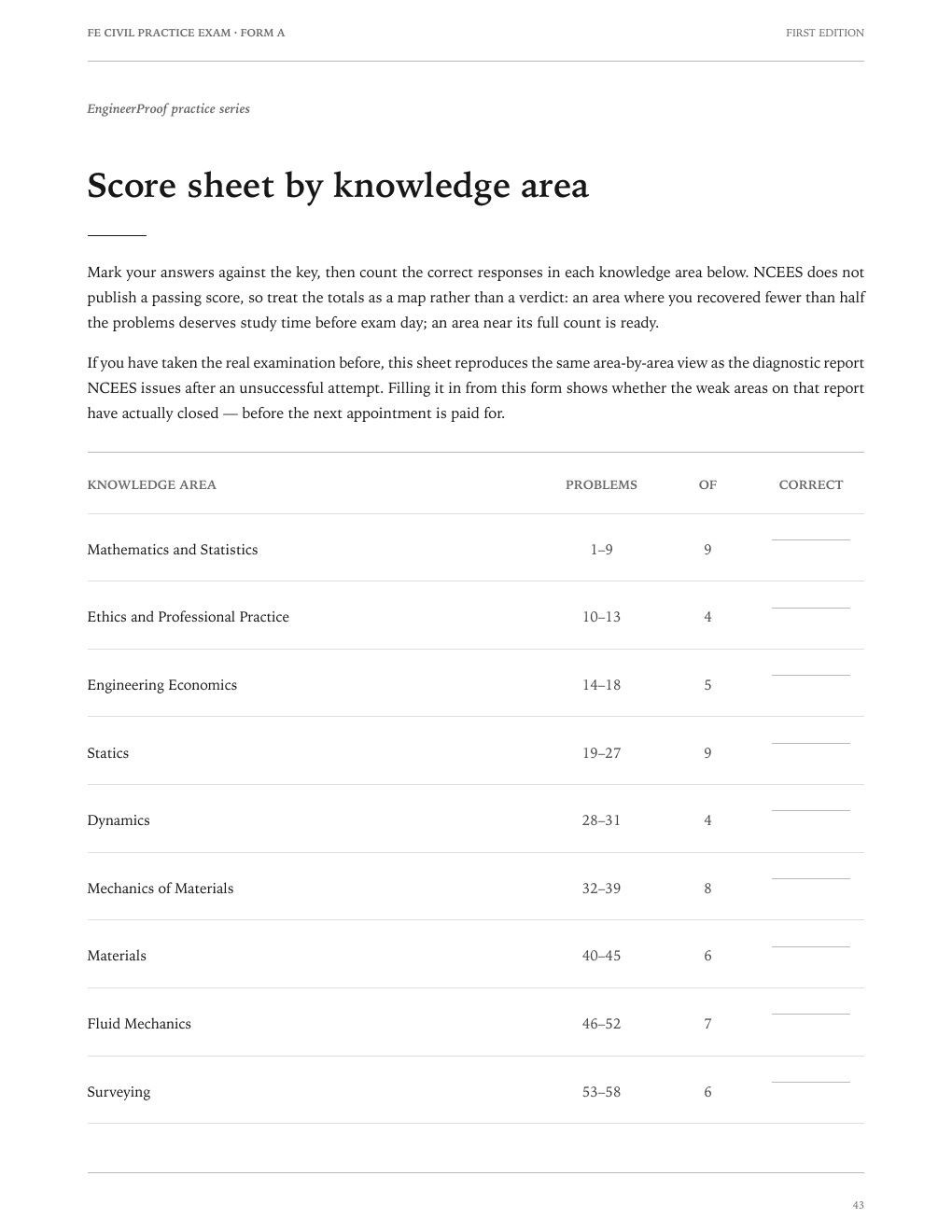
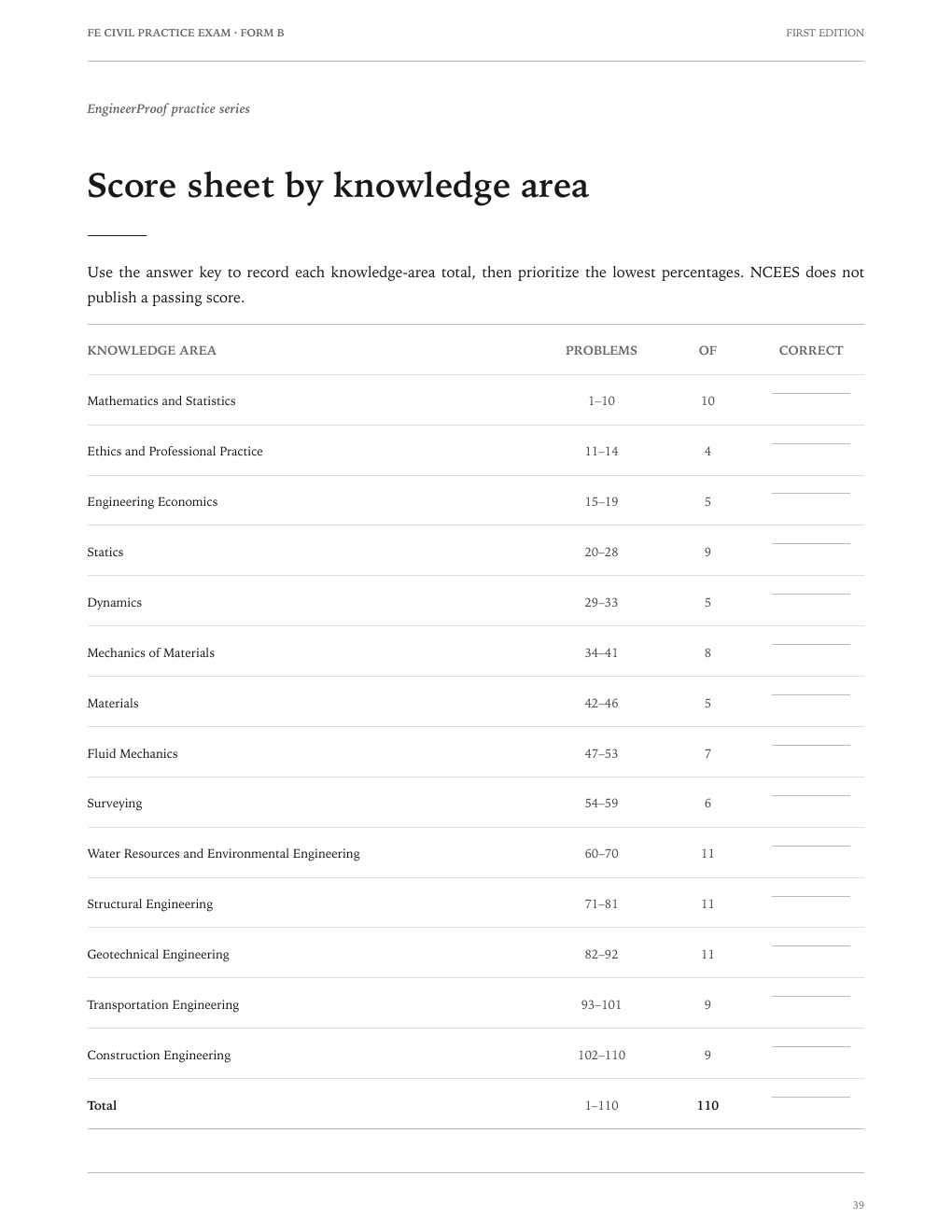
- Form A has a completed area scorecard, not only a total score.
- Every unresolved guess and miss has an earliest cause label.
- At least two dominant causes received cause-specific practice.
- The repaired methods survived unseen values, diagrams, or boundary conditions.
- The timing and checking rules for Form B are written before it begins.
Compare causes, not only totals
Use the same scoring rules for both sittings: correct divided by attempted, first-pass completion, and independent verification. Then compare the count of the earliest error causes. A higher total with the same modelling failures may only mean that Form B sampled those failures less heavily. A similar total with fewer model and unit errors can still show a useful process change, while also identifying the next bottleneck.
The comparison is evidence about these two independent practice forms. It is not an NCEES score conversion, a predicted passing probability, or proof that a particular number of practice exams is sufficient.
Current EngineerProof form availability
As checked August 31, 2026, the EngineerProof catalogue has distinct A/B practice forms for 5 disciplines. The other 2 currently have Form A only.
| Availability | Disciplines |
|---|---|
| Forms A and B | FE Civil, FE Mechanical, FE Electrical and Computer, FE Environmental, FE Other Disciplines |
| Form A only | FE Chemical, FE Industrial and Systems |
This is an EngineerProof catalogue statement. It does not describe the NCEES product catalogue. The official NCEES FE exam page controls current exam-administration facts, and the NCEES exam-preparation page lists NCEES materials and current specifications.
If there is only one form
Keep Form A as the baseline and build transfer checks from fresh area-level problems. Change values, representations, and boundary conditions, then remeasure the same cause labels. Do not reset the same full PDF immediately and treat remembered items as a new measurement.
Start with the FE Civil scorecard workflow or the broader diagnostic-to-retake workflow. The current independent forms and free samples are on the EngineerProof catalogue.
Sources, ownership, and corrections
NCEES is the authority for the FE exam and its own preparation products. EngineerProof owns the two pictured practice artifacts and this editorial decision workflow. Catalogue and source pages were checked August 31, 2026. Report a suspected error through the EngineerProof about page.