FE Other Disciplines Engineering Economics Practice Problems

Work 3 free FE Other Disciplines engineering economics practice problems with complete solutions, governing equations and checks. Attempt the setup before reading the answer.

Free sample problem

A municipal wastewater pumping station incurs a maintenance cost of USD 8{,}000 at the end of year 1. The cost increases by USD 1{,}200 in each following year through the end of year 8. At an interest rate of 7% per year, the present worth of the 8-year maintenance stream is most nearly:

  1. (A)USD 47{,}800
  2. (B)USD 54{,}900
  3. (C)USD 65{,}400
  4. (D)USD 70{,}300
Show worked solution

Answer: (D)

Base series and gradient together discount to a present worth of about USD 70{,}300.

Costs that grow by a constant amount each year separate into a uniform base series of USD 8{,}000 and an arithmetic gradient of USD 1{,}200 whose first increment falls at the end of year 2.

P=A[(1+i)n−1i(1+i)n]+G(1i)[(1+i)n−1i(1+i)n−n(1+i)n]P = A\left[\frac{(1+i)^n-1}{i(1+i)^n}\right] + G\left(\frac{1}{i}\right)\left[\frac{(1+i)^n-1}{i(1+i)^n} - \frac{n}{(1+i)^n}\right]

At 7% over eight years the two factors take the values below, with 1.078=1.718191.07^8 = 1.71819.

(P/A,7%,8)=1.71819−10.07(1.71819)=5.9713(P/A, 7\%, 8) = \frac{1.71819-1}{0.07(1.71819)} = 5.9713
(P/G,7%,8)=10.07[5.9713−81.71819]=18.789(P/G, 7\%, 8) = \frac{1}{0.07}\left[5.9713 - \frac{8}{1.71819}\right] = 18.789

Gradient growth supplies almost a third of the obligation, so a reserve sized on the first-year cost alone falls badly short.

P=8,000(5.9713)+1,200(18.789)=47,770+22,547=70,317P = 8{,}000(5.9713) + 1{,}200(18.789) = 47{,}770 + 22{,}547 = 70{,}317

FE Reference Handbook — Engineering Economics: Uniform Series Present Worth Factor and Uniform Gradient Present Worth Factor

Why the other choices appear

  • (A)Discounting only the uniform USD 8,000 base, 8,000(5.9713) = 47,770, discards the gradient entirely.
  • (B)Treating the whole stream as a uniform USD 9,200 (the year-2 amount) gives 9,200(5.9713) = 54,936.
  • (C)Using (P/G, 7%, 7) = 14.7149, from counting the seven gradient steps as the factor's period count, gives 47,770 + 17,658 = 65,428.
Two more free problem types

Try a different setup before reading the solution. These additional original questions are separate from the sold practice forms, so solving them does not reveal another question from a full practice form.

Present worth with a terminal salvage value

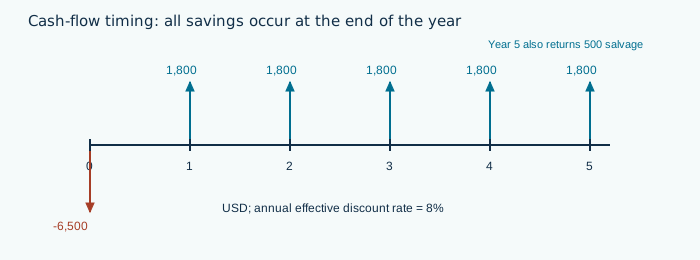
Present worth with a terminal salvage value: geometry, loads or connections stated in the question
Original schematic. Use the stated dimensions and assumptions; the sketch is not a scale drawing.

An energy retrofit costs USD 6,500 now. It saves USD 1,800 at the end of each of the next five years and has a USD 500 salvage value at the end of year five. With an effective annual discount rate of 8%, what is its net present worth?

  1. (A)USD -1,473
  2. (B)USD 687
  3. (C)USD 1,027
  4. (D)USD 3,000
Show worked solution

Answer: (C)

The net present worth is positive, about USD 1,027.

Use end-of-year savings and discount the salvage value separately at year five. The initial cost is already at time zero.

PW=−6500+1800(P/A,8%,5)+500(P/F,8%,5)PW=-6500+1800(P/A,8\%,5)+500(P/F,8\%,5)

The annuity factor is 3.992710 and the single-payment factor is 0.680583.

PW=−6500+18001−(1.08)−50.08+500(1.08)−5=1027.17PW=-6500+1800\frac{1-(1.08)^{-5}}{0.08}+500(1.08)^{-5}=1027.17

Discount each of the five USD 1,800 payments directly and add the discounted salvage. This finite cash-flow sum gives the same result. Positive present worth means the stated cash flows clear the stated 8% rate, not that omitted project risks vanish.

FE Reference Handbook: Engineering Economics — present worth, uniform series and single-payment factors.

Why the other choices appear

  • (A)This omits substantial annual benefits or misplaces their timing.
  • (B)This omits the discounted USD 500 salvage.
  • (D)This totals undiscounted cash flows and ignores the time value of money.

Equivalent annual cost with salvage and maintenance

A machine costs USD 12,000 now, lasts four years, and is sold for USD 2,000 at the end of year four. Maintenance costs USD 900 at each year end. At 6% effective annual interest, what is the equivalent annual cost?

  1. (A)USD 3,000
  2. (B)USD 3,406
  3. (C)USD 3,906
  4. (D)USD 4,500
Show worked solution

Answer: (C)

The equivalent annual cost is about USD 3,906 per year.

Convert purchase and terminal salvage to equivalent uniform annual amounts. Maintenance is already an annual cost.

EAC=12000(A/P,6%,4)−2000(A/F,6%,4)+900EAC=12000(A/P,6\%,4)-2000(A/F,6\%,4)+900

Use the capital-recovery and sinking-fund factors with the same interest rate and four-year horizon.

EAC=120000.06(1.06)4(1.06)4−1−20000.06(1.06)4−1+900=3905.91EAC=12000\frac{0.06(1.06)^4}{(1.06)^4-1}-2000\frac{0.06}{(1.06)^4-1}+900=3905.91

Independently discount the four maintenance costs and salvage to time zero, add the initial purchase, and divide by the present-worth annuity factor. Both routes produce the same positive annual cost.

FE Reference Handbook: Engineering Economics — capital recovery, sinking fund and annual worth.

Why the other choices appear

  • (A)This divides the purchase by life and omits interest, salvage and maintenance.
  • (B)This straight-line calculation ignores time value of money.
  • (D)This omits the salvage credit and misstates the financing adjustment.

Download all 14 additional questions, diagrams and complete solutions (free PDF). Download the editable practice review sheet (CSV).

Original questions and diagrams by EngineerProof, September 30, 2026. Personal study and unchanged redistribution with attribution are permitted. The questions are independent practice, not official NCEES material. Report a correction.

The complete FE Other Disciplines practice exam contains 7 problems in this area and 110 problems overall, with an answer key, full solutions, and a score sheet by knowledge area.

Retaking the FE exam? The FE Other Disciplines retake plan turns the NCEES diagnostic report into an area-by-area plan, starting from the 29 percent repeat pass rate. The same guide covers testing windows, the attempt limit, and the registration fee.